

News & Posts
The Visionary Guide to VR Eye Tracking Research
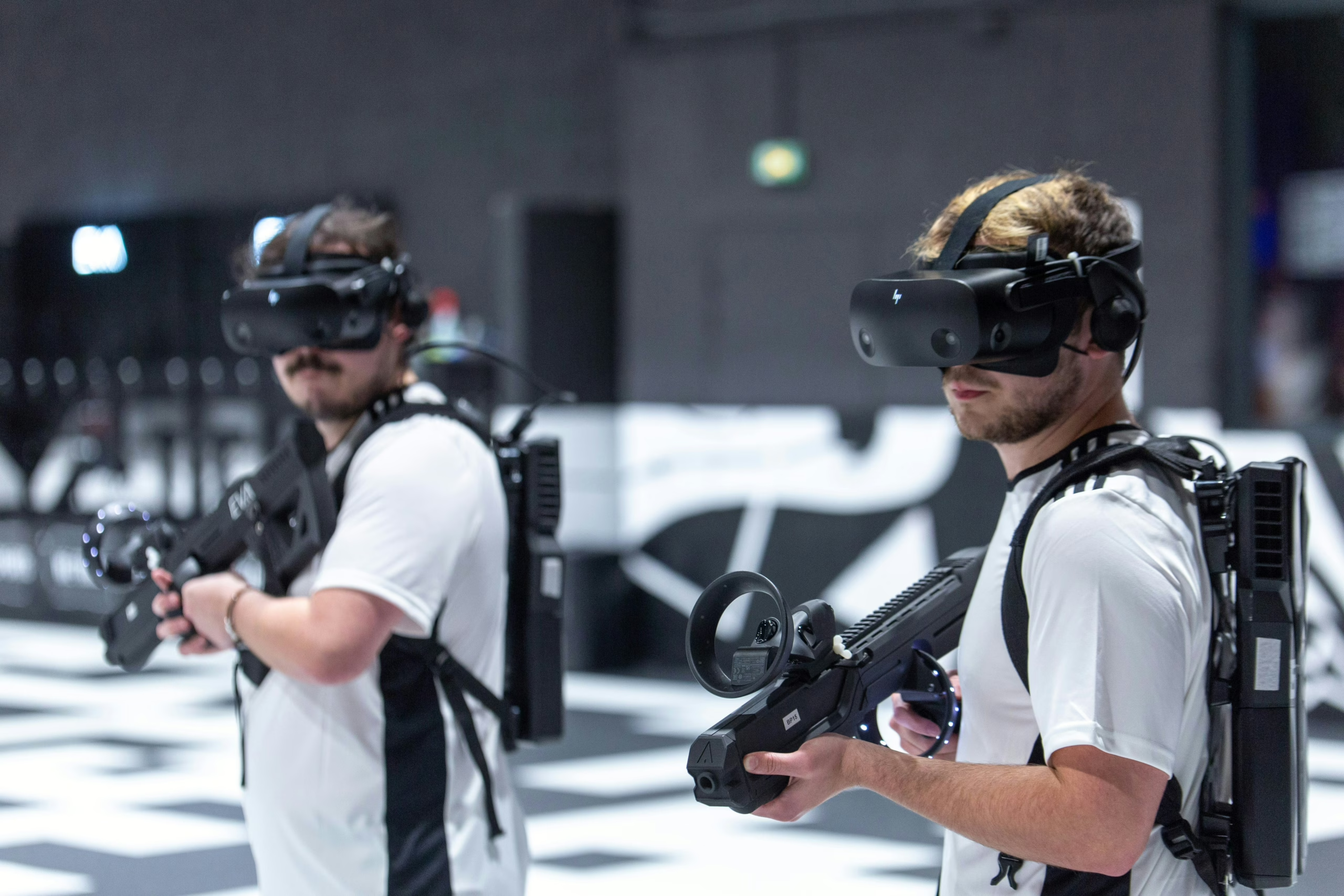
What if you could triangulate the exact coordinates of human intent before a single word is spoken? In a global market projected to reach 3.33 billion dollars in 2026, vr eye tracking research has evolved from a niche academic pursuit into the definitive lens for decoding the subconscious experience. You've likely struggled with the technical friction of synchronizing high-end headsets with external sensors, or felt buried under the weight of high-frequency gaze vectors that refuse to tell a clear story. We recognize that data without context is merely noise; it's a barrier to the growth and legacy your work deserves.
This guide provides the clinical precision and visionary framework you need to transform immersive simulations into breakthrough behavioral insights. You'll discover how to achieve seamless multimodal synchronization and master the complexities of modern research design using sophisticated multi-modal data tools like Prophea.X and eyetracking solutions like Dikablis or Tobi Glasses. We'll outline a path toward error-free precision that prioritizes the human element. This journey ensures your lab moves beyond technical hurdles to define the next phase of human-technology interaction. Prepare to expand the boundaries of your scientific knowledge and unlock the true ROI of immersive behavioral analysis.
Key Takeaways
- Transition from static 2D metrics to dynamic, 360-degree spatial analysis to capture the full spectrum of human attention in immersive environments.
- Master the technical architecture of VR eye-tracking research by integrating high-speed sensors and infrared technology directly into professional-grade hardware.
- Explore high-impact applications across aerospace and automotive sectors to discover how immersive gaze data quantifies expertise and accelerates training.
- Design a frictionless research framework that prioritizes the human element through precise calibration and the definition of specific behavioral KPIs.
- Leverage Prophea.X to synchronize multimodal data streams, transforming high-frequency gaze vectors into a clear narrative of subconscious intent.
Table of Contents
- The Evolution of VR Eye Tracking Research: From 2D Screens to Immersive Realities
- The Technical Architecture of Eye Tracking in Virtual Environments
- High-Impact Applications: Where VR Eye Tracking Research Drives Innovation
- Designing a Robust VR Research Framework: Overcoming Data Friction
- Propelling Human Insights Forward with Ergoneers and Prophea.X
The Evolution of VR Eye Tracking Research: From 2D Screens to Immersive Realities
Define your perspective by looking beyond the flat surface. For decades, behavioral science relied on the two-dimensional confines of desktop monitors, but the emergence of The Evolution of VR Eye Tracking Research has shattered those boundaries. We define vr eye tracking research as the high-precision study of visual attention within simulated, three-dimensional environments. This isn’t merely a change in hardware; it’s a fundamental shift from observing static 2D coordinates to analyzing dynamic, 360-degree spatial interactions. By placing the human subject at the center of a controlled digital universe, we move past the simplistic what of visual data to uncover the subconscious why behind every reaction. Presence and immersion don’t just enhance the experience; they elicit the raw, natural behaviors that traditional labs fail to capture.
Why Immersive Simulation Changes the Research Paradigm
Evaluate the impact of ecological validity within your study design. Traditional lab environments often feel sterile and artificial, forcing subjects into performative behaviors that don’t translate to the real world. Virtual reality solves this by creating a sense of being there, which triggers authentic physiological responses. Contrast this with field studies where variables are chaotic and unmanageable. In a VR environment, you command every photon and every shadow. This absolute control allows for repeatable, high-precision behavioral studies that were previously impossible.
The Core Indicators of Visual Attention in VR
Identify the metrics that matter most in a spatial context. While fixations (moments of visual stillness) and saccades (rapid jumps between points) remain foundational, they gain new depth in 3D. Heatmaps no longer just show flat clusters; they wrap around objects to reveal how users navigate depth and volume. We prioritize Gaze-Object Interaction (GOI) as a superior metric because it links the eye’s vector directly to specific 3D assets, providing a clear narrative of intent. 3D gaze vectors serve as the geometric anchor of your data, representing the precise line of sight originating from the eye and extending into the virtual coordinate system to identify the exact point of intersection with the digital world. By leveraging software like Prophea.X, researchers can synthesize these vectors into actionable human insights, ensuring that every data point contributes to a legacy of scientific excellence.
The Technical Architecture of Eye Tracking in Virtual Environments
Master the infrastructure of immersion. To conduct professional vr eye tracking research, you must first architect a hardware environment that eliminates technical friction. High-end headsets like the Varjo XR-4 series represent the current state of the art, embedding infrared sensors and high-speed cameras directly into the optic frame. This integrated approach offers superior stability compared to add-on solutions, which often struggle with slippage and sensor misalignment during dynamic head movements. These internal sensors track the pupil and corneal reflections to triangulate gaze with clinical precision. High-speed cameras are essential here; they capture the subtle nuances of ocular movement at frequencies that consumer gaming devices simply cannot match.
Sampling rates serve as the pulse of your data accuracy. For scientific-grade results, researchers should prioritize hardware capable of 120Hz to 200Hz or higher. A comprehensive review of VR eye tracking applications confirms that these high frequencies are necessary to capture micro-saccades and rapid visual shifts. When standard hardware falls short of your specific experimental needs, specialized labs rely on custom eye tracking integration to bridge the gap. This tailored approach ensures that your sensors, lenses, and data pipelines function as a singular, cohesive unit. If you’re ready to bridge the gap between hardware and insight, consult with our technical experts to architect your next high-performance lab.
Foveated Rendering and Beyond: Tech for Research
Optimize your simulation performance by leveraging foveated rendering. This technology uses real-time gaze data to concentrate graphical processing power only on the area where the participant is currently looking. By reducing the rendering load on peripheral vision, you can run more complex, high-fidelity simulations without sacrificing frame rates. This visual realism is not just an aesthetic choice; it is a critical factor in maintaining participant engagement and ensuring that the behaviors you record are as authentic as those found in the physical world. For organizations looking to facilitate these high-engagement environments, Immersive Experiences offers the geodesic structures and planetarium technology required to bring high-fidelity simulations to diverse audiences.
Synchronizing Multimodal Data Streams
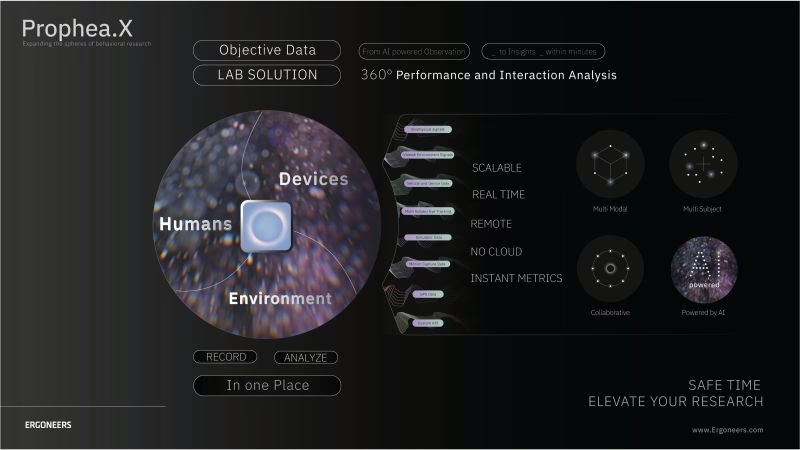
Gaze data alone provides a powerful perspective, but it is only one dimension of the human experience. The true challenge lies in aligning these gaze vectors with physiological markers like EEG, heart rate, and skin conductance. Our behavioral research software acts as the central nervous system for your data, providing a unified platform where disparate streams converge. Achieving microsecond-precision synchronization allows you to see exactly what a participant was looking at the moment their heart rate spiked or their cognitive load increased. This level of multimodal alignment transforms raw numbers into a comprehensive narrative of subconscious intent, moving your work from simple observation to visionary discovery.
High-Impact Applications: Where VR Eye Tracking Research Drives Innovation
Evaluate the impact of ocular metrics on professional mastery. High-stakes industries like Aerospace and Defense don’t just use VR for immersion; they use it for quantification. Through eye tracking for skills assessment research, organizations can now visualize the invisible mechanics of expertise. An expert pilot’s gaze pattern is a distinct “signature” of efficiency, characterized by precise fixations and minimal visual noise. By contrast, a novice displays erratic saccades, revealing cognitive overload and a lack of situational awareness. Implementing vr eye tracking research in these sectors allows for the rehearsal of high-risk scenarios where real-world failure is not an option. You can simulate emergency engine failures or complex tactical maneuvers, ensuring that every decision is backed by data-driven confidence. This ability to replicate the “impossible” safely is why immersive behavioral analysis has become the cornerstone of modern industrial training.
Human-Machine Interaction (HMI) in Virtual Prototyping
Accelerate your design cycles by looking through the eyes of your end-user. In the Automotive and Aerospace sectors, HMI engineers use gaze data to evaluate cockpit ergonomics long before a physical prototype exists. By optimising human machine interaction studies, designers can identify “dark zones,” which are critical areas of an interface that users consistently overlook or struggle to find. This proactive approach reduces cognitive load and ensures that the most vital information is always within the natural line of sight. It’s a visionary shift that prioritizes the human element in the engineering process, preventing costly redesigns and enhancing safety in complex control rooms.
Cognitive Science and Clinical Research
Pioneer new diagnostic frontiers by leveraging the power of controlled immersion. Clinical researchers are increasingly turning to virtual environments to study phobias, PTSD, and social anxiety with unprecedented precision. This review of eye-tracking in VR for education and behavioral science highlights how controlled stimuli can trigger authentic physiological responses that traditional methods miss. Tracking visual avoidance patterns serves as a powerful diagnostic tool for neurological conditions, providing objective data that subjective surveys simply can’t match. We’re also seeing the rise of pupil dilation analysis as a real-time proxy for cognitive effort. This allows researchers to adjust the difficulty of a task on the fly based on the participant’s actual mental state. By integrating these metrics, you aren’t just collecting data; you’re decoding the human experience in its most vulnerable and authentic states.
Designing a Robust VR Research Framework: Overcoming Data Friction
Architect a research methodology that transcends simple data collection. To achieve clinical precision in vr eye tracking research, you must build a framework that eliminates technical noise and prioritizes the human experience. This process begins long before the headset is donned. Follow this structured approach to ensure your data is both actionable and scientifically rigorous:
- Step 1: Define Behavioral KPIs. Establish clear success metrics like gaze duration on critical assets or transition frequencies between control panels before selecting your hardware.
- Step 2: Calibrate for the Individual. Address inter-pupillary distance (IPD) during the onboarding phase. Incorrect IPD alignment doesn’t just cause visual discomfort; it introduces parallax errors that can shift your gaze vectors by several degrees.
- Step 3: Mitigate Simulator Sickness. Design scenarios with steady frame rates and natural movement cues. If a participant feels nauseous, their visual behavior becomes defensive and erratic, rendering the data integrity useless.
- Step 4: Automate AOI Tagging. Utilize software that allows for automated Area of Interest (AOI) tagging in 3D space. Manually tagging dynamic objects in a 360-degree environment is a legacy burden that modern platforms like Prophea.X have solved.
- Step 5: Validate with Multimodal Data. Use physiological markers to confirm the intent behind a gaze. A long fixation could represent interest, or it could indicate cognitive confusion; multimodal synchronization provides the necessary context.
By following these steps, you transform a complex technical exercise into a streamlined engine for human insight. If you’re ready to build a lab that sets new industry standards, schedule a consultation to design your high-precision research framework.
Best Practices for VR Participant Management
Manage the human element with quiet confidence. First-time users often experience a “novelty effect,” where they explore the virtual environment’s boundaries rather than performing the assigned task. Allow for a five-minute habituation period to ensure their behavior settles into a natural state. Ethical data collection must also be a cornerstone of your protocol. Clearly communicate how gaze data is handled and ensure that participants feel safe and comfortable throughout extended sessions. Comfort is a prerequisite for authentic data; a heavy or poorly balanced headset will inevitably bias the participant’s head position and visual focus.
Data Cleaning and Visualization Strategies
Filter the chaos to reveal the signal. Rapid head movements and sensor “jitter” can create a jagged narrative in your raw gaze plots. Apply sophisticated smoothing algorithms to clean these vectors without losing the micro-saccades that indicate cognitive processing. Once cleaned, transform these coordinates into intuitive 3D heatmaps that wrap around your virtual assets, providing a volumetric view of attention. Retrospective think-aloud protocols are significantly enhanced by VR gaze playback, as participants can visually re-experience their own decision-making process in three dimensions while explaining their subconscious intent. This combination of objective tracking and subjective reflection creates a comprehensive bridge between digital immersion and human reality.
Propelling Human Insights Forward with Ergoneers and Prophea.X
Elevate your investigative capabilities by adopting a platform that treats data as a living extension of the researcher. Prophea.X stands as the ultimate environment for high-end vr eye tracking research, offering the agency to operate across diverse sectors while expanding the influence of your findings. We don’t just provide tools; we offer a partnership rooted in a legacy of excellence that began as a specialized spin-off from the Technical University of Munich. This academic foundation ensures that every feature within our ecosystem is grounded in scientific rigor, providing you with the quiet confidence needed to lead technological revolutions.
Prioritize the human element as your functional and ethical guide. Our philosophy dictates that technology should never be a barrier, but rather a seamless conduit for human insight. By integrating Dikablis hardware with the analytical power of Prophea.X, you achieve a level of error-free precision that distinguishes your work in a field often defined by technical friction. This synergy allows you to move from the raw capture of gaze vectors to the profound understanding of subconscious intent; it ensures that your research contributes to a lasting legacy of human-technology evolution.
The Ergoneers Advantage: Precision Meets Vision
Realize the full potential of your facility through our bespoke Behavioral Research Lab Consulting. We understand that scaling your capabilities requires more than just hardware; it demands a strategic alignment of workspace, workflow, and visionary goals. Our specialized Training and Workshops are designed to maximize your equipment utility, moving your team from basic implementation to mastery. Join a global community of intellectual leaders who are currently utilizing our Eye Tracking Integration to shape the future of Human-Machine Interaction across the aerospace and automotive industries.
Ready to Transform Your Research?
Synthesize your journey from fragmented data collection to holistic, visionary insight. The path to decoding the human experience requires a commitment to both clinical precision and aspirational growth. Ergoneers remains your vital partner in this evolution, providing the steady, professional support necessary to navigate the expanding boundaries of scientific knowledge. We invite you to explore a partnership that values your rigor as much as your innovation. Let’s work together to improve the relationship between people and technology, one gaze vector at a time.
Defining the Next Phase of Behavioral Excellence
The transition from static screens to immersive realities has fundamentally changed how we understand visual attention. You’ve explored how 3D gaze vectors and multimodal synchronization provide the clinical precision necessary to decode the subconscious human experience. By integrating high-frequency sensors with professional software, you eliminate technical friction and prioritize the human element. This evolution in vr eye tracking research isn’t just about data capture. It’s about building a legacy of scientific discovery that empowers both industry and academia to reach new heights of understanding.
Our legacy as a Technical University of Munich spin-off ensures that your research is backed by academic rigor and error-free precision. Global leaders in the automotive and aerospace sectors already trust our frameworks to quantify expertise and optimize human-machine interaction. Prophea.X represents the future of multimodal behavioral analysis, acting as a vital partner in your pursuit of transformative human insights. Discover how Prophea.X elevates your VR eye tracking research and join the community of visionary experts shaping the next generation of behavioral science. Your path toward seamless integration and profound discovery begins today.
Frequently Asked Questions
The primary challenge involves the transition from fixed 2D coordinates to dynamic, 360-degree spatial analysis. Unlike screen-based tracking, VR requires managing lens distortion and head rotation while maintaining sensor alignment during rapid physical movement. This technical friction necessitates sophisticated calibration to ensure gaze vectors remain accurate as the participant navigates the virtual coordinate system.
Yes, VR eye tracking measures cognitive load through high-frequency pupil dilation analysis and saccadic velocity tracking. By monitoring the pupil’s response to environmental stimuli, researchers can quantify mental effort in real-time. This allows for the adjustment of simulation difficulty based on the participant’s actual physiological state, providing a far more objective metric than subjective questionnaires. For highest precision and data validation Prophea.X allows seemless connectivity with EEG sensor devices. Natively joined multi modal data streams can be analyzed in Prophea Analyzer.
Professional vr eye tracking research in 2026 relies on enterprise-grade hardware like the Varjo XR-4 series for its integrated high-speed sensors and autofocus capabilities. While consumer devices like the PlayStation VR2 offer entry-level tracking, high-end labs prioritize headsets that offer sub-degree accuracy and high sampling rates. Researchers should select hardware that allows for open data access and seamless integration with professional analytical platforms.
Achieve synchronization by using a unified multimodal platform that acts as the central nervous system for your disparate data streams. Professional software like Prophea.X utilizes hardware triggers and software timestamps to align gaze vectors with EEG microstates with microsecond precision. This ensures that every visual fixation is mapped exactly to the corresponding neural activity, providing a holistic view of the human experience.
Gaze data provides a reliable, objective baseline for studying behavioral patterns and neurological responses in controlled environments. While we don’t offer clinical medical treatment, our tools empower researchers to track visual avoidance or fixation patterns with high precision. You should always verify that your specific research protocol aligns with institutional ethical standards and the latest data privacy regulations regarding biological data.
Foveated rendering is an optimization technique that concentrates graphical processing power on the user’s current point of fixation. For researchers, this enables the use of high-fidelity 3D assets without compromising the frame rate or introducing latency. Maintaining a steady, high frame rate is vital for data integrity, as it prevents simulator sickness and ensures that participants behave naturally within the simulation.
The total investment depends on the scale of your facility and the complexity of your experimental requirements. You’ll need to account for enterprise-grade HMDs, high-performance workstations, and the necessary software licenses for data analysis. If your project requires large-scale physical environments, Immersive Experiences provides a detailed pricing guide for geodesic structures and specialized projection technology. For a precise evaluation of your lab’s needs, we recommend consulting with professional lab designers who can architect a solution tailored to your specific behavioral research goals.
Analyzing 3D gaze data requires a platform capable of processing high-frequency spatial vectors and automating Area of Interest (AOI) tagging. Prophea.X serves as the definitive solution for vr eye tracking research, transforming raw coordinates into intuitive heatmaps and gaze plots. The software must also support multimodal integration to validate visual attention against physiological markers like heart rate or skin conductance.