

News & Posts
The Visionary Guide to Overcoming Challenges of Synchronizing Physiological Data
A recent review of customer surveys revealed a startling reality: a big part of studies utilizing multimodal streams fail to assess synchronization latency. This oversight compromises the very foundation of behavioral research. It turns potential breakthroughs into questionable datasets. You've likely felt the exhausting reality of manual post-processing and the frustration when data drift undermines weeks of recording. Overcoming the complex challenges of synchronizing physiological data requires more than just reactive fixes; it demands a shift toward architectural precision.
Master the technical hurdles of multimodal alignment to ensure your research achieves publication-grade integrity. We'll help you bridge the gap between inconsistent sampling rates and diverse hardware brands to create a seamless, automated workflow. By integrating advanced solutions like Prophea.X and the latest LSL distributions, you can eliminate manual cleaning time and focus on the three-dimensional expansion of human insights. This guide provides the roadmap to transition from technical friction to a visionary state of error-free data synchronization.
Key Takeaways
- Establish “Temporal Fidelity” as the non-negotiable cornerstone of your research to protect the scientific integrity of every recorded session.
- Navigate the friction between high-frequency EEG and low-frequency GSR streams by mastering the nuances of multimodal sensor integration.
- Resolve the hidden challenges of synchronizing physiological data that cause the “Gaze-Brain Gap,” ensuring your eye-tracking and neural signals align with microsecond precision.
- Adopt a strategic hierarchy that prioritizes hardware-based TTL triggers to eliminate the risks associated with software-only or post-hoc alignment methods.
- Discover how Prophea.X, a unified platform, personifies technical agility, automating complex workflows to expand the boundaries of your behavioral insights.
Table of Contents
- The Temporal Architecture of Physiological Data: Why Synchronization Fails
- Navigating the Complexity of Multimodal Sensor Integration
- The Scientific Consequences of Sub-Millisecond Misalignment
- Strategic Frameworks for Precise Data Alignment
- Propelling Research Forward with Unified Synchronization Platforms
The Temporal Architecture of Physiological Data: Why Synchronization Fails
Achieve scientific excellence by mastering the temporal architecture of your study. At its core, Synchronization represents the coordination of events to operate a system in unison. In the context of multimodal behavioral research, this means ensuring that a neural spike from an EEG sensor aligns perfectly with a specific gaze point captured by Dikablis Glasses. This alignment establishes Temporal Fidelity, a cornerstone of data integrity that ensures every physiological reaction is mapped to its exact behavioral stimulus. Without this foundation, your insights into human-technology interaction remain fragmented and unreliable.
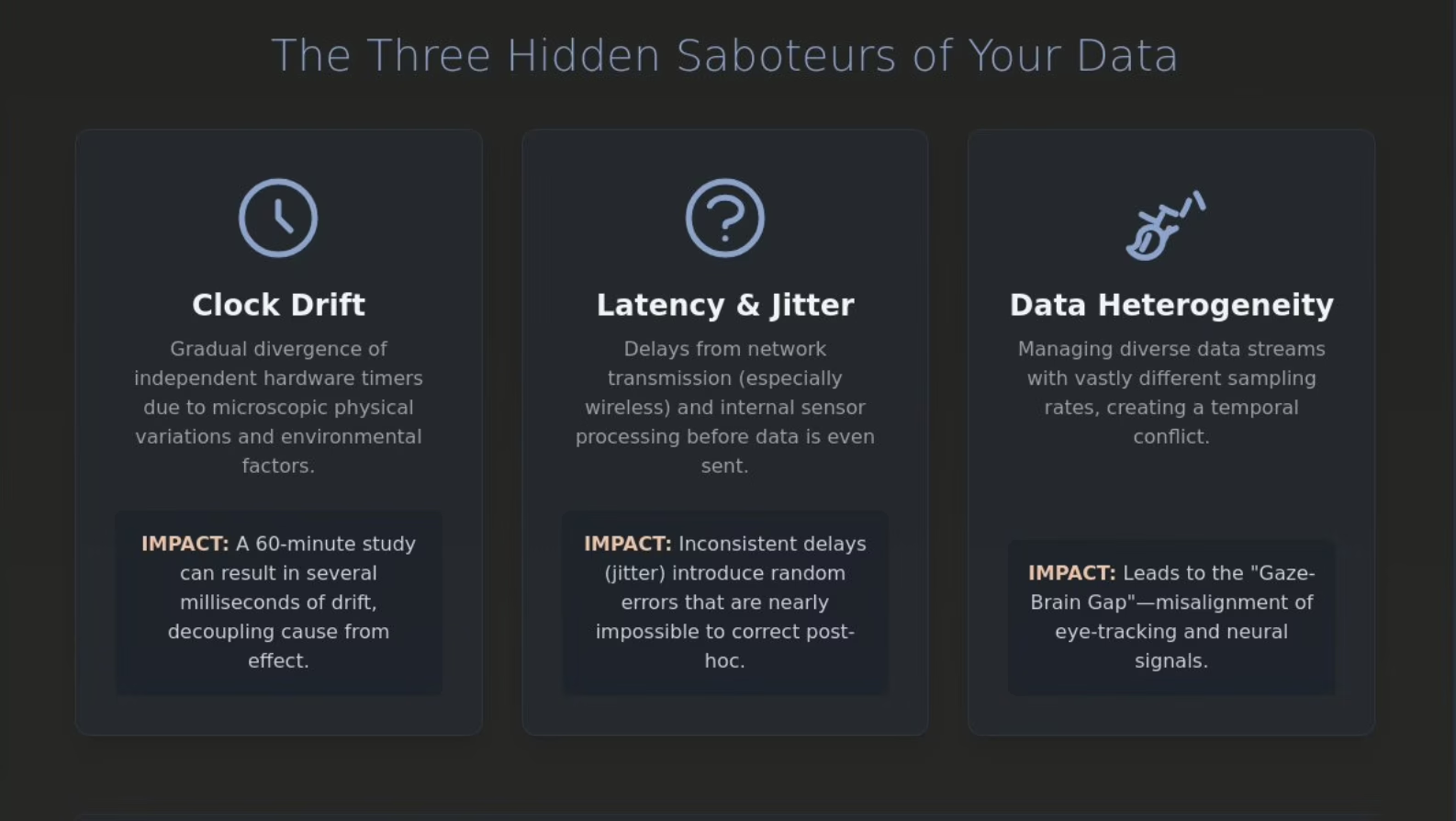
The challenges of synchronizing physiological data often stem from a fundamental misunderstanding of hardware-level physics. Researchers frequently encounter three primary pillars of failure: latency, jitter, and clock drift. While retrospective data alignment attempts to correct these issues after the session, real-time synchronization preserves the raw truth of the human experience. Relying on post-hoc corrections often masks underlying errors rather than solving them. You must prioritize the human element by capturing data as it happens, not as an approximation calculated weeks later.
Clock Drift and Crystal Oscillator Variance
Precision begins at the hardware level, yet even two identical devices from the same manufacturer never tick at the exact same rate. This occurs because the internal crystal oscillators that drive hardware timers are subject to microscopic physical variations and environmental factors like temperature. Over a long-form behavioral study, these tiny discrepancies accumulate into significant misalignments. Clock drift is the gradual divergence of independent hardware timers. If your recording lasts sixty minutes, a drift of just a few parts per million can shift your data by several milliseconds. This shift potentially decouples a participant’s physiological response from the visual trigger that caused it, leading to a collapse of your experimental variables.
Network Latency vs. Internal Processing Lag
Distinguish between the time it takes for data to travel and the time it takes for a sensor to process a signal. Network latency involves transmission delays, especially prevalent in wireless streams where packet loss and interference introduce jitter. Internal processing lag is the delay within the sensor itself before the data even enters the network. Operating systems also play a critical role; Windows often prioritizes background tasks differently than Linux, leading to inconsistent data interrupts. While wireless data streams offer participant freedom, they often lack the rigid temporal precision of wired connections. High-precision research requires an understanding of these multi-dimensional delays to maintain a seamless, automated synchronization workflow.
To better understand this concept, watch this helpful video:
Navigating the Complexity of Multimodal Sensor Integration
Elevate your research by embracing the intricate tapestry of multimodal sensor integration. One of the primary challenges of synchronizing physiological data is managing “data heterogeneity,” where diverse streams like EEG, EMG, and eye-tracking must converge into a single, coherent narrative. These modalities don’t just speak different languages; they operate in different dimensions of time. High-frequency signals like EEG capture neural oscillations at 1000Hz or more, while low-frequency signals like Galvanic Skin Response (GSR) operate at a fraction of that speed. This temporal conflict requires more than just alignment; it demands a robust metadata architecture to preserve the contextual link between a participant’s peak arousal and their specific gaze point.
Mobile eye-tracking, such as Dikablis Glasses, introduces unique friction when integrated with stationary lab equipment. Wearable devices must maintain their temporal integrity while the participant moves through a physical or virtual space, often clashing with the rigid, wired constraints of traditional physiological sensors. Recent studies on Interpersonal Physiological Synchrony highlight how social and environmental variables further complicate these streams, requiring even greater precision in your data fusion. If you’re ready to evolve your lab’s capabilities, consider consulting with our experts to refine your synchronization strategy.
Heterogeneous Sampling Rates and Aliasing
Respect the Nyquist-Shannon theorem to prevent the loss of vital information during multi-sensor fusion. When you attempt to align 2000Hz EEG data with 60Hz eye-tracking, the risk of downsampling high-precision data is significant. You must resist the urge to simplify your data at the cost of its scientific soul. Aliasing is the distortion that occurs when signals are sampled insufficiently. If you don’t account for these discrepancies, your final dataset will suffer from phantom frequencies that never existed in the original biological signal, leading to erroneous conclusions about human behavior.
Data Throughput Bottlenecks in Multi-Sensor Arrays
Anticipate the massive bandwidth requirements of 2026-era high-definition research. Modern arrays stream gigabytes of data per second, pushing hardware to its physical limits. CPU thermal throttling often introduces unexpected data jitter, as the processor shifts its clock speed to manage heat, subtly altering the timing of incoming data packets. Implementing a custom eye tracking integration provides the architectural stability needed to manage these high-load streams without compromising precision. This approach ensures that your hardware remains an invisible partner in your research, rather than a technical bottleneck.
The Scientific Consequences of Sub-Millisecond Misalignment
Precision isn’t a luxury; it’s the bedrock of scientific truth. A 50ms lag might seem negligible in everyday life, but in the laboratory, it’s a chasm that swallows causality. When your eye-tracking data and EEG signals drift apart, you encounter the “Gaze-Brain Gap.” This misalignment forces you to guess whether a neural spike was a genuine response to a visual stimulus or merely background noise. A 50ms lag effectively decouples the stimulus from the response. It creates a scientific fiction where the effect appears to precede the cause, or worse, where the two seem entirely unrelated. The challenges of synchronizing physiological data become insurmountable when you assume alignment can be approximated rather than measured.
Don’t fall for the myth that software can “fix it in post.” Algorithmic alignment is a reactive band-aid, not a proactive cure. It cannot recover the lost temporal resolution required for sophisticated human machine interaction studies. In high-stakes environments like automotive testing or medical simulation, a few milliseconds determine the validity of a safety intervention. Navigating the challenges of synchronizing physiological data is particularly critical when evaluating how pilots or surgeons interact with complex interfaces. Citing technical considerations in physiological signal synchronization reveals that even minor jitter can mask the very biological signatures you’re trying to isolate.
False Correlations in Eye-Brain-Muscle Coupling
Watch how misalignment creates phantom triggers in cognitive load analysis. If your data streams are blurred, a spike in mental effort might appear to happen after a task is already completed. This temporal blurring leads to the publication of flawed results, as the coupling between the eye, brain, and muscles is misrepresented. You risk identifying correlations that don’t exist while missing the subtle, high-speed interactions that define human performance. Command your data by ensuring that every trigger is anchored to a universal time clock, preventing the “ghost” signals that haunt poorly synchronized datasets.
Signal Distortion and Phase Shift Errors
Analyze how phase shifts invalidate frequency-domain analysis. When streams are out of sync, the mathematical relationship between them collapses. A high cross-correlation coefficient requires temporal alignment that respects the physics of the human body. If one signal is shifted, your power spectral density calculations will yield incorrect results, distorting your understanding of heart rate variability or neural oscillations. This distortion isn’t just a technical error; it’s a barrier to the next phase of behavioral research. Temporal precision determines the resolution of human insights. Without it, your view of the human experience remains out of focus, limited by the very tools meant to expand your vision.
Strategic Frameworks for Precise Data Alignment
Command the temporal landscape of your laboratory by adopting a rigid hierarchy of synchronization. To achieve absolute data integrity, you must prioritize hardware-based triggers over software protocols, leaving post-hoc alignment as a final, desperate resort. This architectural approach establishes a “Master Clock” philosophy, where every sensor in your array—from neural interfaces to biometric belts—references a single, unified time source. While the challenges of synchronizing physiological data often paralyze complex studies, these strategic frameworks restore your agency over the data, ensuring your insights are built on a foundation of microsecond precision.
Implementing network-wide clock unification requires the deployment of Precision Time Protocol (PTP) or Network Time Protocol (NTP). PTP is particularly essential for 2026-era high-stakes research, as it offers sub-microsecond accuracy across distributed hardware nodes. By synchronizing the internal clocks of every recording computer and sensor hub, you eliminate the jitter that typically plagues multi-device setups. Secure the integrity of your next study by contacting our consulting team for a custom lab architecture review.
Hardware-Based TTL Triggering and Strobe Signals
Utilize Transistor-Transistor Logic (TTL) to send physical signal pulses directly across sensor ports. This method bypasses the unpredictable latencies of operating system interrupts, providing a “ground truth” for event marking. You can seamlessly integrate professional eye tracking glasses with external TTL boxes to bridge the gap between wearable mobility and stationary lab precision. To maintain signal purity, always employ opto-isolation for your trigger lines. This prevents ground loops and electrical noise from contaminating your sensitive physiological streams, preserving the clinical clarity of your results.
Software Solutions: Lab Streaming Layer (LSL) and Unified APIs
Lab Streaming Layer (LSL) has emerged as the visionary standard for real-time data fusion. It personifies technical agility by time-stamping data at the exact point of capture, rather than when it reaches the recording PC. LSL possesses the internal agency to handle jitter correction and clock offset estimation automatically, significantly reducing the challenges of synchronizing physiological data during the analysis phase. Follow this protocol to initialize a synchronized session:
- Activate LSL outlets for all peripheral sensors to begin local time-stamping.
- Enable the LSL Clock Sync algorithm to calculate offsets between devices.
- Deploy a unified software trigger to start all recording streams simultaneously.
- Verify the synchronization quality in real-time via a central monitoring dashboard.

Propelling Research Forward with Unified Synchronization Platforms
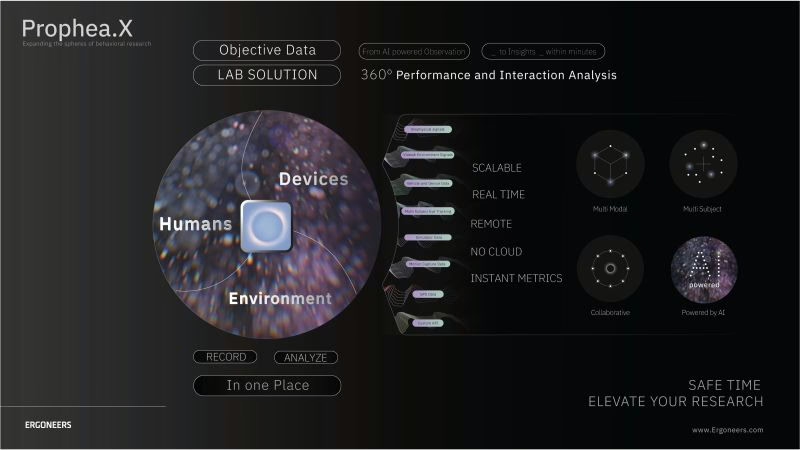
Embrace the next phase of behavioral research by centralizing your multimodal streams within a unified ecosystem. While previous sections detailed the physical and temporal hurdles of data alignment, Prophea.X emerges as the visionary solution that personifies technical agility. This platform possesses the agency to operate across diverse sectors, bridging the gap between raw biological physics and actionable human insights. By utilizing Prophea.X, you eliminate the technical friction that typically defines complex setups. These platforms don’t just record data; they orchestrate it, ensuring that every signal is anchored to a definitive, universal timeline.
Scaling your research from single-subject pilots to complex, multi-user environments requires an architecture that remains stable under pressure. The challenges of synchronizing physiological data multiply exponentially as you add participants and sensors. Native Dikablis integration ensures that gaze data remains perfectly aligned with neural and muscular streams, even in dynamic, high-load scenarios. This seamless integration allows you to focus on the human element of your study, rather than the underlying connectivity. You are no longer a technician fighting for alignment, but a partner in the evolution of scientific knowledge.
The Prophea.X Advantage: Native Multi-Sensor Fusion
Activate a plug-and-play workflow for your most demanding datasets. Prophea.X handles the heavy lifting of multi-sensor fusion, automatically managing EEG, EMG, and eye-tracking streams with clinical precision. It possesses the computational power to handle heterogeneous sampling rates in real-time, allowing you to view perfectly aligned streams as they occur. This real-time capability dramatically reduces the weeks typically spent on manual post-processing and data cleaning. By automating the alignment of high-frequency and low-frequency signals, you protect the scientific integrity of your work while expanding the three-dimensional boundaries of your analysis.
Future-Proofing Your Lab with Visionary Expert Support
Sustain your lab’s legacy of excellence by pairing advanced hardware with expert guidance. High-level research requires more than just tools; it demands a strategic partnership that understands the nuances of biological physics. Engaging in behavioral research lab consulting provides you with a direct path to optimizing your synchronization workflows for 2026 and beyond. Ergoneers training and workshops further empower your team to maintain high temporal fidelity across every session. We invite you to experience the future of behavioral analysis through a Prophea.X demonstration, where you can see how our unified platforms turn the challenges of synchronizing physiological data into a seamless, automated reality.
Commanding the Future of Human-Centered Research
Secure the scientific integrity of your work by moving beyond reactive post-hoc corrections. You’ve explored how temporal fidelity serves as the cornerstone of data integrity and how a master clock philosophy protects your research from the “Gaze-Brain Gap.” Overcoming the challenges of synchronizing physiological data requires an architectural shift toward unified, real-time fusion. By prioritizing hardware-based triggers and leveraging visionary software, you transform technical friction into a seamless flow of discovery. The three-dimensional nature of human behavior demands a synchronization strategy that is as dynamic as the participants you study.
Prophea.X, founded as a spin-off from TU Munich, embodies this evolution. It handles microsecond-precision multimodal fusion with the agency to scale across complex, multi-user environments. Trusted by global leaders in automotive and aerospace R&D, our solutions empower you to focus on the human element while we manage the biological physics. Your pursuit of truth deserves a partner that values precision as much as you do.
Experience Prophea.X: The Future of Seamless Behavioral Synchronization
Step into the next phase of behavioral analysis with quiet confidence. Your legacy of excellence begins with data you can trust, and the boundaries of your scientific knowledge are ready to expand.
Frequently Asked Questions
Time-stamping involves assigning a local clock value to an individual data packet at the exact moment of capture. In contrast, time-synchronization is the rigorous process of aligning multiple independent clocks to a single master reference. This distinction is vital for researchers navigating the challenges of synchronizing physiological data, as local stamps are scientifically meaningless if the underlying hardware timers haven’t been unified across your sensor array.
Acceptable clock drift should ideally remain below half the sampling interval of your highest frequency sensor to prevent significant phase errors. In a 60-minute study involving 1000Hz EEG, even a drift of 1 millisecond can compromise the temporal fidelity of your results. You should aim for sub-millisecond precision by using PTP protocols or hardware-based synchronization to ensure that long-form recordings don’t suffer from cumulative temporal divergence.
You can synchronize eye-tracking and EEG using software protocols like Lab Streaming Layer (LSL), though this method introduces potential jitter from operating system interrupts. While software-only solutions offer greater flexibility for mobile studies, they lack the rigid ground truth provided by physical TTL triggers. For high-precision behavioral research, relying solely on software often requires extensive post-processing to account for the unpredictable latencies inherent in non-real-time operating systems.
Lab Streaming Layer (LSL) is an open-source research standard designed to handle the unified collection of multimodal measurement time series. It possesses the agency to automatically calculate clock offsets and correct for network jitter in real-time. You should use LSL because it provides a hardware-agnostic framework that simplifies the integration of diverse sensors, ensuring that data packets from different brands arrive with accurate, synchronized timestamps.
Hardware triggers like Transistor-Transistor Logic (TTL) improve precision by sending a physical electrical pulse directly between devices through dedicated ports. This mechanism bypasses the variable latencies of software and network stacks, offering microsecond-level accuracy for event marking. By anchoring your data to these physical pulses, you eliminate the challenges of synchronizing physiological data caused by CPU thermal throttling or background system tasks that can delay software-based triggers.
The most frequent mistakes include neglecting to measure synchronization latency and failing to account for cumulative clock drift over long sessions. Many labs also overlook the impact of electrical noise and ground loops when connecting multiple high-precision sensors via wired trigger lines. You must verify your synchronization quality before data collection begins; assuming that hardware from different manufacturers will align perfectly out of the box is a recipe for scientific error.
Prophea.X is engineered as a visionary, hardware-agnostic platform that natively supports a wide array of third-party physiological sensors. It possesses the flexibility to integrate EEG, EMG, and GSR streams from various manufacturers into a single, synchronized environment. This capability ensures that your lab isn’t restricted by proprietary silos, allowing you to build a customized sensor array that meets the specific needs of your behavioral research while maintaining microsecond precision.
Network latency introduces variable delays that can decouple a participant’s physiological response from the digital stimulus delivered during remote sessions. This jitter makes it difficult to establish a precise temporal link between cause and effect. To mitigate these effects, you must implement local time-stamping at the participant’s end and use protocols that can estimate and correct for round-trip time, preserving the integrity of your remote behavioral data despite the lack of a shared local network.