

News & Posts
Enter High-Precision Eye-Tracking Research with Dikablis Glasses X
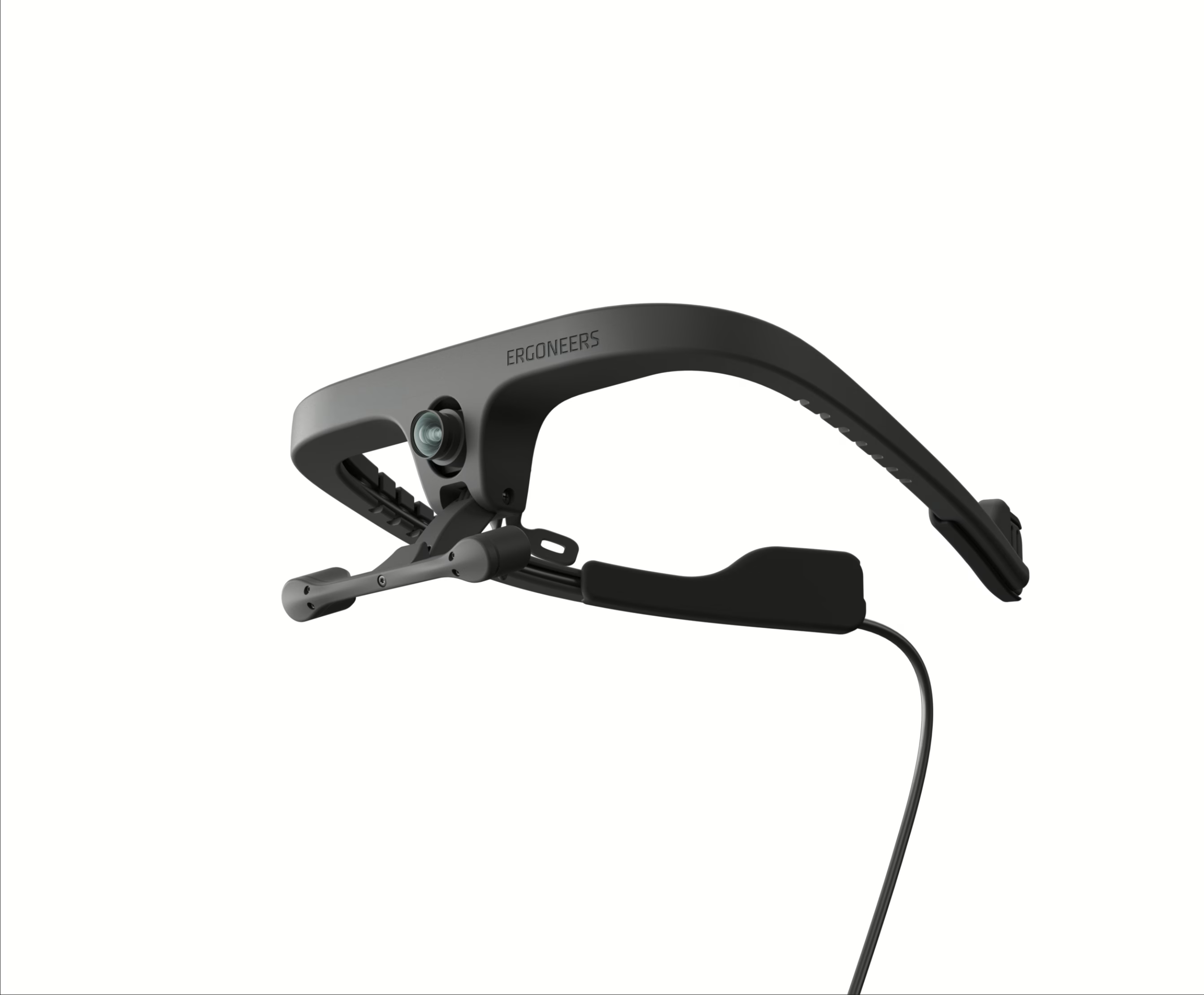
What if the primary bottleneck in your behavioral research isn't the volume of your data, but the friction of its integration? Achieving scientific breakthroughs requires professional eye tracking glasses that do more than record glances; they must serve as the foundation for a synchronized, multimodal ecosystem. You likely understand the frustration of data friction between hardware and software, especially when attempting to align gaze patterns with EEG or biometric streams in dynamic, real-world environments.
This guide promises to help you master the selection and implementation of high-precision wearable technology to unlock deep human-centric insights. We will examine how the Dikablis Glasses X and the Prophea.X platform facilitate zero-error data synchronization and high-precision mapping in 3D space. By the end of this article, you'll know how to transform raw data points into actionable behavioral intelligence that bridges the gap between human intent and technological response. Discover how to empower your research lab with tools designed for the future of human-technology interaction.
Key Takeaways
- Master the “Three-Dimension Rule” to evaluate hardware based on accuracy, robustness, and synchronization rather than just raw sampling rates.
- Distinguish between basic gaze trackers and high-frequency professional eye tracking glasses to ensure your lab captures scientific-grade data in dynamic, real-world environments.
- Learn how to eliminate “Data Drift” by implementing hardware-level time-stamping for seamless, multimodal integration with EEG and other biometric sensors.
- Discover how to translate sub-millisecond gaze precision into actionable insights for high-stakes fields like automotive HMI design and elite human performance.
- Explore how the Prophea.X ecosystem acts as a central intelligence hub, transforming complex data streams into a holistic view of human behavior
Table of Contents
- What Defines Professional Eye Tracking Glasses in 2026?
- A Technical Framework for Evaluating Wearable Eye Trackers
- The Multimodal Frontier: Synchronizing Gaze with EEG and Biometrics
- Strategic Applications: From Automotive HMI to Elite Performance
- The Ergoneers Ecosystem: Dikablis & Prophea.X
What Defines Professional Eye Tracking Glasses in 2026?
Elevate your understanding of human behavior beyond simple visual attention. In 2026, professional eye tracking glasses represent far more than a recording device; they are high-frequency wearable sensors engineered for rigorous, scientific-grade data acquisition. While consumer-grade trackers might suffice for basic interface feedback or gaming, professional systems have evolved into comprehensive behavioral insight platforms. They bridge the gap between biological physics and actionable research outcomes, providing a level of fidelity that basic hardware cannot replicate. This shift marks a transition from merely seeing where someone looks to understanding why they process information in a specific sequence.
Prioritize the human element as the ethical and functional guide for every study you design. Technology should serve the person, not the other way around. This philosophy transforms the research from a cold data collection exercise into a visionary exploration of human-technology interaction. Moving from 2D screen-based tracking to 3D real-world spatial gaze mapping allows you to capture the full geometry of human intent within a physical environment. It’s no longer enough to track a cursor on a monitor; you must map the gaze vectors that define how a person navigates a cockpit, a factory floor, or a retail space. This spatial clarity is what distinguishes a professional-grade study from a superficial observation.
The Core Pillars of Professional Grade Hardware
Precision defines the boundary between noise and knowledge. Achieve scientific-grade accuracy between 0.1 and 0.5 degrees to ensure every data point contributes to a valid conclusion. While 60Hz remains a baseline for basic fixations, the professional standard has shifted to 120Hz or higher. This increased frequency is vital for the granular analysis of eye movement, particularly when studying rapid saccades that reveal cognitive processing speeds. Professional systems also demand binocular tracking. Capturing data from both eyes is essential for understanding depth perception and how subjects interact with complex 3D environments. Without this binocular foundation, your data lacks the three-dimensional context required for high-stakes research.
Beyond Data: The Visionary Expert Perspective
Empower your team to step out of the restricted laboratory and into practical industrial training environments. Ergoneers approaches human-machine interaction as a collaborative partnership, where the hardware provides the clarity needed to optimize safety and performance. Visualize your data through geometric metaphors; think of gaze as a three-dimensional vector cutting through the space of possibilities. This perspective helps you quantify cognitive load by measuring how the visual search pattern expands or contracts within the physical world. By grounding technical precision in human needs, you create a legacy of research that truly moves the needle in your industry. Choosing professional eye tracking glasses is the first step in moving from theoretical speculation to empirical mastery.
A Technical Framework for Evaluating Wearable Eye Trackers
Establish a rigorous evaluation protocol to manage the complexities of modern behavioral hardware. Lab managers and procurement officers often fall into the trap of prioritizing “lightweight” frames, yet in 2026, a low-mass design is a baseline prerequisite rather than a competitive differentiator. Instead, focus your assessment on the “Three-Dimension Rule”: Accuracy, Robustness, and Synchronization. These pillars ensure that your professional eye tracking glasses deliver scientific value rather than just wearable convenience. A visionary researcher looks beyond the frame to the data architecture beneath it.
Evaluate the geometric relationship between the scene camera and the eye-tracking sensors with clinical precision. A professional system must offer a scene camera Field of View (FOV) that aligns with the natural human visual field, while the eye cameras must maintain a high-resolution lock on the pupil regardless of rapid head movement. All with flexible data rates If the scene camera FOV is too narrow, you lose the peripheral context that often drives reactive behavior. Conversely, excessive wide-angle views can introduce lens distortion that compromises the integrity of your gaze vector mapping. Balance is essential for capturing the three-dimensional truth of a participant’s environment.
Precision vs. Accuracy: The Scientific Distinction
Distinguish between these two metrics to maintain absolute data integrity. Precision refers to the reproducibility of gaze points over time, indicating the system’s internal consistency and lack of jitter. Accuracy represents the specific spatial offset between the recorded gaze point and the subject’s true point of interest. Parallax error occurs when the scene camera is offset from the subject’s eye level, necessitating a system that automatically compensates for this geometric discrepancy to ensure the gaze overlay remains valid at varying distances. For a deeper dive into these metrics, explore our Visionary’s Guide to Scientific Accuracy in 2026.
Form Factor and Participant Comfort
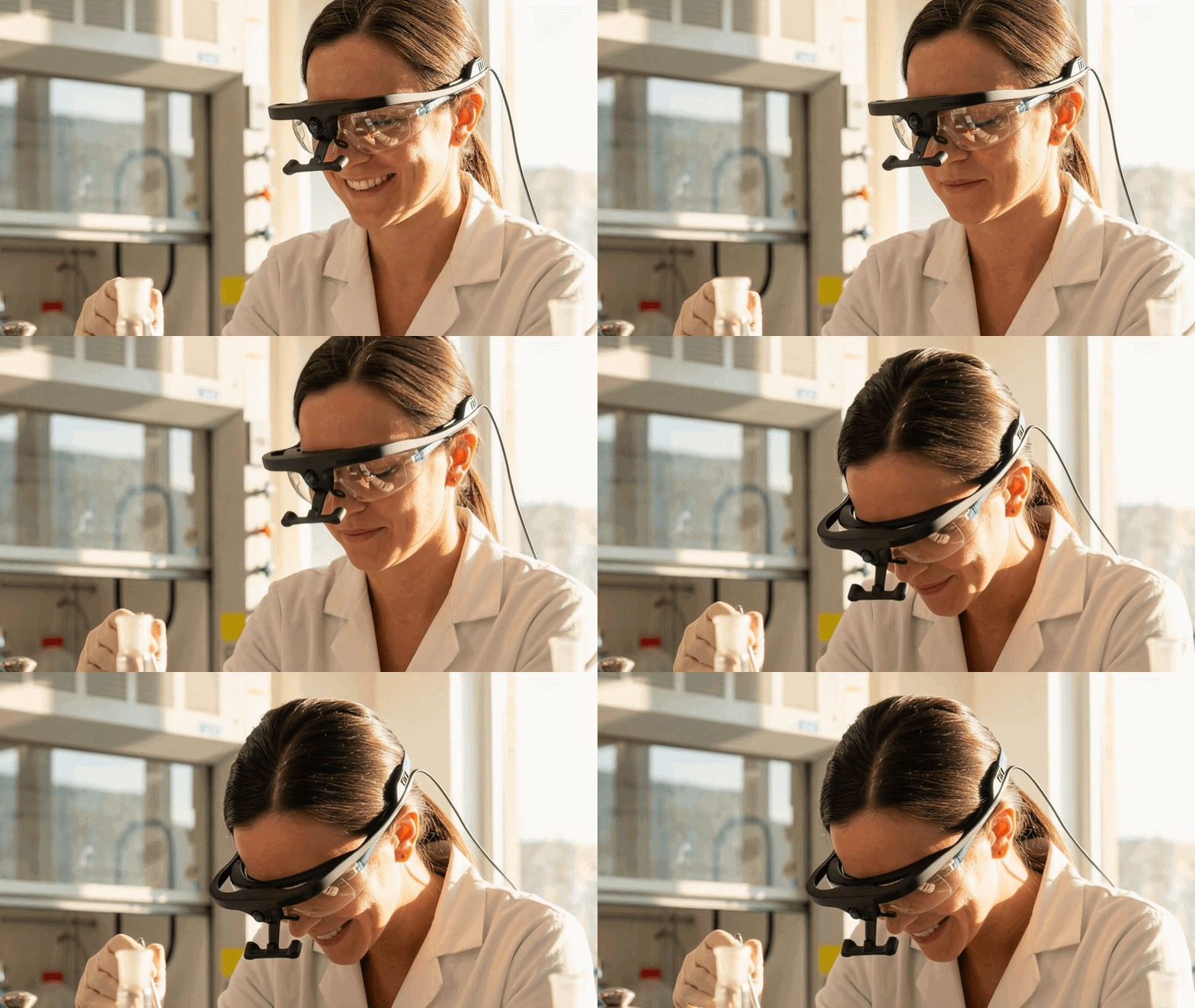
Prioritize ergonomics to eliminate “sensor fatigue” during long-duration longitudinal studies. If a participant becomes consciously aware of the hardware weight or specific pressure points, their natural behavior shifts, effectively contaminating your results. In high-movement environments like sports science or industrial training, slip-resistant frames are essential to prevent the cameras from shifting during explosive or repetitive movements. Robustness in the frame design ensures that the calibration holds even when the subject is in motion, preserving the continuity of your data stream. If you’re ready to upgrade your lab’s capabilities, consult with our eye tracking integration experts to find the optimal configuration for your specific research environment.
The Multimodal Frontier: Synchronizing Gaze with EEG and Biometrics
Expand your research horizons by looking beyond the isolated gaze vector. In the high-stakes environments of 2026, single-stream data no longer provides the depth required for high-impact behavioral insights. While knowing where a subject looks is valuable, understanding the physiological response to that visual stimulus is what separates a standard study from a visionary breakthrough. Integrating professional eye tracking glasses into a broader biometric array allows you to capture the complete human experience, from cognitive load to physical stress. This holistic approach transforms raw coordinates into a narrative of human intent and reaction.
Eliminate the pervasive threat of “Data Drift” through hardware-level time-stamping. In many systems, software-based synchronization leads to micro-delays that cause gaze points to desync from brain activity or muscle responses. Professional systems solve this by ensuring every frame and every biometric packet shares a universal clock. This synchronization is critical when aligning gaze data with EEG for brain activity, EMG for muscle tension, or GSR for skin conductance. By anchoring these disparate streams to a single temporal reference, you move from fragmented observations to a unified behavioral model. Prophea.X acts as the primary agent in this process, orchestrating the execution of multimodal data streams with clinical precision.
Achieving Zero-Latency Synchronization
Master the technical architecture required for true temporal alignment. Achieving zero-latency synchronization demands robust protocols like TTL (Transistor-Transistor Logic) for hardware triggers or NTP (Network Time Protocol) for network-based syncing. These methods allow your professional eye tracking glasses to function as the “Master Clock,” providing the heartbeat for every other sensor in your lab. This level of control ensures that a 2026 research setup remains agile and error-free. For those designing complex environments, our guide on Mastering Custom Eye Tracking Integration offers deeper insights into building these sophisticated multimodal ecosystems.
The Impact of Unified Software Platforms
Reduce technical friction by centralizing your analysis within integrated software environments like Prophea.X . These platforms don’t just store data; they personify the analytical agency required to operate across different research sectors. Visualize complex, multi-sensor data on a single, synchronized timeline where fixations, saccades, and heart rate variability intersect seamlessly. This visual clarity empowers you to identify patterns that remain hidden in siloed spreadsheets. Error-free precision in software expands the boundaries of scientific knowledge, allowing researchers to focus on high-level insights rather than troubleshooting connectivity issues. It’s time to demand a software experience that matches the sophistication of your hardware.
Strategic Applications: From Automotive HMI to Elite Performance
Translate the technical potential of high-frequency sensors into tangible industrial progress. In the automotive sector, the integration of professional eye tracking glasses allows engineers to dissect driver distraction with sub-millisecond precision. By mapping gaze vectors against the complex geometry of a modern cockpit, you can optimize ergonomics to ensure safety-critical information is always within the primary visual field. This isn’t merely about where a driver looks; it’s about the speed and sequence of their visual processing during high-stress maneuvers. Moving from the lab to the road, these insights empower manufacturers to design interfaces that harmonize with human biology.
Apply these same rigorous standards to sports science to identify the “Quiet Eye” phenomenon. Elite performance often hinges on the final fixation before a critical action, a metric that requires 120Hz+ tracking to capture with scientific validity. By visualizing the gaze stability of top-tier athletes, researchers can decode the visual search patterns that distinguish champions from the field. This data moves beyond simple observation, providing a blueprint for targeted vision training programs that enhance reaction times and decision-making accuracy. It’s a visionary approach to human potential that relies on the clinical precision of professional hardware.
Shift your focus to the retail and UX environment to understand the cognitive load of wayfinding. While basic heatmaps offer a surface-level view of attention, professional systems reveal the underlying decision-making process within a three-dimensional space. Analyze how a shopper navigates complex environments, identifying the friction points where visual clutter leads to cognitive fatigue. This human-centric approach ensures that retail design and digital interfaces support, rather than hinder, the user journey. By quantifying the geometry of attention, you can create spaces that feel intuitive and empowering.
Human-Machine Interaction (HMI) Optimization
Refine intuitive controls in aerospace and defense simulations by analyzing the operator’s visual attention in real-time. Immersive VR and AR environments provide a safe yet realistic theater for testing human-machine interaction under extreme conditions. For a comprehensive look at these methodologies, read our guide on Optimising Human Machine Interaction Studies. These simulations allow you to iterate on design before a single physical component is manufactured, ensuring the final product is perfectly tuned to the human element.
Workplace Safety and Training Assessment
Visualize the “Expert Gaze” to accelerate training for high-risk industrial roles. By recording the visual patterns of seasoned professionals, you can create a benchmark for trainees, effectively reducing human error in complex control rooms through real-time attention monitoring. This comparative utility demonstrates how eye tracking serves both academic rigor and industrial efficiency. If you’re ready to implement these high-precision tools in your facility, contact Ergoneers to discuss your specific HMI and training needs. Empower your workforce with the clarity that only high-precision data can provide.
The Ergoneers Ecosystem: Dikablis & Prophea.X
Orchestrate your research with a system that prioritizes the human element at every turn. The Ergoneers ecosystem isn’t merely a collection of tools; it’s an integrated architecture designed to bridge the gap between biological physics and behavioral insight. By choosing our professional eye tracking glasses, you gain access to a legacy of excellence that empowers you to lead technological revolutions in your field. This partnership ensures that your lab remains agile, innovative, and deeply rooted in scientific rigor. We don’t just sell hardware; we provide the foundation for your next scientific breakthrough.
Prophea.X serves as the visionary intelligence of this ecosystem. It’s software with the agency to operate across diverse sectors, from academic psychology to high-stakes industrial training. By centralizing multimodal data streams from your professional eye tracking glasses, Prophea.X eliminates the technical friction that often stalls high-impact research. It transforms raw gaze vectors into a holistic narrative of human interaction, providing the error-free precision required to expand the boundaries of scientific knowledge. This platform doesn’t just store data; it expands its influence by providing the computational analysis necessary for deep human-centric insights.
Maximize the utility of your investment through our specialized Behavioral Research Lab Consulting. We understand that high-precision hardware requires a strategic roadmap for effective implementation. Our consultants act as vital partners, ensuring that your lab configuration supports zero-error data synchronization and robust gaze mapping. This collaborative approach ensures that your research equipment delivers maximum value from day one, allowing your team to focus on discovery rather than troubleshooting.
DikablisGlasses X _ Precision in Motion
Capture every nuance of human behavior with the DikablisGlasses X, the professional high precision eyetracking glasses. This flagship hardware features a crisp wide-angle HD-camera system, ideal for sports and close-to-body observation, and fully adjustable eye cameras to accommodate various facial geometries. It’s the preferred choice for high-movement human factors studies because its slip-resistant frame maintains calibration even during explosive physical activity. Key features include:
- Advanced camera tracking for superior pupil detection.
- Fully adjustable eye cameras for personalized participant fitting.
- Reliable gaze data in any light condition. Robust to sudden counter-light, flares, and reflection.
- Seamless prescription lens compatibility to ensure inclusive study groups.
- Integration-ready architecture for seamless multimodal data streams.
For a detailed exploration of lab setup and hardware optimization, read our Professional Behavioral Research Lab Consulting guide.
Empowering Your Research Legacy
Look toward the future of human-technology interaction with a partner committed to your success. Ergoneers remains dedicated to the prioritization of human needs, ensuring that scientific rigor and visionary inspiration go hand in hand. We invite you to move beyond raw data points and start generating actionable behavioral intelligence that leaves a lasting impact on industry and academia. Begin your visionary research journey with Ergoneers and discover the power of error-free precision today.
Advancing the Boundaries of Human Insight
Mastering the complexities of 2026 behavioral research requires a move beyond isolated hardware toward integrated, multimodal ecosystems. You’ve explored how professional eye tracking glasses serve as the master clock in high-precision environments, synchronizing gaze with EEG and biometrics to reveal the full spectrum of human intent. Ergoneers, founded as a spin-off from the Technical University of Munich (TUM), brings decades of academic rigor to your lab. Our flagship Prophea.X software platforms provide the agency to transform raw data into actionable intelligence, ensuring your research legacy remains rooted in clinical precision.
Don’t let technical friction limit your scientific potential. Our specialized behavioral research lab consulting ensures your setup is perfectly tuned to your specific industrial or academic goals. By prioritizing the human element, we help you bridge the gap between biological physics and visionary innovation. It’s time to empower your team with tools that match your ambition. The next phase of human-centric research is not just about recording glances, but about understanding the very fabric of human-technology interaction.
Contact our visionary experts to design your professional eye tracking solution and begin your journey toward error-free precision. The future of human-technology interaction is waiting for your discovery.
Frequently Asked Questions
Professional systems prioritize data validity through binocular tracking and high-frequency sampling rates that consumer devices cannot achieve. While consumer trackers focus on simple user interaction for gaming or basic UI feedback, professional eye tracking glasses provide the clinical precision required for peer-reviewed behavioral research. They offer the robustness needed to capture scientific-grade gaze vectors in three-dimensional space, ensuring your results withstand rigorous academic or industrial scrutiny.
Pricing for high-precision eye tracking systems is provided upon request via a direct quote from the manufacturer or official resellers. This tailored approach ensures that the hardware configuration and software package, such as Prophea.X, align perfectly with your specific research objectives. Factors influencing the final investment include the level of integration required, the number of sensors, and whether you require specialized behavioral research lab consulting to optimize your environment.
Achieve seamless multimodal integration by synchronizing gaze data with EEG, EMG, and skin conductance sensors through hardware-level time-stamping. Professional systems utilize TTL or NTP protocols to eliminate data drift, ensuring every frame aligns perfectly with biological signals. This unified approach allows researchers to observe the human element with holistic clarity, connecting visual attention directly to cognitive load and physiological stress responses within a single synchronized timeline.
Scientific-grade research generally requires a minimum sampling rate of 60Hz, though 120Hz or higher is the professional standard for detailed saccade analysis. Higher frequencies allow you to capture the rapid, micro-movements of the eye that reveal deep cognitive processing patterns. Choosing professional eye tracking glasses with high-frequency capabilities ensures your data remains valid for complex behavioral modeling and high-stakes human-machine interaction studies where every millisecond counts.
Advanced eye tracking frames are engineered to accommodate participants who wear corrective glasses or contact lenses without losing tracking stability. Features like adjustable eye cameras and slip-resistant frames ensure a stable lock on the pupil regardless of external lens interference. This inclusivity is vital for maintaining a representative sample in your research, allowing you to capture natural behavior across a diverse group of human subjects without compromising data accuracy.
Parallax error occurs when the offset between the scene camera and the participant’s eye creates a discrepancy in gaze mapping at varying distances. Professional-grade hardware compensates for this geometric offset automatically, ensuring that the gaze overlay remains precise whether the subject looks at a near object or the distant horizon. This capability is essential for real-world environments where participants interact with three-dimensional objects at different depths and distances.
Analyzing complex gaze data requires sophisticated platforms like Prophea.X to transform raw coordinates into actionable behavioral insights. These software solutions act as the central intelligence hub for your lab, facilitating data acquisition, multimodal synchronization, and comprehensive analysis. By centralizing your workflow, you reduce technical friction and empower your team to focus on expanding the boundaries of scientific knowledge rather than manually managing siloed data files.
Wearable eye trackers are frequently utilized within virtual reality and augmented reality environments to study human factors in immersive simulations. This application is particularly valuable for aerospace, defense, and automotive HMI development, where researchers must analyze user attention under realistic yet controlled conditions. Integrating high-precision tracking into VR allows for the safe exploration of high-risk scenarios while maintaining the scientific-grade data integrity required for professional validation.