

News & Posts
High Precision Eye Tracking: The Visionary’s Guide to Scientific Accuracy in 2026

In 2026, the true measure of high precision eye tracking has evolved beyond the simple accuracy of a gaze point to the absolute repeatability of data across complex, multimodal environments. While high-end systems now achieve a remarkable 0.3 degrees of accuracy, the real challenge lies in maintaining that fidelity when your research moves from the lab to the real world. You understand that noisy data from low-cost sensors isn't just an inconvenience; it's a fundamental threat to the reproducibility of your findings. It's time to bridge the gap between raw data collection and the expansion of human insights.
We recognize the technical friction that occurs when you try to synchronize gaze data with EEG or EMG sensors under the pressure of shifting global regulations like the EU AI Act. This article promises to help you master these technical nuances and discover how to leverage professional-grade hardware for breakthrough behavioral research. We'll examine the ROI of scientific-grade tools, explore the integration of AI-powered analysis via Prophea.X, and provide a roadmap for achieving publication-quality results in an increasingly complex regulatory landscape. By anchoring your workflow in a multidimensional understanding of human interaction, you can transform technical precision into a legacy of scientific excellence.
Key Takeaways
- Differentiate between gaze accuracy and data repeatability to ensure your research remains valid in high-stakes, dynamic environments like driving simulators.
- Identify the critical hardware specifications, such as 200Hz+ sampling rates, required to achieve high precision eye tracking for detailed micro-saccade analysis.
- Leverage pupillometry to measure cognitive load, transforming standard behavioral observations into a deeper understanding of human-machine interaction.
- Synchronize gaze data with EEG and EMG sensors with millisecond accuracy to build a comprehensive, multimodal map of the human experience.
- Explore how Prophea.X streamlines complex data acquisition and AI-powered analysis to navigate evolving privacy regulations while maintaining publication-quality precision.
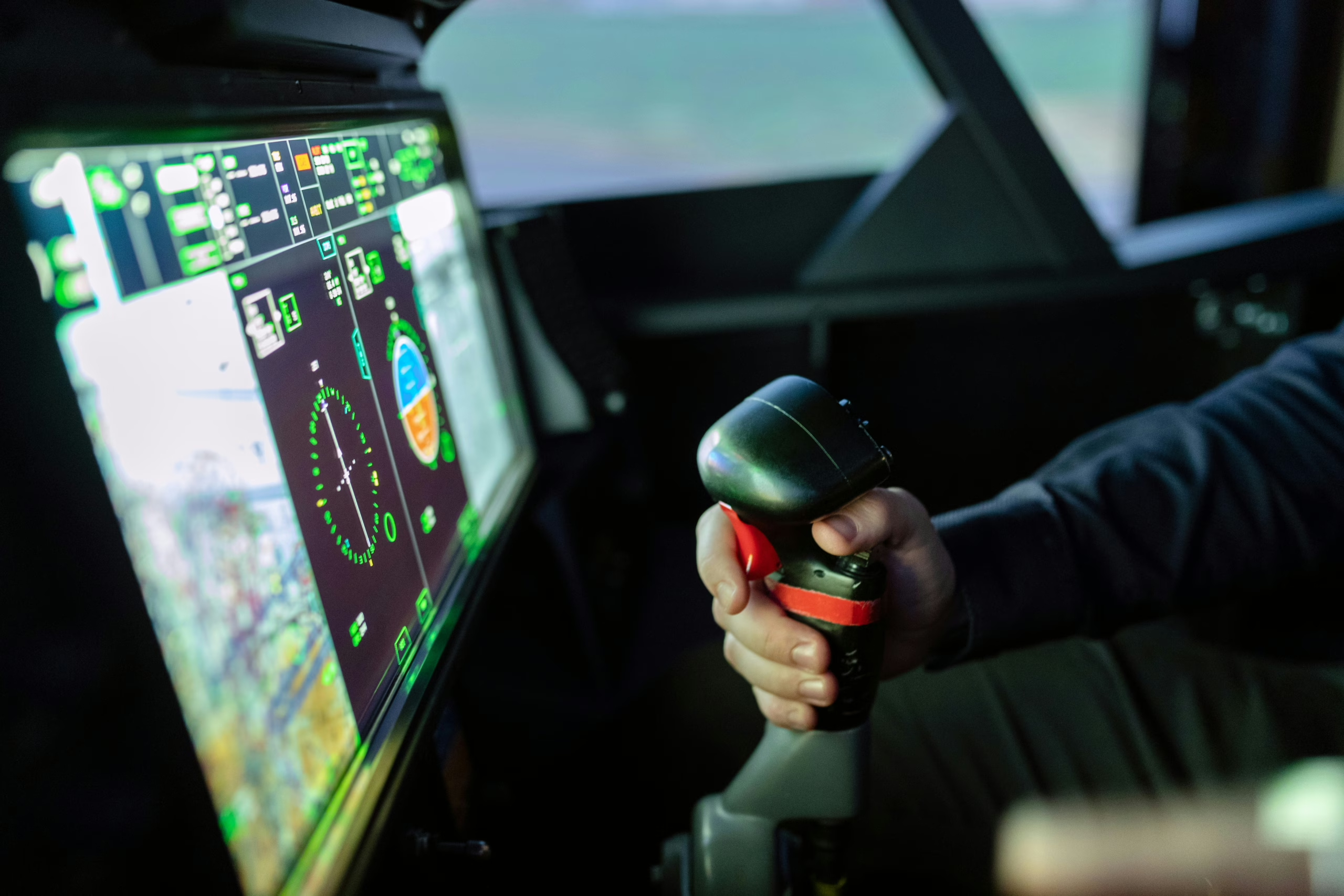
Table of Contents
- Decoding High Precision Eye Tracking: Accuracy vs. Precision in 2026
- The Technical Pillars of Professional-Grade Eye Tracking Hardware
- Why Precision is the Deciding Factor in Human-Machine Interaction (HMI)
- Synchronizing Precision: Multimodal Integration and Data Reliability
- Elevating Research with Ergoneers: From Data to Human Insight
Decoding High Precision Eye Tracking: Accuracy vs. Precision in 2026
Distinguish between hitting a target once and hitting it every single time. In the rigorous world of behavioral science, accuracy represents the proximity of a gaze point to its actual target, but high precision eye tracking defines the consistency and repeatability of those measurements over time. Research in 2026 demands more than a lucky hit; it requires a system that maintains a stable gaze vector even when the subject is navigating the high-stress, high-vibration environment of a flight cockpit or a driving simulator. While consumer-grade trackers often struggle with signal jitter, professional-grade hardware eliminates the noise that obscures true human intent. The evolution of eye tracking technology has moved us past simple coordinate mapping toward a multidimensional understanding of visual attention.
Establish gaze vector stability as your primary KPI. In dynamic environments, accuracy alone fails because it cannot account for the rapid shifts in head position or lighting that characterize real-world interaction. High-end systems now achieve an accuracy of 0.3 degrees, but that number is meaningless if the precision doesn’t allow for repeatable results across a diverse cohort of participants. You’re looking for the threshold where data becomes evidence, moving beyond the shaky, inconsistent outputs of low-cost alternatives toward the clinical reliability needed for professional validation.
The Mathematical Foundations of Measurement Quality
Command a clear understanding of the difference between spatial resolution and angular accuracy. In 2026, spatial resolution describes the smallest detectable change in eye position, while angular accuracy measures the offset between the calculated and actual gaze direction. These two metrics must work in harmony to produce high precision eye tracking data that stands up to peer review. When using wearable systems, parallax errors often degrade precision because the distance between the scene camera and the eye cameras isn’t perfectly accounted for in the software’s geometric model.
Root mean square (RMS) error serves as the industry benchmark for precision, quantifying the spatial jitter or noise within a recorded gaze sample.
Why ‘Good Enough’ Data is a Liability in Behavioral Science
Protect your research from the hidden costs of false positives. When precision is low, software algorithms often misidentify gaze jitter as a series of micro-saccades or fail to detect short fixations entirely. This creates a cascade of errors that leads to data cleaning fatigue, forcing researchers to spend hundreds of hours manually correcting algorithmic failures. It’s a drain on resources that hampers the velocity of your discovery.
Link measurement error directly to the ongoing replication crisis in psychological and industrial research. If your hardware cannot produce repeatable data under identical conditions, your findings won’t hold up in other labs or real-world applications. By investing in scientific-grade precision, you ensure that your work contributes to a legacy of reliable, human-centric knowledge rather than becoming another statistic in the world of unrepeatable studies.

The Technical Pillars of Professional-Grade Eye Tracking Hardware
Achieve a new dimension of clarity by looking beyond the surface of hardware aesthetics. The integrity of high precision eye tracking rests on specific technical pillars that distinguish scientific instruments from mere gadgets. Prioritize sampling rates that meet or exceed 200Hz. This high frequency is essential for capturing micro-saccades, those rapid, involuntary eye movements that reveal the subconscious processing of visual stimuli. Without this temporal resolution, your data risks smoothing over the very nuances that define human behavioral responses.
Integrate infrared (IR) illumination to maintain a constant signal regardless of ambient lighting fluctuations. This technology ensures that your data remains clean whether you’re in a dim laboratory or a brightly lit industrial floor. Binocular tracking is equally non-negotiable; analyzing the coordination of both eyes is the only way to achieve accurate depth perception analysis in three-dimensional space. Address the physical reality of research with slippage compensation. In wearable systems like Dikablis Professional, this feature maintains the calibration’s geometric integrity even if the headset shifts during vigorous participant movement, ensuring your session’s longitudinal reliability.
Optics and Sensors: Achieving Sub-Degree Precision
Analyze the geometry of your sensor array to maximize data quality. Camera placement relative to the eye directly dictates the signal-to-noise ratio; professional systems optimize this angle to ensure every pixel of the sensor captures meaningful data. High-resolution sensors are required for Pupil and Corneal Reflection (PCCR) tracking, as they provide the granular detail needed to distinguish the reflection point from the pupil center with absolute certainty. Understanding these technical tiers is vital when reviewing the eye tracking glasses price for research, as premium optics directly correlate to the reliability of your insights and the expansion of your scientific capabilities.
Wearable vs. Remote: Choosing the Right Precision Tier
Compare your research objectives to the available hardware configurations to find the perfect fit. Head-mounted systems offer unparalleled precision stability in mobile contexts, allowing participants to interact naturally with their environment while maintaining a fixed distance between the eye and the sensor. Conversely, a remote, screen-based tracker might offer superior precision for static stimulus testing where head movement is restricted and the focal plane is consistent. Balance participant comfort with the necessity for rigid sensor alignment. If you need guidance on which configuration fits your specific lab setup, consult with our behavioral research experts to find your ideal integration and elevate your data collection workflow.
Why Precision is the Deciding Factor in Human-Machine Interaction (HMI)
Abandon the misconception that high precision eye tracking is a luxury reserved only for the physics lab. In the evolving landscape of Human-Machine Interaction, precision represents the difference between a successful interface and a frustrating, or even dangerous, user experience. When you’re designing for a world where humans partner with autonomous systems, understanding the subtle shift of a gaze is vital. It’s not overkill; it’s the only way to measure cognitive load with scientific rigor. Through pupillometry, high-precision sensors detect the minute dilations that signal mental strain, allowing researchers to identify exactly when a user is overwhelmed by an interface long before they make a conscious error.
Empower your design process by moving beyond the “where” of a gaze to the “why.” In safety-critical sectors like robotic surgery or aviation, every millisecond counts. By utilizing high precision eye tracking, you ensure that the data you collect is a true reflection of the expert’s focus, providing the foundation for training protocols that save lives. By capturing the nuances of visual search patterns, you can create intuitive interfaces that align with human biological physics, fostering a seamless relationship between the operator and the technology.
Automotive and Aerospace: Precision in High-Stakes Environments
Identify “look-but-failed-to-see” (LBFTS) errors by analyzing the duration and stability of fixations in high-velocity contexts. In aviation, a pilot might gaze at a warning light without cognitively processing the information; high-precision data reveals these gaps in situational awareness. Similarly, stable gaze data is the backbone of driver distraction analysis software, allowing for the precise mapping of visual attention in complex urban environments. High-precision fixations correlate directly with situational awareness, providing a clear metric for how well a human operator is integrating critical information from their surroundings.
Human-Centered Design and Professional UX Labs
Map gaze coordinates to tiny UI elements on mobile screens with absolute confidence. While standard trackers might provide a general area of interest, high-precision systems allow you to see exactly which icon or text string captured the user’s attention. This allows professional UX labs to transition from generic heatmaps to detailed scanpath analysis, uncovering the logical flow of a user’s decision-making process. Integrate these insights into a broader behavioral research software workflow to ensure your design decisions are rooted in empirical, human-first data rather than subjective preference.

Synchronizing Precision: Multimodal Integration and Data Reliability
Expand your research horizon by recognizing that gaze data is only one chapter in the narrative of human behavior. While previous sections established the need for sub-degree accuracy, the visionary expert understands that high precision eye tracking reaches its full potential when it serves as the spatial anchor for a broader physiological story. By linking visual attention to brain activity, muscle tension, and heart rate, you create a multidimensional map of the human experience. This holistic approach prevents data from existing in a vacuum and instead positions your lab as a vital partner in the evolution of human-technology interaction.
The technical challenge of millisecond-accurate synchronization remains a primary hurdle for many researchers. Without a unified platform, time-drift between sensors can lead to misaligned data, rendering complex behavioral analysis impossible. Professional-grade systems eliminate this friction by providing a single point of truth where every data point is timestamped with absolute precision. This ensures that when you see a spike in EEG activity, you can correlate it exactly to the moment the participant’s gaze landed on a specific visual stimulus, providing a clear window into the subconscious mind.
Multimodal Synergy: Combining Gaze, EEG, and EMG
Utilize synchronized data acquisition to prevent time-drift during long-duration studies. In EEG research, high precision eye tracking is essential for triggering event-related potentials (ERPs) based on gaze fixations rather than external timers. This allows for a more organic study of cognitive processing. Integrating EMG sensors further expands this insight by correlating visual attention with physical muscle responses, revealing how a subject’s body prepares for action before the conscious mind even registers intent. This synergy transforms raw signals into a legacy of comprehensive human insight.
The Role of API and Custom Integration
Harness the power of an eye tracking API to enable real-time interaction in immersive VR and AR environments. In 2026, raw data access is no longer a luxury; it’s a requirement for researchers developing custom algorithmic analysis for breakthrough discoveries. This bridge between standard hardware and innovative software allows you to build proprietary tools that push the boundaries of your specific field. If you’re ready to unify your sensor array and eliminate data friction, consult with our integration specialists to design your custom multimodal research lab.
Elevating Research with Ergoneers: From Data to Human Insight
Transform your research from a mere collection of data points into a legacy of human insight. At Ergoneers, we don’t just provide hardware; we cultivate a partnership rooted in academic rigor and industrial scale. As a spin-off from the Technical University of Munich (TUM), our foundation is built on the clinical precision required for high-end research hardware. We invite you to move beyond the limitations of standard tools and embrace a holistic ecosystem designed for behavioral excellence. Prioritize the human element. By anchoring your studies in our visionary expert approach, you navigate the expanding boundaries of scientific knowledge with quiet confidence.
Achieve a level of technical depth that standard consumer devices simply cannot match. The integration of high precision eye tracking into your workflow isn’t just about better numbers; it’s about the expansion of human insights. Our legacy of excellence is reflected in our long-standing relationships with industry leaders who trust our tools to lead technological revolutions. We see ourselves as a vital partner in your journey, providing the reliable infrastructure needed to turn complex computational analysis into practical, real-world improvements in the relationship between people and technology.
Dikablis Professional: Precision Without Compromise
Secure the stability of your data even during rapid head movements or high-vibration scenarios. The Dikablis Professional frame is specifically engineered for ergonomic stability, ensuring the sensors remain perfectly aligned with the eye’s geometry throughout the recording session. Equipped with high-speed cameras, this system captures the rapid dynamics of visual attention with the error-free precision that distinguishes our brand in a field often defined by technical friction. Whether your subjects wear prescription lenses or safety goggles, the Dikablis ecosystem maintains its tracking integrity, allowing for seamless data acquisition across diverse industrial and academic environments.
Prophea.X: The Future of Behavioral Analysis Software
Empower your workflow with a software platform that possesses the agency to handle the heavy lifting of data processing across different sectors. Prophea.X personifies our visionary research ethos by automating the complex tasks of multi-sensor synchronization and three-dimensional visualization. By integrating the AI-powered “Prophea autorecog” module, the software identifies gaze patterns and objects with a level of efficiency that allows you to focus on high-level analysis rather than troubleshooting. This intuitive interface ensures that high precision eye tracking remains accessible and actionable, bridging the gap between raw biological physics and the breakthrough behavioral insights that define the future of your field.
Take the next step in the evolution of your research and join a collaborative community of intellectual leaders. Contact our experts to design your high-precision research lab and discover how our integrated solutions can elevate your scientific output.
Transforming Technical Precision into Scientific Legacy
Mastering the nuances of high precision eye tracking is the first step toward redefining the boundaries of behavioral science. You now understand that scientific-grade hardware and seamless multimodal integration are not merely tools; they are essential partners in capturing the complexity of human intent. By prioritizing data repeatability and millisecond-accurate synchronization, you ensure that your research contributes to a global standard of excellence. This commitment to accuracy allows you to navigate shifting regulations and complex HMI challenges with absolute confidence.
As a spin-off from the Technical University of Munich (TUM), Ergoneers has led the field of HMI and behavioral research for over 20 years. Our flagship solutions, Prophea.X and Dikablis, empower top-tier automotive and aerospace companies to achieve breakthrough insights that were once out of reach. We invite you to move beyond technical friction and embrace a workflow that prioritizes the human element at every stage. It’s time to translate raw data into the expansion of human knowledge.
Empower your research with Ergoneers’ high-precision solutions and join a global community of visionaries dedicated to scientific rigor. We look forward to supporting your next major discovery.
Frequently Asked Questios
Accuracy measures how close a recorded gaze point is to the actual target, while precision defines the consistency and repeatability of those measurements over time. High-end systems achieving 0.3 degrees of accuracy still require high precision to ensure the gaze signal doesn’t jitter or drift during critical observations. Think of it as the difference between hitting a target once and hitting the exact same coordinate repeatedly across a diverse cohort.
Professional UX studies require high precision eye tracking to map gaze to small mobile icons and analyze cognitive load through pupillometry. Standard trackers often provide heatmaps that obscure the subtle visual search patterns of your users. Elevate your research by capturing the micro-nuances that reveal a user’s true mental effort and decision-making process during complex interactions.
Professional-grade hardware utilizes infrared (IR) illumination to maintain data integrity in challenging lighting conditions. While consumer devices often fail under direct sunlight or high-glare environments, scientific systems filter out ambient noise to ensure a stable signal. This capability allows you to move your behavioral studies from controlled labs to real-world industrial floors or outdoor training sites without losing data fidelity.
Sampling rates of 200Hz or higher are essential for capturing micro-saccades and the rapid dynamics of visual attention. A low sampling rate effectively blurs the data, causing you to miss the millisecond-long shifts that indicate subconscious processing. High-frequency data acquisition provides the temporal resolution needed to build a precise, three-dimensional model of human visual behavior in high-velocity environments.
Achieve millisecond-accurate synchronization by using a unified software platform like Prophea.X to link high precision eye tracking with EEG and EMG sensors. This multimodal integration prevents the time-drift that often plagues long-duration studies. By aligning physiological signals with visual attention, you create a comprehensive map of the human response to technological interfaces and immersive simulations.
Advanced hardware like Dikablis Glasses is engineered to track through most types of prescription eyewear and contact lenses without compromising signal quality. The specific geometry of the eye cameras and the use of specialized IR sensors minimize reflections that would otherwise create data noise. This ensures that your participant pool remains diverse and your data remains inclusive of all users regardless of their visual correction.
Select a wearable tracker for mobile research where natural interaction and a wide field of view are paramount. Choose a remote, screen-based system for static experiments where the stimulus is fixed on a monitor and the participant’s head movement is restricted. Both tiers offer high precision, but the right choice depends on whether you’re mapping interaction in a virtual cockpit or a controlled desktop UX lab.
Parallax errors and sensor slippage represent the most frequent technical hurdles in maintaining data reliability. Professional systems mitigate these issues through slippage compensation algorithms and sophisticated calibration models that account for the distance between the eye and the scene camera. By addressing these mathematical foundations, you transform raw ocular signals into publication-quality scientific evidence that stands up to peer review.