

News & Posts
Eye Tracking Glasses Price – A Guide for Modern Researchers

© getty
The real cost of a behavioral study isn't the invoice for the hardware; it's the price of a failed experiment caused by jittery data or a missed synchronization window. You've likely felt the frustration of trying to align gaze data with complex biophysical streams, only to find that hidden software fees or low-cost sensor drift have compromised your results. Experience a more precise path forward as we deconstruct the true eye-tracking glasses price for research in 2026. We look past the raw acquisition numbers to find the value in scientific-grade validity and analysis efficiency.
You will discover how to budget for the next era of human-centered insights without the friction of technical silos. This guide provides a clear framework for professional labs, comparing entry-level tools like the €799 Kexxu to high-end systems where accuracy reaches 0.3°. We'll explore the expanding spheres of AI-powered analysis and the total cost of ownership, including the role of advanced platforms like Prophea.X. Enter the world of absolute compatibility and learn how to secure a partner for your long-term research chain.
Key Takeaways
- Learn the technical variables, from sensor quality to sampling rates, that define the “Scientific Gap” between consumer hardware and professional tools.
- Master a tiered budgeting framework to understand how the eye tracking glasses price for research scales from initial pilot studies to high-precision laboratory environments.
- Identify the hidden factors in the total cost of ownership, including the vital role of automated analysis software in reducing long-term researcher salary expenses.
- Discover how high-precision data accelerates the peer-review process and delivers actionable ROI in high-stakes fields like automotive safety.
- Explore how to customize your human-centered research lab setup with professional integration services and specialized hardware like Tobii Glasses and the Dikablis range.
Table of Contents
-
Decoding the Spectrum: Why Eye Tracking Glasses Prices Vary for Research
-
Tiered Budgeting: Comparing Entry-Level, Mid-Range, and Professional Systems
-
Beyond the Frame: Calculating the Total Cost of Ownership
-
The Scientific ROI: Why Precision Justifies the Premium
-
Navigating Your Investment with Ergoneers
Decoding the Spectrum: Why Eye Tracking Glasses Prices Vary for Research
We have entered an era of behavioral analysis where every millisecond of gaze data is crucial. The cost of unreliable techniques can significantly impact a study’s turnover time, researchers’ frustration, and the overall success of a project. Therefore, understanding the price of eye-tracking glasses for research extends beyond just the frames; it encompasses the sophisticated engineering that links observation with validation.
While consumer-grade sensors may suffice for basic interactions, professional research demands more. It requires a higher standard of reliability, usability, synchronicity, and multimodal integration. This is where the “Scientific Gap” becomes relevant, highlighting the hardware’s ability to manage complex environmental variables without losing sight of human intent.
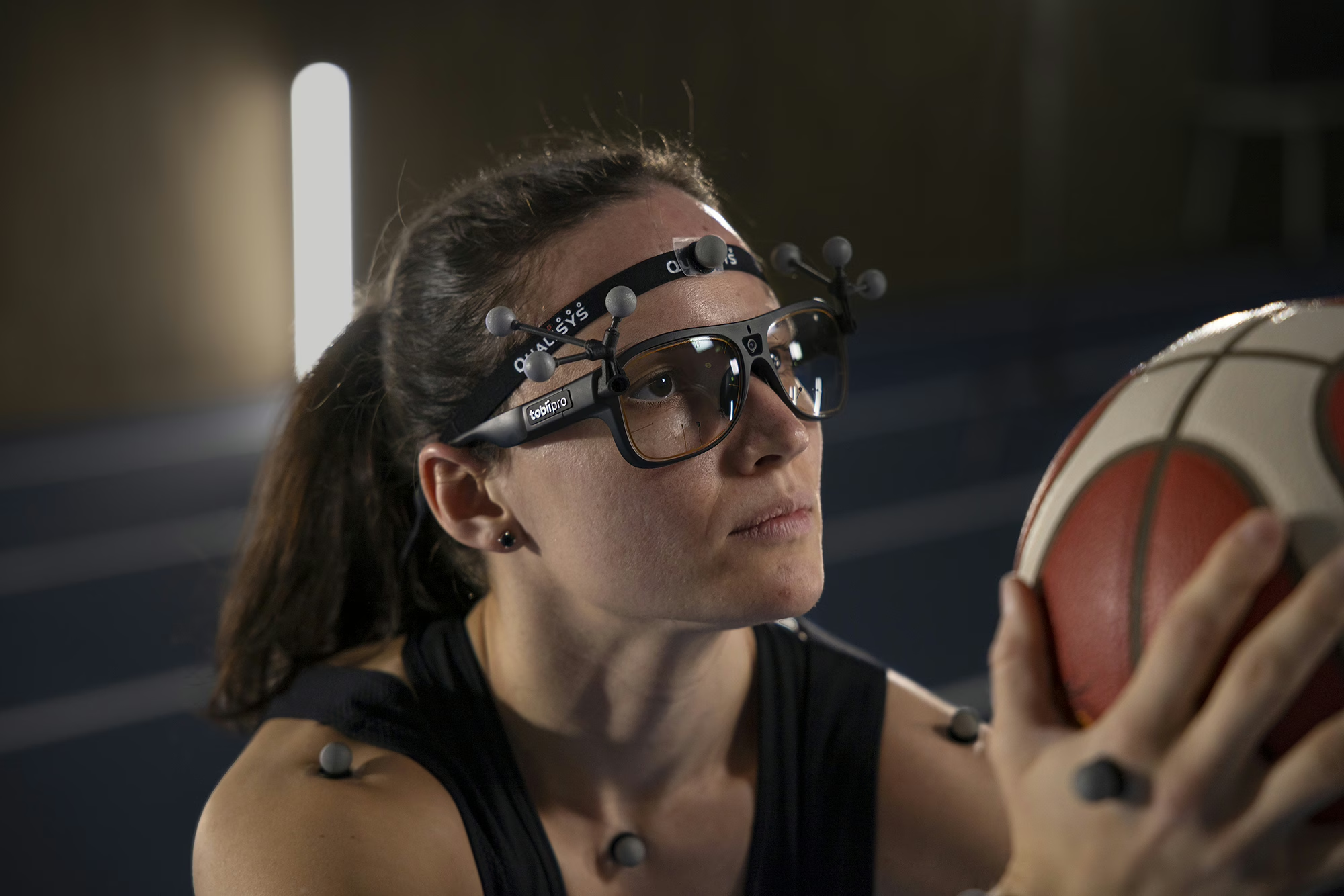
Bridging this gap is essential for accurate research outcomes. High-end pricing reflects features like binocular tracking and advanced parallax compensation. These ensure that whether a subject is gazing at a near-field dashboard or a distant horizon, the gaze vector remains precise. Eye tracking technology has evolved from simple screen-based setups to mobile, “human-centered” systems designed to broaden the scope of what we can measure in the real world. Thus, investing in premium hardware means paying for the ability to capture human behavior in its most natural, unconstrained state.
The Role of Angular Precision and Sampling Rates
Precision plays a significant role in the statistical power of a study. While a 60Hz sensor may capture general trends, sampling rates of 120Hz or higher are crucial for identifying micro-saccades and rapid cognitive shifts. Angular precision refers to the margin of error in gaze estimation; minimizing this margin enhances the clinical authority of your data, making it suitable for high-tier publications. Moreover, investing in higher sampling rates reduces noise in your dataset, ensuring that insights are grounded in reality rather than algorithmic guesswork. This level of detail distinguishes a pilot study from a breakthrough discovery.
Build Quality: Essential vs. Professional Grade
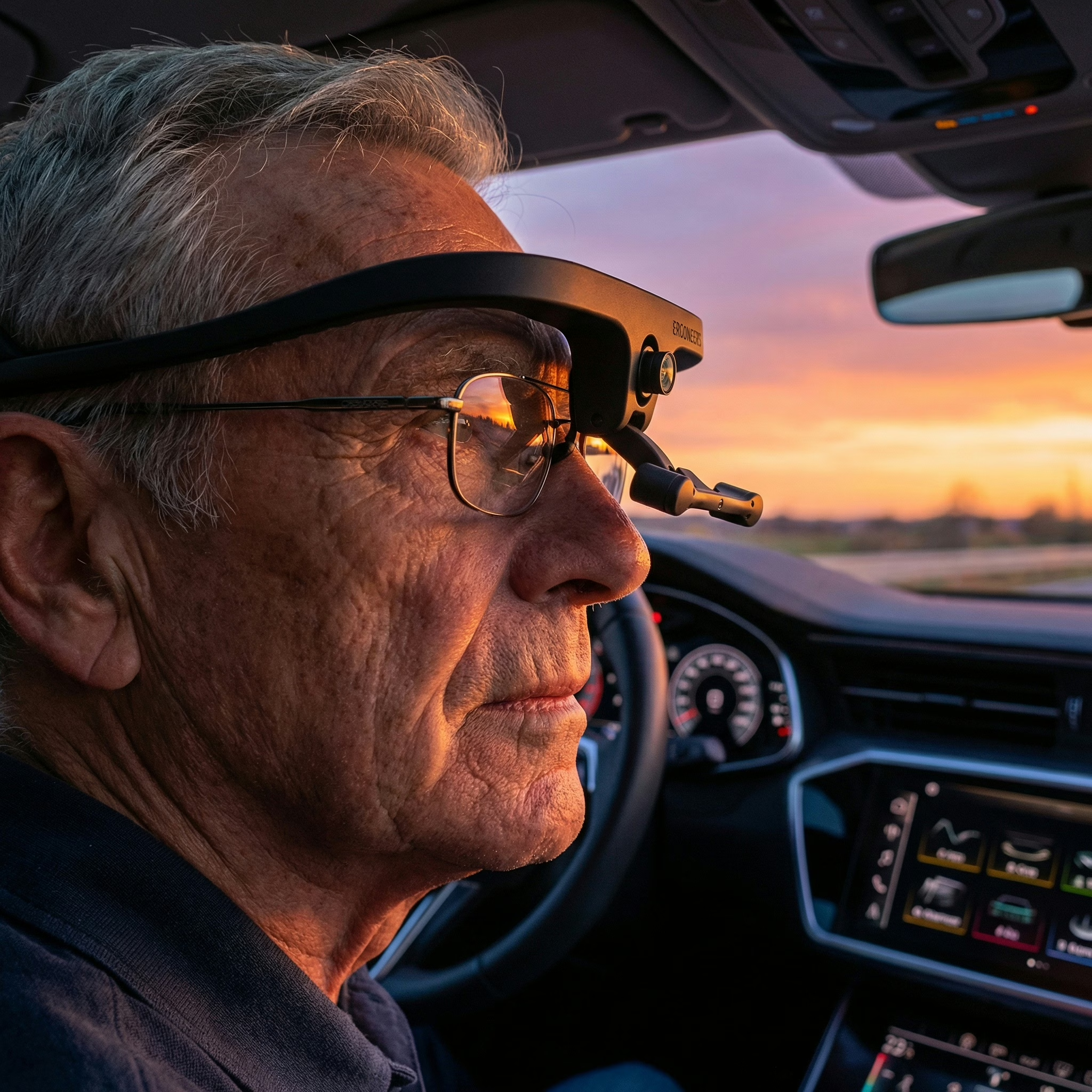
Experience the contrast between fragile consumer plastics and reinforced, ergonomic research hardware. Professional systems, such as Tobii Glasses III or the Dikablis range, prioritize compatibility with various head shapes and corrective eyewear. This engineering ensures sensor stability during movement, a critical factor influencing the price of eye-tracking glasses for research. In high-stakes environments, like automotive simulators or industrial training floors, field-swappable components are necessary to avoid costly downtime. A unified design facilitates easy deployment; when your hardware is built to last, the long-term value far outweighs the initial investment. Ultimately, professional-grade tools empower researchers to concentrate on data rather than device maintenance.
Tiered Budgeting: Comparing Entry-Level, Mid-Range, and Professional Systems
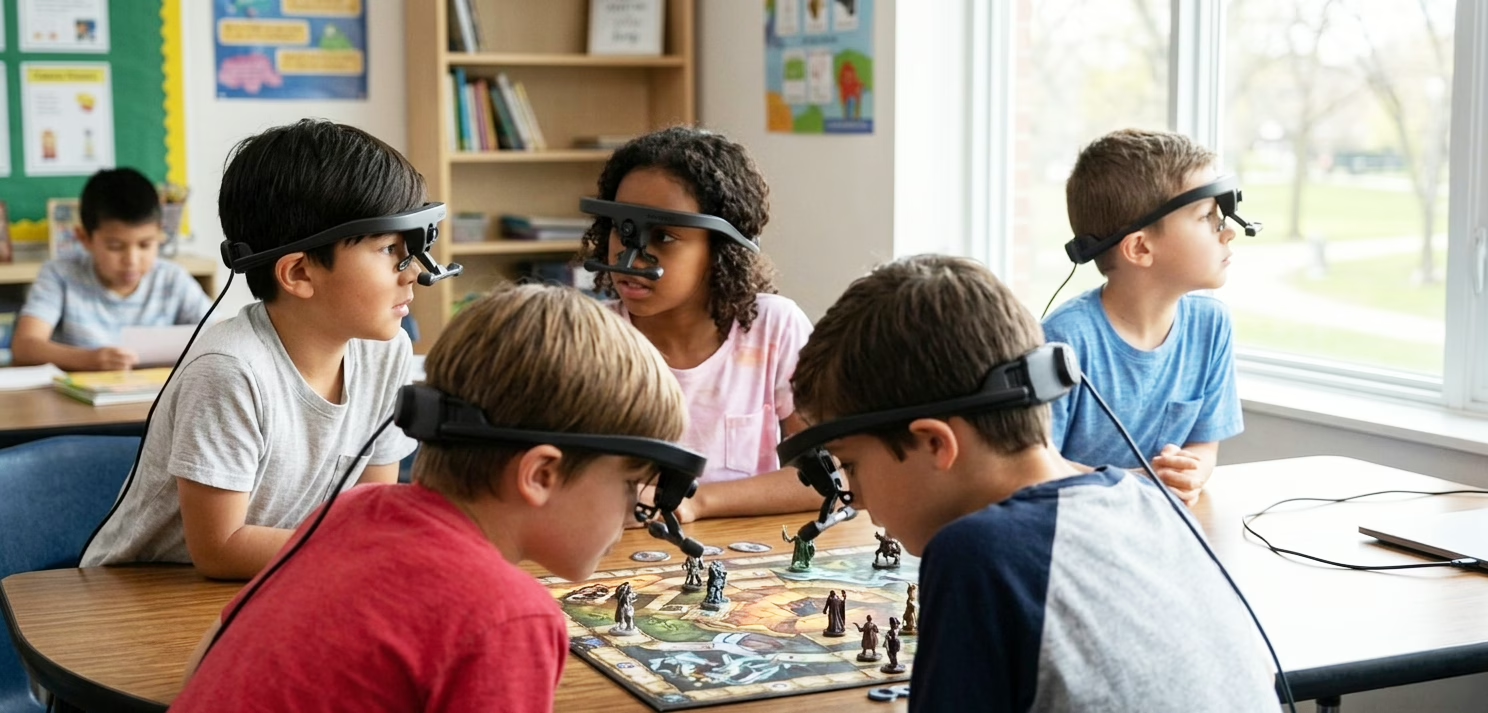
A strategic approach to lab capitalization begins by categorizing technology into performance-based tiers. When determining the eye tracking glasses price for research, it’s essential to align the hardware’s capabilities with your specific scientific output requirements. Entry-level systems, available at under $1,000 , provide a low-barrier entry point for pilot studies and classroom demonstrations where high-frequency data isn’t the primary objective. However, as research moves from the classroom to the field or the simulator, the complexity of the research chain necessitates a transition to more robust, integrated hardware.
Mid-range systems, typically priced between $3,000 and $12,000, offer improved deep-learning algorithms and calibration-free operation, making them suitable for general UX testing and market research. The professional tier, starting at $15,000, represents the pinnacle of high-precision engineering required for human factors, automotive, and medical research. Unified equals easy; by selecting a system that scales across these tiers, you ensure that your lab remains agile without the need to relearn different software environments for every new study. This scalability allows you to expand your research spheres as your funding and project complexity grow.
Entry-Level Limitations and Hidden Hurdles
Low initial costs often mask the long-term expense of manual data cleaning and technical friction. Entry-level systems frequently struggle in dynamic or high-luminance environments, leading to inconsistent data that requires extensive post-processing. While a budget sensor might seem efficient for a quick test, the lack of hassle-free accuracy often results in lost research hours and compromised data validity. If you’re looking to build a sustainable foundation, you might [explore our behavioral lab consulting services](https://ergoneers.com) to ensure your technology stack scales with your scientific ambitions.
The Professional Tier: Where Precision Meets Reliability
Enter the professional tier, where clinical precision meets industrial-scale reliability. Systems like Dikablis Professional are designed for high-impact research where accuracy as high as 0.1° is the standard, not the exception. Industry leaders in the automotive and aerospace sectors invest in this tier because the cost of data noise in these spheres is far greater than the hardware premium. This level of investment provides absolute compatibility with multimodal sensors and ensures your work stands up to the most rigorous peer-review standards. The eye-tracking glasses’ price for research at this level reflects a commitment to data that is not just captured but trusted to shape a human-centered future.
© Tobii
Beyond the Frame: Calculating the Total Cost of Ownership (TCO)
Look past the initial hardware invoice to discover the true economic engine of a modern lab. The eye tracking glasses price for research is often conflated with the physical frames, yet the most significant investment lies in the software ecosystem that transforms raw video into publishable insights. Why is the software license frequently separate from the hardware? It’s because the glasses act as the sensory input, while the software provides the cognitive processing. Professional behavioral research software provides multi subject capability and the multimodal synchronicity required to bridge gaze data with complex biophysical streams like EEG or EMG. Without this unified architecture, researchers find themselves trapped in a manual coding purgatory, spending dozens of hours on frame-by-frame analysis for every hour of recorded behavior.
Analyze the cost of human capital to understand the real ROI of automation. Manual gaze mapping is a labor-intensive process that can consume an entire semester of a graduate student’s time. At a standard research salary, this creates a massive hidden deficit that budget sensors and software simply cannot offset. Automated coding through deep-learning algorithms, however, reduces this burden by orders of magnitude, effectively saving thousands of dollars in researcher salaries over the course of a single study. Integrated APIs and SDKs are not just technical luxuries; they are the vital infrastructure of efficiency. They allow for the expansion of research spheres without adding friction to the data chain, ensuring that your team remains focused on high-level insights rather than administrative data cleaning.
Modern Software Ecosystems: Prophea.X
Experience the power of Prophea.X, our flagship software that personifies the next era of AI-powered analysis by expanding spheres across industry and academia. This platform plays cross-industry, moving seamlessly from automotive simulator data to social behavior studies. When deciding between subscription and perpetual licensing, consider your lab’s heritage of excellence and funding cycles. Subscription models can lower the initial barrier to entry, but perpetual licenses offer the long-term stability required for multi-year trials. Deep-learning based gaze mapping ensures that your data remains valid even in dynamic, real-world environments where traditional algorithms fail.
Support, Training, and Maintenance
Technical heritage and reliable support are the guardians of your investment. The hidden cost of “zero support” in budget systems often manifests as “shelfware,” where hardware sits unused due to technical friction or compatibility issues. Expert-led workshops and dedicated training prevent this outcome by ensuring your team is fully empowered to use the tool’s full range of capabilities. Budgeting for hardware calibration and firmware updates over a 5-year lifecycle is essential to maintain the hassle-free accuracy that high-stakes research demands. A trusted partnership ensures that your lab remains agile and ready to lead the next revolution in human-technology interaction.
© Ergoneers
The Scientific ROI: Why Precision Justifies the Premium
Scientific validity is the currency of the Publication Hub. When you evaluate the eye tracking glasses price for research, consider the velocity of your peer-review process. High-precision systems, offering accuracy as high as 0.1°, provide the undeniable data integrity that skeptical reviewers demand. This clinical rigor accelerates the journey from data collection to published breakthrough, effectively shortening the research cycle. In industry spheres, this precision translates directly to safety and efficiency. For automotive or aerospace leaders, reducing “driver distraction” or “operator error” is a necessity. Absolute accuracy in these high-stakes environments prevents the catastrophic costs of design flaws or human-machine interaction failures.
Experience the expansion of your research spheres when technical friction is removed. Professional systems justify their premium by eliminating the “data noise” that plagues low-cost sensors. When your gaze vectors are stable and your sampling rates are high, you spend less time defending your methodology and more time uncovering human-centered insights. This reliability is what allows global industry leaders to trust behavioral data for multi-million dollar product developments. If you’re ready to elevate your data quality, you can explore our behavioral research lab consulting
Multimodal Data Acquisition and Synchronicity
True behavioral insight rarely exists in a vacuum. The real value of a professional setup lies in its ability to facilitate multimodal synchronicity without the headache of manual alignment. While budget systems leave you struggling to stitch together EEG, EMG, and gaze streams, a unified platform like Prophea.X handles the heavy lifting through absolute compatibility. This integration is our ethical North Star for complex human-machine interaction studies. It ensures that every physiological spike is perfectly anchored to a specific visual fixation. Synchronized data is the prerequisite for reliable behavioral insights. By investing in a system designed for multimodal expansion, you’re buying back the hundreds of hours typically lost to technical troubleshooting.
Future-Proofing Your Behavioral Research Lab
Enter the next era of research with a system that grows alongside your ambitions. Modular hardware allows for custom eye tracking integration as new biophysical sensors emerge, ensuring your lab remains at the cutting edge for years to come. Ergoneers brings a unique heritage as a TUM spin-off, bridging the gap between rigorous academic standards and global industrial scale. This legacy of excellence is baked into our AI-powered analysis platforms, such as Prophea.X, which are designed to lead the deep-learning revolution. The eye tracking glasses price for research is an investment in a future-proof ecosystem that remains agile, innovative, and deeply rooted in academic rigor. Unified equals easy; when your tools are built to connect, your research has no boundaries.

© Ergoneers
Navigating Your Investment with Ergoneers
Experience the confidence that comes with a partner dedicated to your human-centered evolution. Choosing the right eye tracking glasses price for research is not just about comparing data sheets; it’s about finding a synergy between hardware precision and software intelligence. Ergoneers positions itself as a vital ally in this process, offering a foundation of academic excellence that transforms technical tools into comprehensive research capabilities. Whether you’re conducting field studies in social environments or high-frequency tests in automotive simulators, our range is designed to expand your scientific spheres without the friction of incompatible systems.
Enter a relationship built on reliability and clinical authority. We invite you to dwell and connect with our team of experts to explore how our technology has shaped industry standards. By focusing on absolute compatibility and the “Unified equals easy” philosophy, we ensure your lab is equipped for the AI-powered revolution. We don’t just sell sensors; we provide the intellectual leadership required to shape a better, human-centered future. Our goal is to ensure that your data is not only precise but also actionable within your specific research chain.
Dikablis Glasses X
Discover the tailored performance of the Dikablis range. In the tradition of the Dikablis Glasses range, Dikablis Glasses X offers a superior price-to-performance ratio for researchers focused on mobile studies and real-world behavioral observation. It provides the portability needed for social research and field testing while maintaining the hassle-free accuracy our brand is known for. In contrast, Dikablis Professional is engineered for high-precision labs where sub-degree gaze estimation and high sampling rates are non-negotiable. This model fits the sphere of complex simulator training and cognitive neuroscience, where every micro-saccade matters. Both tiers benefit from the same robust engineering, ensuring your data remains valid regardless of the environment.
Consulting and Turnkey Lab Solutions
Move beyond the simple act of buying a device and begin building a genuine research capability. Ergoneers offers custom consulting to help you navigate the eye tracking glasses price for research relative to your specific scientific goals. Our roots in high-level academic research ensure that every lab we design meets the highest levels of rigor and industrial scale. We provide more than hardware; we offer training, workshops, and technical integration services that prevent your investment from becoming shelfware. Experience the future of research; request a customized quote today. or join one of our webinars for deeper first hand insights.
Shaping the Next Era of Human-Centered Insight
Selecting the right tools for your lab requires a balance between clinical precision and long-term operational efficiency. We’ve explored how the eye tracking glasses price for research encompasses far more than the initial frame cost, factoring in the immense value of automated analysis and multimodal synchronicity. Whether you’re conducting field studies or high-stakes simulator training, the true ROI is found in data that remains valid under the most rigorous peer-review standards.
Ergoneers brings a unique heritage of academic rigor to every project. Founded as a spin-off from the Technical University of Munich (TUM), we’re trusted by global leaders in automotive and aerospace research to deliver hassle-free accuracy. By leveraging Prophea.X, the world’s first AI-powered multimodal analysis platform, you can eliminate technical friction and focus on the insights that matter. Enter the next era of behavioral research—get a personalized quote, today!
Frequently Asked Questions
Professional systems for university labs typically start around $6,000 for mid-range units and can exceed $35,000 for high-precision, multimodal-ready laboratory setups. While entry-level portable sensors might be found for under $1,000, these often lack the robust synchronization features required for complex behavioral studies. The eye-tracking glasses’ price for research is best viewed as a multi-year investment in data integrity rather than a one-time equipment purchase.
The disparity exists because research-grade hardware must account for physiological variables that consumer devices ignore. High-end systems utilize superior optics and specialized IR illumination to ensure data validity across diverse eye colors and lighting conditions. This engineering eliminates the “Scientific Gap,” providing the clinical authority needed for high-impact journals. For researchers who also require high-purity laboratory reagents, it is vital to learn more about vetting specialized suppliers to maintain this same level of scientific rigor. Professional tools are built to capture human behavior in its most natural state without sacrificing precision.
Most professional hardware is priced separately from the analysis software to allow for customized research workflows. While recording modules might be included, sophisticated AI-powered platforms like Prophea.X are typically licensed as an ecosystem. This approach ensures you only pay for the analysis depth required by your specific project, whether you are performing simple gaze mapping or complex multimodal behavior analysis across the entire research chain.
Beyond hardware, significant costs arise from manual data analysis and the time required for technical troubleshooting. If a system lacks automated gaze mapping, the salary costs for research assistants to manually code video can quickly dwarf the initial equipment investment. Additionally, budgeting for technical training and expert-led workshops is crucial to ensure the technology is fully utilized and doesn’t become “shelfware” due to a lack of internal expertise.
Integration is technically feasible but often results in high data friction and compromised synchronicity. Low-cost systems rarely provide the open APIs or hardware-level triggers necessary for absolute compatibility with biophysical sensors like EEG. For studies requiring millisecond-accurate alignment, the eye tracking glasses price for research at a professional level is justified by removing the labor-intensive burden of manual data stitching and ensuring ethical, reliable results.
Sampling rates dictate the temporal resolution of your data; a 120Hz sensor captures a gaze point every 5 milliseconds, whereas a 60Hz sensor only captures one every 16.6 milliseconds. Higher rates are essential for identifying rapid cognitive shifts and micro-saccades that define complex human-machine interaction. Professional systems offer these higher frequencies to provide the statistical power necessary to detect subtle behavioral changes that lower-frequency sensors would simply miss.
Visionary labs prefer modular systems like the Dikablis range, which allows for incremental upgrades rather than total hardware replacement. You can often expand your capabilities by integrating new software modules or adding biophysical sensors to your existing setup. This future-proof approach ensures that your lab remains at the cutting edge of the AI-powered revolution while respecting the heritage and investment of your initial laboratory capitalization.
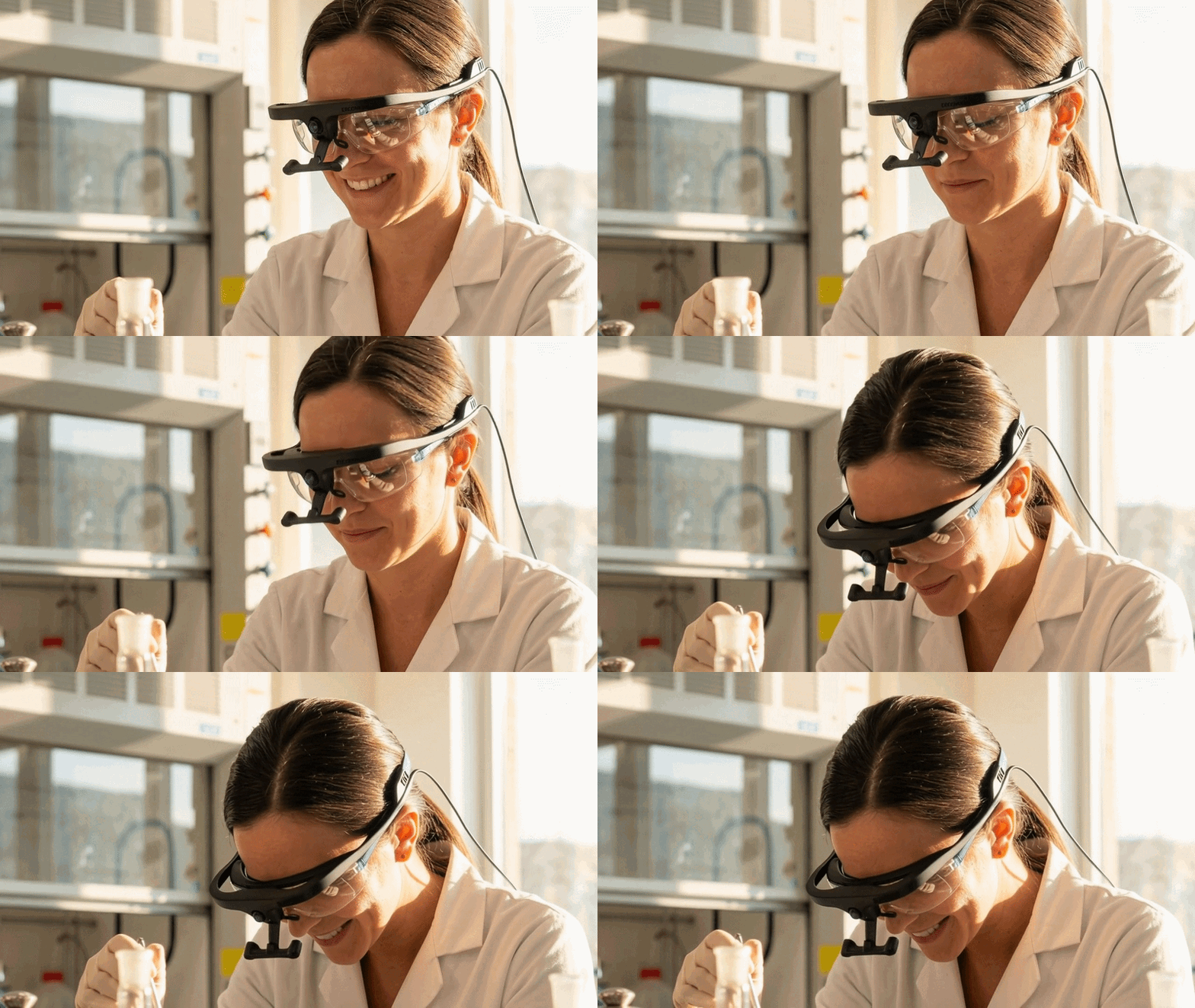
Specific hardware like Dikablis Essential is designed precisely for the rigors of high-mobility and outdoor environments. These systems utilize specialized frame geometry and light-compensation algorithms to maintain hassle-free accuracy where standard lab sensors fail. By focusing on the human-centered experience, these mobile solutions allow researchers to enter the subject’s natural sphere, capturing valid gaze data during active tasks like driving, sports, or industrial maintenance.