

News & Posts
Multimodal Behavioral Analysis: Synchronizing Data for High-Precision Research in the era of AI

True multimodal behavioral analysis is defined not by the sheer volume of sensors you deploy, but by the synchronous fusion of that data into a single, coherent timeline of human intent. As the global multimodal AI data market climbs in global interest, the pressure to deliver error-free, high-precision results has never been greater. You recognize that collecting data is easy, yet triangulating gaze, physiology, and environmental context into a unified narrative remains a complex technical hurdle. Eliminate the friction of data silos where sensors refuse to communicate.
Multimodal Behavioral Analysis: Synchronizing Data for High-Precision Research in physical AI development
We understand the frustration of manual synchronization and the exhaustion of interpreting conflicting signals from different modalities. This article promises to reveal how you can integrate these disparate streams into a streamlined, unified research workflow. By leveraging the computational power of Prophea.X and the precision of Dikablis glasses, you’ll reduce your time-to-insight for complex HMI testing. Discover the path to scientific validation that empowers your lab to lead the next evolution of human-centric research.
Key Takeaways
- Integrate disparate data streams into a unified narrative of human intent for deeper research precision.
- Master the technical architecture needed to eliminate hardware clock drift in long-duration behavioral studies.
- Utilize multimodal behavioral analysis to bridge the gap between observed actions and internal cognitive states.
- Accelerate time-to-insight in high-stakes environments like automotive HMI and aerospace simulations.
- Leverage the Prophea.X ecosystem to automate complex data integration and focus on high-level scientific breakthroughs.
What is Multimodal Behavioral Analysis? Beyond Single-Stream Observation
High-precision research demands more than just a glimpse into a participant’s actions; it requires a deep understanding of their internal state. Multimodal behavioral analysis is the simultaneous capture and analysis of multiple data streams, such as gaze, audio, and physiological signals. This approach transforms research from a collection of isolated data points into a multidimensional map of human intent. By synchronizing these streams, you gain the ability to see the human experience as a whole, rather than a series of fragmented events.

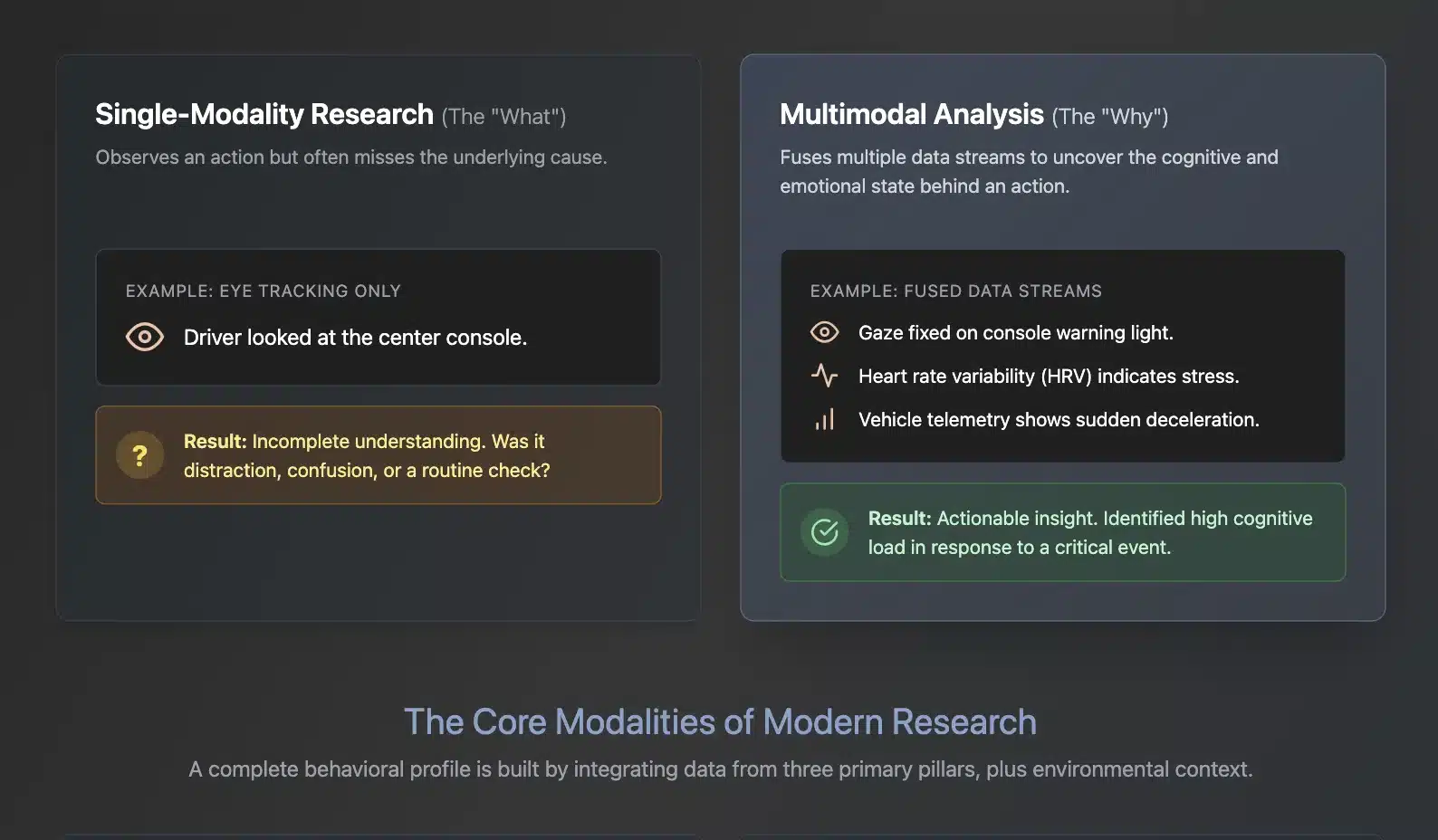
Relying on single-modality research, like eye tracking alone, often leaves researchers guessing at the “why” behind the “what.” You might see where a driver looks, but without heart rate data or cabin context, you can’t determine if they’re distracted, fatigued, or simply performing a routine check. Understanding What is Multimodal Interaction? helps researchers move beyond simple observation toward a more sophisticated model of human-technology engagement. This is the foundation of modern behavioral science.
To better understand this concept, watch this helpful video:
This evolution in methodology leads us to the concept of Data Fusion. Instead of viewing sensors as parallel but separate tracks, Data Fusion integrates diverse signals into a single, actionable insight. It’s the process of blending environmental data, like vehicle telemetry or room temperature, with human responses to complete the behavioral picture. When these elements align, the data stops being a list of numbers and starts being a story of human behavior.
The Core Modalities of Modern Research
Modern research frameworks rely on three distinct categories of data to build a complete profile of the user. Visual attention remains a cornerstone, often captured through professional eye tracking glasses that reveal exactly where a subject’s focus lies in real-time. Physiological signals provide the internal context, including heart rate variability (HRV) to measure stress, skin conductance (EDA) for arousal, and EEG for neural activity. Finally, verbal and non-verbal cues, such as voice prosody, facial expressions, and body posture, offer the outward manifestation of the subject’s emotional state.

Why Multimodal Data is the New Standard
Adopting a multimodal approach increases the validity of your findings by cross-verifying results across different biological systems. If a subject reports low stress but their heart rate and skin conductance suggest otherwise, you’ve identified a critical discrepancy that single-stream data would have missed. This is particularly vital when decoding cognitive load; by combining gaze data with biosignals, you can precisely measure the mental effort required for a task. Multimodal behavioral analysis is a comprehensive research methodology that integrates the three primary pillars of human-centric data: systematic observation, physiological response, and environmental context.
The Architecture of a Multimodal Research Framework
Constructing a robust architecture for multimodal behavioral analysis requires a deliberate selection of hardware and software that functions as a unified organism. You must align your technical stack to capture high-fidelity data while maintaining the ecological validity of the study environment. This framework rests on three pillars: high-precision sensors, hardware-level synchronization triggers, and a centralized data engine. When these elements harmonize, you move beyond simple data collection and enter the realm of true behavioral synthesis.
High-precision hardware is non-negotiable for studies requiring granular detail, such as Clinical Discovery in Autism Research, where subtle eye-movement patterns and physiological responses provide vital diagnostic markers. Selecting the right sensors depends entirely on your research question. For field studies, you might prioritize lightweight wearables that minimize participant burden. In a controlled lab environment, you can deploy a denser array of ambient sensors to capture a wider spectrum of human response. Balancing this obtrusiveness with the need for data quality is the hallmark of a visionary researcher.
Hardware Integration: From Wearables to Ambient Sensors
Integrate Dikablis Professional into your workflow to achieve mobile, high-speed gaze tracking that remains stable even during rapid head movements. This hardware serves as your primary window into visual attention. To expand the dimensions of your study, connect specialized biosensors like EEG for neuro-ergonomics or EMG for detailed kinesiology analysis. These physiological layers provide the internal context for the external actions you observe. Always include high-definition video as your ground-truth reference; it provides the essential visual anchor that validates every other data stream in your technical stack.
Software as the Central Nervous System
While hardware captures the signal, your choice of behavioral research software is the most critical investment you’ll make. It acts as the central nervous system of your lab, processing diverse inputs into a coherent whole. Prophea.X manages the inherent complexity of diverse data formats in real-time, ensuring that every millisecond of gaze data aligns perfectly with physiological spikes. Meanwhile, Prophea.X provides the structured legacy required for long-term behavioral studies, allowing you to revisit and re-analyze datasets as your research goals evolve. This software agency empowers you to focus on high-level insights rather than technical troubleshooting.
Building a turnkey multimodal lab is a journey from technical friction to scientific empowerment. If you’re ready to design your own high-precision environment, you can consult with our laboratory experts to bridge the gap between scientific ambition and technical execution.
Solving the Synchronization Challenge in Multi-Sensor Studies
Asynchronous data streams represent the single most common failure point in high-precision research. When sensors operate on independent internal clocks, they inevitably succumb to the “Drift” phenomenon. This occurs because hardware clocks fall out of sync over time, even if they start perfectly aligned. Reliable multimodal behavioral analysis demands a common time-stamp for every data point across all active sensors. Without this temporal anchor, you risk misinterpreting the sequence of human intent, as a physiological spike might appear to precede the visual stimulus that caused it.
Manual synchronization is a significant liability in the modern lab. The cost of human error during data alignment often leads to hours of wasted effort and compromised datasets that lack scientific validity. Automated systems eliminate this friction by locking all devices into a master clock from the moment recording begins. This precision is especially critical in a clinical application of multimodal behavioral analysis, where even the slightest temporal misalignment can lead to an incorrect interpretation of a participant’s cognitive or emotional state.
Technical Methods for Data Alignment
Achieve millisecond-accurate alignment by implementing Network Time Protocol (NTP) or Precision Time Protocol (PTP) within your lab infrastructure. These protocols maintain a consistent temporal reference across distributed hardware. For even tighter precision, utilize TTL triggers and event markers to send physical signals that mark specific moments in time across all devices simultaneously. Adopting a custom eye tracking integration strategy allows for seamless API-level synchronization, effectively turning your hardware into a cohesive, responsive network that captures human behavior with clinical precision.
Data Fusion Strategies: Early vs. Late Fusion
Once your data is synchronized, you must choose a fusion strategy that matches your research goals. Early fusion involves combining raw data features into a single vector before any analysis takes place, which is ideal for identifying complex, overlapping patterns. Conversely, late fusion integrates the results from separate models to reach a final conclusion, providing a clearer view of how individual modalities contribute to the overall behavior. Hybrid approaches allow you to move between these methods fluidly. Prophea.X empowers researchers to choose the best path for their data, providing the computational agency to automate the friction of integration while maintaining the integrity of the human element.
High-Impact Applications: From Automotive HMI to Clinical Discovery
Multimodal behavioral analysis isn’t just a theoretical framework; it’s the engine driving safety and performance in high-stakes industries. In automotive research, identifying the exact moment of driver distraction requires more than just knowing where a person looks. By fusing Dikablis gaze data with vehicle CAN-bus telemetry and head motion, engineers can pinpoint exactly how a specific interface element impacts reaction time. Aerospace research follows a similar trajectory. Measuring pilot cognitive load during complex landing simulations allows for the development of cockpits that support, rather than overwhelm, the human operator. These applications prove that when we synchronize data, we unlock the ability to predict and prevent human error before it occurs.
Beyond industrial settings, this methodology transforms clinical discovery and professional development. Researchers use objective markers like gaze patterns and physiological arousal to refine diagnostic tools for conditions like ASC or ADHD. This moves diagnosis away from subjective observation toward data-driven precision. In professional training, surgeons and elite athletes benefit from multimodal feedback that optimizes skill acquisition. By correlating physical performance with mental state, trainers can identify the “flow state” and help practitioners reach it more consistently. This holistic view ensures that training programs are grounded in biological reality and long-term skill retention.
Optimizing Human-Machine Interaction (HMI)
Identifying “UX friction” becomes intuitive when you correlate gaze fixations with heart rate spikes. If a user stares at a button while their heart rate increases, you’ve found a point of cognitive frustration that requires design intervention. Review our guide on Optimising human machine interaction studies to see how these principles apply to the latest automated driving systems. Measuring emotional responses through facial coding and electrodermal activity (EDA) ensures that every interface change prioritizes the human element. This level of detail allows for a sophisticated refinement of technology that feels natural to the user.
The Future of Immersive Simulation
Virtual and augmented reality provide a safe sandbox for high-risk testing, but only if the data is reliable. Integrating eye tracking into these headsets allows for realistic training assessments that capture intent. Our visionary guide to VR eye tracking research provides the technical foundation for these complex setups. Researchers use multimodal analysis to validate “presence,” which is the feeling of being truly inside the simulation. Validating this presence ensures that the training environment effectively translates to real-world expertise, making immersive simulations a vital tool for the future of professional development.
Ready to elevate your research with a custom multimodal setup? Connect with our laboratory consultants to design a framework that meets your scientific goals and scales with your ambition.
Empowering Your Vision with Prophea.X and Ergoneers Consulting
Realizing the full potential of multimodal behavioral analysis requires more than just high-end sensors; it demands a cohesive ecosystem where hardware and software operate in perfect synergy. Ergoneers serves as the vital bridge between your scientific ambition and technical execution. We don’t just provide tools. We position ourselves as your partner in the evolution toward a truly human-centric research model. By removing the technical friction that often stalls complex studies, we empower you to focus on the expansion of human insights.
Prophea.X personifies the Visionary Expert within your lab. It acts as the intelligent engine that automates the manual synchronization and data integration tasks that once consumed your team’s time. Version 1.0 of the Prophea data engine is designed to handle the high-density requirements of 2026 research environments with clinical precision. This software agency allows you to transcend the limitations of fragmented data silos and move directly into the next phase of behavioral discovery.
Prophea.X: The Multimodal Engine
Seamless sensor integration is the core of the Prophea.X experience. Whether you’re utilizing Dikablis Professional glasses for high-precision gaze tracking or connecting third-party biosensors for physiological depth, the platform handles diverse data formats with ease. Real-time visualization provides a palpable sense of excitement as the human story unfolds across multiple charts simultaneously. You can observe the direct link between a visual fixation and a heart rate spike as it happens, allowing for immediate validation of your experimental setup. This advanced computational analysis translates complex biological physics into high-level benefits for your research legacy.
Building Your Legacy in Behavioral Research
Scaling a lab is a significant undertaking that requires expert guidance. Engaging in behavioral research lab consulting ensures your facility remains agile and future-proof against the rapid growth of the multimodal AI market. Our consultants bring years of academic rigor and industrial experience to your project, helping you design turnkey environments that prioritize the human element. We also provide error-free precision through dedicated training and workshops, ensuring your team is equipped to lead technological revolutions in their respective fields.
Your research shouldn’t be defined by technical friction. It should be defined by the clarity of your insights and the impact of your findings on industry and academia. Partnering with Ergoneers means choosing a legacy of excellence and a commitment to innovation. It’s time to move beyond simple data collection and embrace industry-leading human-centered design. Take the first step toward a more sophisticated research workflow and Empower your research with Prophea.X today.
Advancing the Boundaries of Human Insight
The transition from fragmented observation to high-precision multimodal behavioral analysis marks a pivotal shift in how we understand human-technology interaction. You’ve seen how synchronizing gaze, physiology, and environmental context eliminates the friction of data silos and temporal drift, allowing for a deeper exploration of human intent. By integrating high-fidelity hardware with the automated agency of Prophea.X, your lab moves beyond mere collection toward visionary discovery. This unified framework ensures that every data point contributes to a coherent narrative of the human experience.
Founded as a specialized spin-off from TU Munich, Ergoneers has established a legacy of excellence that is trusted by global leaders in the automotive and aerospace sectors. We provide the turnkey solutions, high-precision hardware, and expert consulting required to scale your scientific ambitions with absolute confidence. It’s time to prioritize the human element in every study you conduct. We invite you to Empower your next breakthrough with Prophea.X and join the elite researchers defining the future of behavioral science. Your vision for a more intuitive, human-centered world is within reach.
Frequently Asked Questions
What is the difference between multimodal and unimodal behavioral analysis?
Unimodal analysis relies on a single data source, such as eye tracking or video, which often fails to capture the underlying cognitive state. Multimodal behavioral analysis captures the full spectrum of human response by integrating gaze, physiology, and environmental context. This holistic approach provides the necessary data fusion to move beyond simple observation. It allows researchers to validate findings across different biological systems for a more accurate result.
Which biosensors are most commonly used in multimodal research?
Modern research frameworks typically integrate EEG for neural activity, EDA or GSR for skin conductance, and HRV for heart rate variability. These sensors provide the internal physiological context that complements outward actions. Researchers also frequently use EMG to measure muscle response in kinesiology studies. Combining these layers with high-precision gaze tracking creates a multidimensional map of human behavior that unimodal studies simply can’t replicate.
How do I synchronize data from different hardware manufacturers?
Synchronizing hardware from various manufacturers requires a centralized time-stamping strategy to prevent data drift. You can implement master clock protocols like NTP or use physical TTL triggers to send simultaneous markers across all devices. Prophea.X simplifies this process by acting as a universal data engine that aligns disparate streams into a single timeline. This ensures that a physiological spike and a gaze fixation are captured at the exact same millisecond.
What are the biggest challenges in multimodal data analysis?
The most significant challenge in multimodal behavioral analysis is the technical friction caused by asynchronous data streams. Hardware clocks naturally fall out of sync over time, creating “drift” that can lead to incorrect conclusions about human intent. Other hurdles include managing massive volumes of fragmented data and developing the computational frameworks needed to interpret conflicting signals. Overcoming these obstacles requires a unified software environment that automates the integration process.
Is multimodal analysis possible in real-world environments outside the lab?
Real-world multimodal studies are now highly effective thanks to mobile wearables like Dikablis Professional glasses and wireless biosensors. These tools allow you to capture high-fidelity data in naturalistic settings, such as a vehicle cabin or a retail floor. While environmental noise and connectivity present challenges, robust software handles these variables to maintain data integrity. This flexibility is vital for researchers who need to validate lab findings in ecological environments.
How does AI and machine learning assist in multimodal behavioral analysis?
AI and machine learning accelerate the research process by automating pattern recognition across vast, multi-sensor datasets. These technologies reduce the time required for manual annotation and help identify complex correlations that might be invisible to the human eye. Advanced algorithms can fuse disparate features to predict cognitive load or emotional states with high accuracy. This computational agency empowers researchers to focus on high-level insights rather than repetitive data processing.
What software is best for managing multi-sensor behavioral data?
Prophea.X and D-Lab are the industry standards for managing complex, multi-sensor behavioral data with clinical precision. Prophea.X acts as a real-time data engine that handles the integration of diverse hardware, while D-Lab provides a structured environment for long-term analysis. These platforms are designed to eliminate data silos and automate the synchronization process. Choosing a unified ecosystem ensures that your research remains agile, scalable, and scientifically validated.
Can I integrate eye-tracking with EEG for cognitive load studies?
You can certainly integrate eye tracking with EEG to conduct advanced cognitive load and neuro-ergonomics studies. Combining gaze patterns from Dikablis glasses with neural activity data allows you to see exactly which visual stimuli trigger specific mental effort responses. This dual-modality approach is essential for optimizing complex interfaces in automotive and aerospace environments. It provides a high-precision map of the participant’s mental state during high-stakes tasks.