News & Posts
Eye Tracking in Immersive Simulation Research: A Unified Framework for 2026

Discover how to integrate high-precision eye tracking and multi-modal analysis into immersive simulations. Unlocking deeper insights into human behavior and cognitive load has never been as crucial as today. As industries from automotive to aerospace push the boundaries of human-machine interaction, understanding the user's focus, attention, and cognitive state within complex environments has become the latest necessity for valid, impactful research.
Table of Contents
1) The Evolution of Eye Tracking in Immersive Simulation Research
2) Core Metrics: Quantifying Human Behavior in 3D Space
3) Bridging the Synchronicity Gap: Multimodal Data Integration
4) Cross-Industry Applications: Where Simulation Meets Reality
5) Propelling Research Forward with Ergoneers Prophea. X
1) The Evolution of Eye Tracking in Immersive Simulation Research
The Evolution of Eye Tracking for Immersive Simulation Research
Immersive simulation is provided through virtual and augmented reality (VR/AR) headsets or high-fidelity physical mockups like CAVE systems, flight simulators, and driving cockpits. The main window into the human-centred research chain is gaze because it shows cognitive processes in real time. The research setting has moved from 2D screen tracking to the complex demands of 3D immersive environments. This shift has created an immediate need for compatibility-based hardware and software that can collect meaningful behavioral data regardless of the form factor of the simulation.
Why Gaze Data Is Critical to Simulation Validity
In high-stakes environments, what a person looks at—and for how long—is directly tied to their performance and safety. Gaze data is essential for measuring situational awareness in aviation and surgical training, where a missed cue can have critical consequences. It also serves to validate the simulation’s fidelity itself; if a user’s visual behavior in the simulation mirrors their behavior in the real world, the research yields trustworthy results. In essence, immersive gaze analysis is the gold standard for capturing behavioral truth in simulated environments.
From Academic Curiosity to Industrial Necessity
Eye tracking in immersive simulation research has advanced beyond the university lab, now crucial in autonomous vehicle testing to help engineers gauge driver attention and handover readiness. Immersive simulations enable R&D departments to cut development costs, safely test numerous scenarios, and refine safety protocols before building any physical prototypes. This evolution has increased the demand for future-proof behavioral research labs capable of managing complex data streams in modern human factors studies.

2) Core Metrics: Quantifying Human Behavior in 3D Space
Behavioral research software—Why the output matters:
To extract meaningful insights, researchers must move beyond basic metrics. While fixations and saccades are foundational, their true power in immersive simulation research is unlocked through 3D volume analysis and their correlation with cognitive states.
- Fixations and Saccades: Moving beyond 2D coordinates, modern analysis involves mapping gaze vectors onto 3D objects within the simulation, revealing not just what users look at but how they visually explore a three-dimensional space.
- Pupillometry: Pupil diameter is a reliable proxy for cognitive workload and physiological arousal. Tracking subtle changes in pupil size can indicate moments of high stress, mental effort, or surprise during a simulation.
- Heatmaps vs. Gaze Plots: While heatmaps provide an excellent aggregate view of visual attention across many participants, gaze plots (or scanpaths) are crucial for analyzing the sequence of attention for an individual, which is vital for process-oriented research.
- Hassle-Free Accuracy: Capturing microsaccades and other subtle eye movements during dynamic simulations requires hardware that delivers exceptional precision without constant recalibration.
Advanced Metrics for Cognitive Load Analysis
Cognitive load—the mental effort required to complete a task—is a critical factor in human factors research. Advanced gaze metrics provide direct insight into this state. Blink rates and duration, for example, correlate strongly with mental fatigue, especially in long-duration simulations like long-haul trucking or flight operations. Furthermore, analyzing transitions between Areas of Interest (AOIs) maps the sequence of a user’s attention, revealing their strategy and efficiency. AI-powered software dramatically simplifies the extraction of these complex biophysical signals, turning raw data into quantifiable metrics for cognitive load.
Spatial Gaze Mapping in Virtual Environments
Tracking gaze in 3D space introduces challenges like parallax and varying focal depths. Hardware must be engineered to overcome these obstacles. Eye-tracking systems like Ergoneers Dikablis or Tobi Glasses III are designed to maintain high precision in dynamic environments, ensuring that the gaze vector is accurately mapped onto objects within the simulation engine. This is either achieved through Area of interest recognition or robust SDKs and integrations that connect the eye tracker’s data stream directly with the simulation’s world-space coordinates as well as mock-up data: Integrating steering wheel or pedal position or haptic UX activations enables a true object-based interaction analysis. AI-powered, image-based object recognition is a latest option that thrives on flexibility for most application scenarios using mobile head-mounted eyetracking systems.

© Ergoneers
3) Bridging the Synchronicity Gap: Multimodal Data Integration in Behavioral Research Software
Eye-tracking data is powerful, but its full potential is realized when synchronized with other physiological sensors. The biggest hurdle in modern behavioral research is the technical friction caused by data silos. The solution is a unified platform where a single, master timestamp governs every data stream. This “Unified equals easy” approach is essential for integrating eye tracking with EEG (brain activity), EMG (muscle activity), and ECG (heart activity) to create a holistic view of human behavior. API-driven connectivity and robust software are key to overcoming the “jitter” and data loss common in wireless, multi-sensor setups.
The Power of Synchronized Data Acquisition
A unified data acquisition platform like Prophea.X acts as the central nervous system for your research data. It ingests, synchronizes, and harmonizes data from a heterogeneous hardware ecosystem, ensuring absolute data integrity. While post-hoc synchronization is possible, real-time synchronization is the gold standard, allowing researchers to observe time-locked events as they happen and trigger actions in the simulation based on a participant’s physiological state. This ensures that every data point, from every sensor, can be analyzed in perfect context.
Multimodal Analysis: The Future of Behavioral Insights
The future of human-centered insights lies in multimodal analysis. By combining gaze metrics with EMG, ergonomics researchers can understand the physical strain associated with visual search tasks. Correlating heart rate variability (HRV) from an ECG with gaze fixations can precisely measure the emotional arousal caused by specific events in a simulation. Building a lab capable of this level of analysis relies on a heritage of excellence in multi-sensor integration and a deep understanding of the research chain, from sensor to insight.

4) Cross-Industry Applications: Where Simulation Meets Reality
The application of eye tracking in immersive simulation research has expanded far beyond its academic origins, becoming an indispensable tool for innovation across major industries.
- Automotive: Analyzing driver distraction, optimizing Human-Machine Interface (HMI) designs in dynamic driving simulators, and assessing autonomous vehicle handover protocols.
- Healthcare: Advancing surgical training by mapping the gaze patterns of expert surgeons versus novices and improving team communication in simulated emergency rooms.
- Defense & Aerospace: Enhancing pilot training by measuring situational awareness under extreme g-forces and cognitive stress in high-fidelity flight simulators.
- Retail & UX: Testing and optimizing store layouts, product placement, and signage in virtual reality environments before investing in costly physical build-outs.
Automotive HMI and Autonomous Driving
In the automotive sector, researchers use Dikablis eye-tracking glasses to track a driver’s “readiness to take over” in Level 3 autonomous driving scenarios. By understanding where a driver is looking in the moments before a handover request, engineers can design more intuitive and safer systems. Gaze-contingent design principles are also used to optimize the placement of information on heads-up displays (HUDs), ensuring critical alerts are always within the driver’s field of view. This data-driven approach dramatically reduces the time-to-market for new vehicle interiors and HMI concepts.
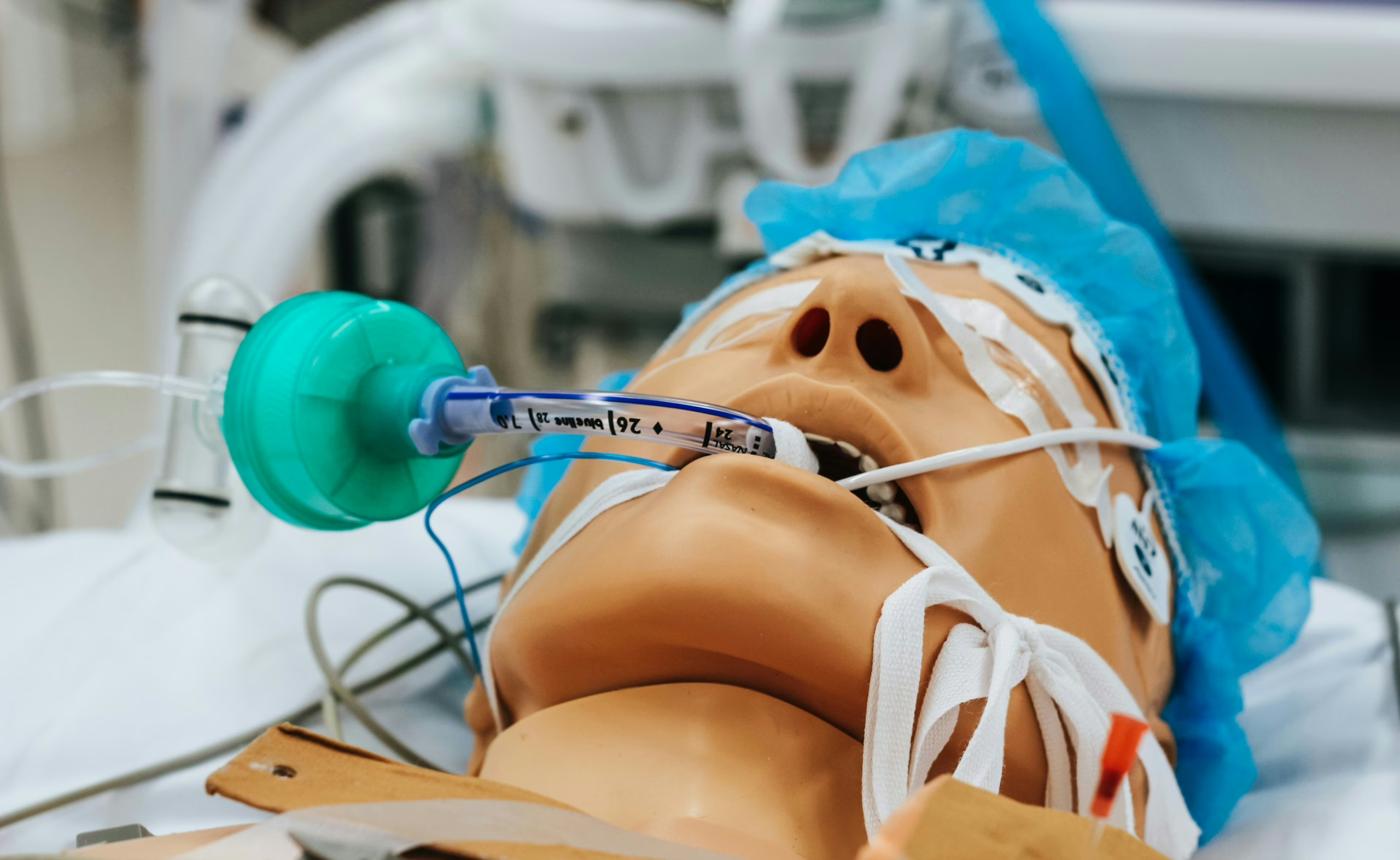
Medical Simulation and Skills Assessment
Immersive simulation offers a safe and repeatable environment for medical training. Eye tracking provides objective competency mapping by revealing how experts “see” a surgical field differently from trainees, focusing on critical anatomical structures while ignoring distractions. This data allows for targeted feedback loops, helping to reduce medical errors in high-pressure scenarios. By training the next generation of specialists with this technology, healthcare institutions can ensure higher standards of care and patient safety.
5) Propelling Research Forward with Ergoneers Prophea.X
Behavioral research software in the era of AI
The next era of research requires more than just hardware; it demands a seamless ecosystem that connects data capture, synchronization, and analysis. Experience this future with Prophea.X, the AI-powered platform designed to manage the complexity of modern behavioral studies. High-precision data from Dikablis eye-tracking systems provides the foundation, while Prophea.X delivers the insights. With a heritage of academic and industrial success documented in our Publication Hub, Ergoneers offers a partnership that extends beyond tools to include lab consulting and custom integration.
Prophea.X: Expanding Spheres of Insight
The “Unified equals easy” philosophy is the core of Prophea.X. It is one software platform for all your data, eliminating the silos that stall research. Its most powerful feature is AI-driven behavioral coding, which automates the tedious process of annotating events and behaviors, saving researchers hundreds of hours of manual work. Prophea.X allows you to visualize the entire research chain, from raw, synchronized sensor data to compelling, publication-ready metrics and reports, empowering you to discover deeper and more reliable insights.
Your Partner in Human-Centered Innovation
Building a state-of-the-art research lab is a complex undertaking. Ergoneers provides expert consulting services to help you design a bespoke behavioral research facility tailored to your specific goals. We offer comprehensive training and workshops to empower your team with the latest eye-tracking techniques and multimodal analysis methods. Take the next step in shaping a better, human-centered future. Join one of our free webinars or connect with our experts to start your journey.