

News & Posts
Mastering Custom Eye Tracking Integration
What if the greatest barrier to your next breakthrough isn't the volume of your data, but the silence between your sensors? Many researchers struggle with the fragmented reality of modern labs, where hardware from different vendors often refuses to speak the same language. You've likely felt the frustration of battling clock drift and synchronization errors that turn a promising study into a post-processing nightmare. This technical friction doesn't just waste time; it obscures the holistic view of human behavior you're striving to capture.
Mastering custom eye tracking integration allows you to collapse these silos and architect a seamless, high-precision research ecosystem. By leveraging these issues with a scalable multimodal analysis platform like Prophea.X you can transform disconnected inputs into a unified data stream for deeper behavioral analysis. This guide provides a visionary roadmap to help you navigate complex APIs and synchronize multimodal sensors with clinical precision. You'll learn how to build a future-proof infrastructure that reduces manual labor and expands the boundaries of scientific insight.
Key Takeaways
- Architect a transparent research ecosystem by transitioning from closed “black box” solutions to a high-precision custom eye tracking integration.
- Leverage high-performance APIs and platform-agnostic SDKs to capture raw gaze vectors and pupil diameter with clinical accuracy.
- Evaluate whether to build internally or partner with behavioral research lab consulting to ensure your infrastructure scales with your scientific ambitions.
- Implement a unified master clock protocol to eliminate clock drift and synchronize eyetrackers with your entire multimodal sensor array. Any other wearable can easily be connected using TCP/IP or UDP.
- Utilize Prophea.X as a visionary hub that employs AI-powered coding to synthesize complex data into actionable human-centric insights.

Table of Contents
- The Architecture of Insight: Why Custom Eye Tracking Integration Matters
- Technical Frameworks for Custom Eye Tracking APIs and SDKs
- Choosing Your Path: OEM Integration vs. Research Lab Consulting
- How-To: Implementing Multimodal Data Synchronization
- Prophea.X: The Visionary Hub for Integrated Behavioral Insights
The Architecture of Insight: Why Custom Eye Tracking Integration Matters
Architecting a research environment requires more than just connecting hardware; it demands a strategic alignment of data streams to reveal the hidden nuances of human behavior. For decades, researchers relied on “black box” solutions that offered convenience at the cost of transparency. Today, the shift toward open, integrated research ecosystems is non-negotiable. Custom eye tracking integration serves as the essential bridge between raw gaze data and holistic behavioral analysis, allowing you to move beyond simple point-of-regard metrics toward a comprehensive understanding of cognitive load and intent. By eliminating data silos, you prioritize the human element in technology interaction, ensuring that your tools adapt to people rather than the other way around. Relying on generic, non-customized integrations carries significant risks, such as uncompensated latency, critical data loss, and a total lack of environmental context that can render your findings obsolete.
Beyond Standard SDKs: The Visionary Approach
Standard plug-and-play solutions often collapse when introduced to the rigors of complex industrial environments. In sectors like automotive engineering or aerospace, a simple gaze overlay isn’t enough to ensure safety or optimize performance. These high-stakes fields require high-precision integration that can handle rapid head movements and varying light conditions without dropping a single frame. As we move through 2026, behavioral data synchronization has emerged as the gold standard for elite research. This approach treats eye tracking technology not as a standalone metric, but as one component of a synchronized symphony of sensors. Achieving this level of precision requires a deep understanding of hardware capabilities and the agility to customize software interfaces to meet specific experimental demands.
The Cost of Fragmentation in Behavioral Research
Fragmented data is the enemy of scientific progress. When your eye tracker, EEG, and heart rate monitors operate on independent clocks, you’re forced into a grueling cycle of manual data alignment during post-processing. This manual labor doesn’t just drain your resources; it introduces human error and creates “insight gaps” where the relationship between a visual stimulus and a physiological response becomes blurred. These gaps undermine the scientific reproducibility of your studies, making it difficult for peers to validate your results. Seamless integration ensures that every data point is timestamped with microsecond accuracy, providing a clear, uninterrupted view of the human experience. By investing in a unified infrastructure, you reduce the time from data collection to discovery, allowing your team to focus on innovation rather than troubleshooting technical friction.
© Unsplash
Technical Frameworks for Custom Eye Tracking APIs and SDKs
Construct a robust technical foundation by mastering the APIs that drive your research infrastructure. High-performance APIs provide the direct access required to extract raw gaze vectors and precise pupil diameter metrics, moving beyond the restricted outputs of standard consumer software. A successful custom eye tracking integration relies on these frameworks to bypass generic limitations and unlock the full potential of your hardware. Choose your transmission protocol based on your specific temporal needs; UDP offers the low-latency streaming essential for real-time gaze-contingent displays, while TCP provides the reliability required for exhaustive data logging where every packet is critical. This level of control empowers you to create custom event-triggering mechanisms, where a single glance can launch a specific simulation event or trigger a secondary physiological sensor. For a deeper dive into the landscape of these systems, consult this review of multimodal interaction technologies.
Leveraging Prophea.X for Centralized Data Management
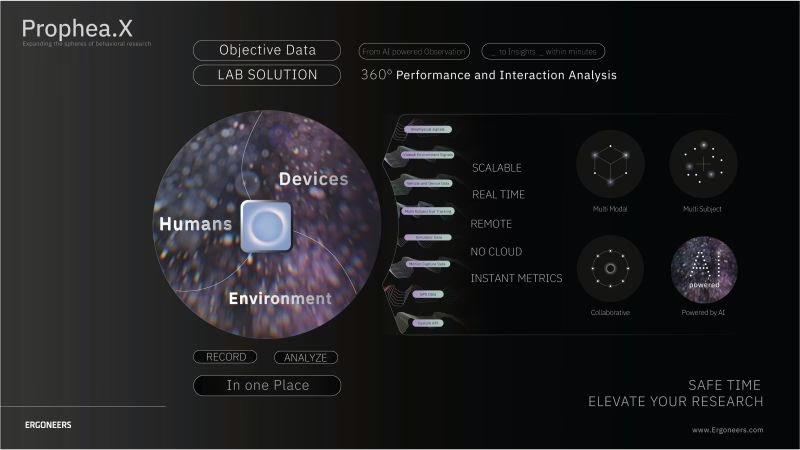
Prophea.X serves as the visionary computational engine of your behavioral research lab. It operates with an inherent agency, effortlessly synthesizing high-frequency data streams from multiple sources without performance degradation or lag. This software doesn’t just record data; it orchestrates the entire research workflow across different hardware sectors, ensuring that your analysis remains fluid and responsive. By acting as a centralized hub, it allows you to visualize complex human-technology interactions in real time. This capability is vital for researchers who need to monitor cognitive load or emotional state across diverse experimental paradigms. If you’re ready to architect a unified stream for your next study, speak with our integration specialists to explore the possibilities.
Hardware Compatibility: From Dikablis to Third-Party Sensors
Integrate professional eye tracking glasses like Dikablis Glasses X , Tobii Glasses III or respective hardware-developing kits into your central recording station to achieve unparalleled mobility and precision. Wearable trackers must maintain a persistent, low-latency handshake with external simulation environments to ensure the “error-free precision” promise that distinguishes elite research tools. This hardware-software synergy allows for the expansion of scientific knowledge in three-dimensional space, whether you’re working in a flight simulator or a physical retail environment. Connecting these devices requires a platform-agnostic approach, ensuring that your eyetracking data flows perfectly into Prophea.X alongside EEG, EMG, or skin conductance sensors. This comprehensive utility ensures that your research infrastructure remains future-proof and ready for the next phase of human-centric discovery.

Choosing Your Path: OEM Integration vs. Research Lab Consulting
Select your integration strategy based on the complexity of your scientific objectives and the required scale of your infrastructure. While a DIY API approach offers granular control for specialized software developers, it often leaves researchers stranded in a labyrinth of technical troubleshooting that detracts from their core mission. Custom eye tracking integration is not merely a software bridge; it’s a strategic partnership rooted in academic rigor and a legacy of excellence. When choosing a partner, prioritize those who demonstrate a humanistic understanding of the research process rather than those who simply sell hardware. Ergoneers stands as a visionary leader in this field, originating as a spin-off from the Technical University of Munich (TUM). This deep connection to scientific methodology ensures that every technical solution is built to withstand the scrutiny of peer review and the demands of high-stakes industrial applications.
The OEM Integration Model
Embed eye tracking technology directly into your finished products to create intuitive, human-centric interfaces. The OEM model is ideal for developers creating smart cockpits or advanced training simulators where the eye tracker must remain invisible to the user. This path involves navigating significant technical constraints, including minimal sensor footprints, restricted power consumption, and the need for near-zero latency. Long-term maintenance of these custom software stacks requires a dedicated commitment to compatibility as operating systems and hardware evolve. Successful OEM projects demand a partner who can provide a future-proof architecture that grows alongside your product lifecycle, ensuring your custom eye tracking integration remains a competitive advantage for years to come.
Expert-Led Lab Consulting and Custom Setups
Accelerate your study timelines by leveraging behavioral research lab consulting to bypass the trial-and-error phase of lab construction. This expert-led approach provides turnkey solutions that allow corporate R&D departments to scale their operations rapidly without sacrificing data quality. Tailored workshops bridge the gap between raw technical capability and sophisticated research execution, empowering your team to master the nuances of multimodal data collection. By outsourcing the architectural complexity to our specialists, you ensure that your lab or final product is equipped with a seamless hardware-software handshake from day one. This collaborative model transforms the vendor relationship into a vital partnership, focusing your resources on the expansion of human insights rather than the maintenance of device connectivity.
How-To: Implementing Multimodal Data Synchronization
Synchronizing disparate data streams requires clinical attention to detail and a visionary understanding of temporal dynamics. A successful custom eye tracking integration hinges on your ability to align every sensor to a single, unwavering temporal reference. Without this alignment, your research is vulnerable to clock drift that can decouple a visual fixation from a physiological response by several milliseconds. This technical friction obscures the true relationship between stimulus and reaction. Follow these five essential steps to architect a synchronized research environment:
- Define the Master Clock: Establish a unified time-sync protocol using Lab Streaming Layer (LSL) or Network Time Protocol (NTP). This serves as the rhythmic heartbeat of your entire lab.
- Hardware Interfacing: Connect your eye-tracking glasses to our central recording station PropheaData Engine, ensuring the hardware-software handshake is established with zero-latency protocols.
- Multi-Sensor Calibration: Align your gaze data with biometric triggers. This process ensures that when a participant fixates on a target, the corresponding spike in EEG or heart rate is captured at the exact same moment.
- Real-Time Verification: Continuously monitor data integrity and signal-to-noise ratios. Identifying a dropped packet during a trial allows for immediate correction rather than a failed post-processing session.
- Unified Export: Aggregate these synchronized data layers into Prophea.X. This visionary platform synthesizes the complexity into a single, navigable stream for holistic behavioral analysis.
Integrating EEG and Eye Tracking
Mastering the EEG and eye tracking integration requires a deep appreciation for the biological physics of the human body. When you align brain activity with visual attention, you’re essentially mapping the relationship between perception and cognition. This process is often complicated by ocular artifacts, where eye movements create electrical noise in the EEG signal. To ensure scientific reproducibility, implement a rigorous checklist for artifact rejection: identify blink-related spikes, apply baseline corrections, and validate every timestamp against your master clock. If your lab requires a bespoke configuration to handle these complex dynamics, consult with our technical architects to design your ideal setup.
Advanced Synchronization for Kinesiology (EMG)
Elevate your sports science or ergonomics research by synchronizing muscle activation with gaze intent. In high-performance environments, the delay between a visual stimulus and a physical reaction is measured in microseconds. Use TTL triggers to achieve sub-millisecond precision, ensuring that your EMG data points align perfectly with the onset of a gaze fixation. Prophea.X provides the visual clarity needed to see how physical performance fluctuates based on visual search patterns. This three-dimensional view of human movement allows you to identify the specific visual cues that drive peak athletic performance or reduce industrial fatigue. By mastering these connections, you don’t just collect data; you empower the next generation of human-technology interaction.
Prophea.X: The Visionary Hub for Integrated Behavioral Insights
Prophea.X is more than a data repository; it is a vital partner in the evolution of modern industry. It possesses the agency to operate across different sectors, expanding its influence from the clinical laboratory to the high-pressure environments of industrial training. By facilitating a sophisticated custom eye tracking integration, Prophea.X transforms raw, three-dimensional gaze data into a legacy of scientific excellence. This platform allows you to prioritize the human element, ensuring that every technological advancement is grounded in a deep understanding of user needs. We are entering an era where AI-assisted behavioral coding automates the identification of cognitive patterns. This shift allows researchers to focus on the expansion of human insights rather than manual data tagging, igniting a palpable sense of excitement for the future of behavioral science.
Scalable Analysis for Global Research Teams
Standardize your research protocols across worldwide locations to ensure absolute scientific reproducibility. Prophea.X provides the collaborative infrastructure necessary for distributed research labs to synchronize their efforts without technical friction. This centralized hub offers global teams a unified view of complex datasets, fostering a communal invitation to solve the most pressing challenges in human-machine interaction. You can operate with quiet confidence, knowing that professional-grade reliability and rigorous data security protocols protect your intellectual property. This scalability ensures that your research infrastructure remains future-proof as your organization expands its geographic and scientific reach. By unifying your methodology, you create a professional scale that bridges the gap between local discovery and global impact.
Your Next Step in the Behavioral Revolution
Move beyond theoretical academic contexts and embrace the practical implementation of high-precision research tools. The transition from a fragmented lab to an integrated ecosystem requires both the right technology and the expertise to wield it effectively. Our expert-led training and workshops empower your team to master the nuances of multimodal data collection and analysis. This collaborative journey ensures that your custom eye tracking integration delivers the actionable insights required to improve the relationship between people and technology. Our legacy of excellence is built on long-standing relationships with industry leaders who prioritize human-centric design. Explore how Prophea.X can transform your custom integration strategy and join the vanguard of the behavioral revolution.
Architecting the Future of Behavioral Insight
The transition from fragmented data collection to a unified research ecosystem represents the next phase of scientific discovery. By mastering custom eye tracking integration, you move beyond the limitations of standard hardware to capture a holistic view of the human experience. You’ve seen how establishing a master clock and leveraging platform-agnostic SDKs eliminate technical friction; this allows brain activity and muscle intent to align with visual attention in perfect synchronization.
Our legacy of excellence began in 2005 as a spin-off from the Technical University of Munich (TUM). Since then, we’ve partnered with visionary researchers to deploy Prophea.X in high-stakes environments worldwide. We don’t just provide tools; we offer a strategic partnership rooted in academic rigor and a commitment to prioritizing the human element in technology. Whether you’re optimizing a smart cockpit or conducting complex studies, our team is ready to support your evolution. Partner with our Visionary Experts for your custom integration project and begin your journey toward error-free precision today. Get inspired by the latest studies published using Ergoneers equipment–The boundaries of what you can discover are expanding; it’s time to lead the revolution.
Frequently Asked Questions
An API provides the specific protocols and endpoints required for two software components to communicate, while an SDK is a comprehensive development kit that includes those APIs alongside libraries, documentation, and sample code. Utilizing an SDK simplifies the process of custom eye tracking integration by providing a pre-built framework for developers. This allows for faster implementation of complex features like raw gaze vector extraction and pupil diameter monitoring.
Achieve sub-millisecond precision by implementing hardware-based TTL triggers or utilizing a high-performance master clock via Lab Streaming Layer. These methods ensure that every brain wave and gaze fixation is timestamped to the same reference point, effectively eliminating clock drift. Establishing a dedicated hardware handshake between your Dikablis Glasses and the EEG amplifier is essential to maintain this clinical level of accuracy throughout your trial.
Yes, our hardware and software are designed with an open architecture that supports seamless integration with proprietary software environments. We provide the necessary APIs and technical documentation to allow your custom applications to control and receive data either from Dikablis hardware or from Prophea.X and connected sensors such as Tobii eye-tracking glasses, screen-based eye trackers, cameras, simulators, and other biometric wearables. This flexibility ensures that our tools can operate as a vital component within your unique research infrastructure, adapting to your specific computational needs and experimental demands.
Latency issues typically arise from network jitter, software buffer delays, or the choice of transmission protocol. Using TCP for real-time gaze streaming can introduce lag due to its error-correction overhead; switching to UDP often resolves these bottlenecks by prioritizing speed. Additionally, non-optimized data processing pipelines in the host software can cause cumulative delays that obscure the temporal relationship between a visual stimulus and a behavioral response.
Prophea.X operates as a high-performance computational engine that fully supports real-time data streaming from multiple sensors simultaneously. It allows researchers to visualize and analyze gaze patterns, physiological responses, and environmental context as they occur. This live capability is crucial for adaptive simulations or industrial training environments where immediate feedback or intervention is required based on the participant’s current cognitive state.
While basic programming proficiency in languages like Python or C++ is required to work directly with APIs, we offer several ways to reduce this complexity. Our behavioral research lab consulting and specialized training workshops provide the expert guidance needed to architect your system without requiring deep software engineering expertise. These resources bridge the gap between technical capability and research execution, ensuring your lab remains agile and innovative.
Lab Streaming Layer serves as a unified time-sync protocol that allows different hardware devices to share a common temporal reference. It acts as the rhythmic heartbeat of a multimodal lab, handling the synchronization and data collection across various sensor types. By using LSL, you can integrate eye tracking data with EEG, EMG, and other biosensors into a single, cohesive stream for holistic behavioral analysis and scientific reproducibility.
Yes, we provide expert behavioral research lab consulting to help you design and implement sophisticated experimental paradigms. Our team leverages a legacy of excellence to assist with lab construction, sensor selection, and the strategic alignment of your data streams. This collaborative approach ensures that your custom eye tracking integration is optimized for the expansion of human insights within your specific industry or academic context.