

News & Posts
How to Integrate EEG and Eye-Tracking
© Ergoneers
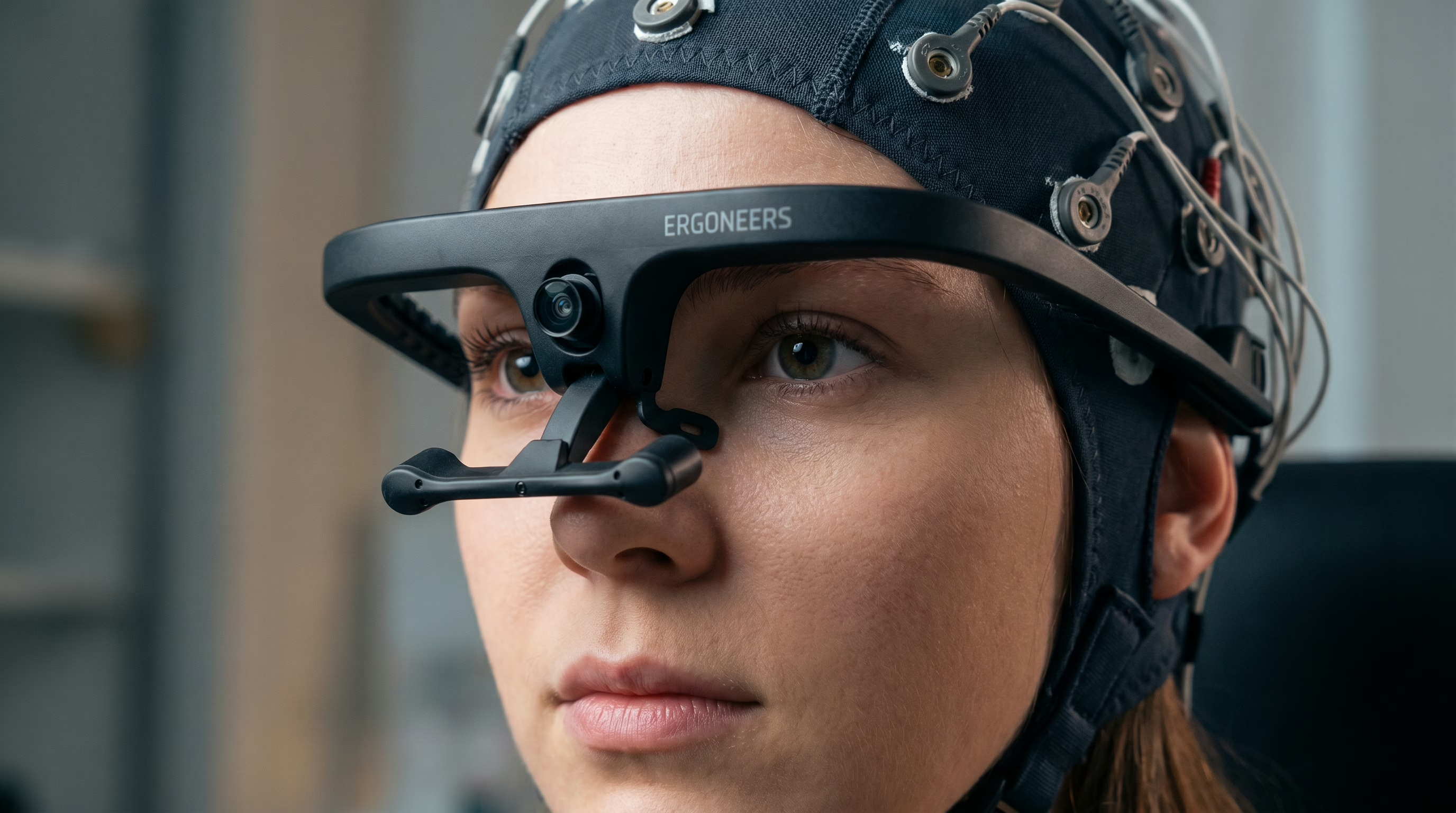
To observe where a person looks is to witness their intent, but to synchronize that gaze with neural activity is to map the very architecture of human thought. You understand that the true frontier of behavioral science lies in the space between visual attention and cognitive response. As the scientific application of eye-tracking intensifies, the demand for sophisticated EEG and eye-tracking integration follows along. Yet, you've likely spent far too many hours correcting for clock drift or manually aligning fragmented data streams that should've been unified from the start.
We believe your focus belongs on the expansion of human insights, not the mechanics of troubleshooting. This guide demonstrates how to bridge the gap between brain dynamics and ocular metrics to create a seamless, error-free workflow. You'll discover how Prophea.X empower you to analyze Fixation-Related Potentials (FRPs) with clinical precision. We'll show you how to transform raw data into a visionary cognitive map that defines the next phase of your research legacy.
Key Takeaways
-
Align temporal and spatial data streams to move beyond isolated metrics toward a truly multimodal understanding of the human element.
-
Discover how EEG and Eye-tracking integration facilitates automated ocular artifact rejection, allowing for cleaner neural signals and more reliable data interpretation.
-
Protect the integrity of your research by addressing the critical challenge of clock drift through high-precision, sub-millisecond synchronization markers.
-
Bridge the gap between theoretical neuroscience and practical industrial applications like automotive HMI to measure real-world cognitive workload and distraction.
-
Elevate your lab’s capabilities using Prophea.X to transform fragmented software workflows into a unified, future-ready research ecosystem.
Table of Contents
The Convergence of Gaze and Brain Dynamics: Defining Multimodal Research
Decoding the Cognitive Load: How EEG and Eye-Tracking Work Together
Overcoming the Synchronization Barrier: Markers, Clocks, and Drift
From Lab to Industry: Multimodal Research in Human-Machine Interaction
Future-Proofing Your Research with Integrated Multimodal Platforms
Master the Cognitive Map of the Future
The Convergence of Gaze and Brain Dynamics: Defining Multimodal Research
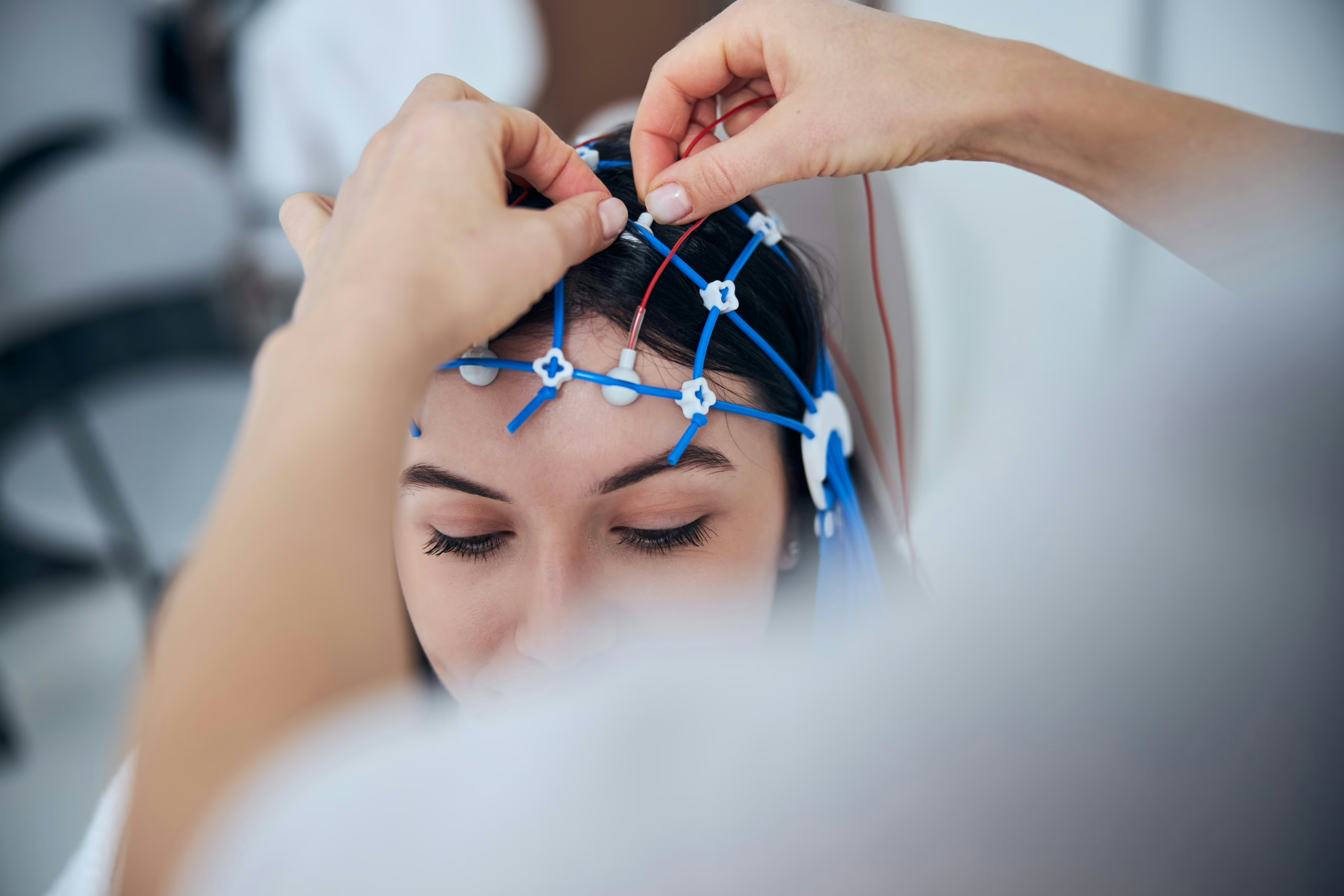
True multimodal research aligns neurophysiological and oculomotor data precisely in time and space. When we discuss EEG and eye tracking integration, we build a high-fidelity cognitive map. In this framework, gaze provides context while EEG reveals internal states. This synergy helps researchers move beyond simple artifact removal to proactive behavioral insights, making the mind’s mechanics visible and actionable.
As we approach 2026, human-technology interaction’s complexity demands more than isolated metrics. High-end research now requires a holistic view of how individuals process information in real time. By linking visual attention’s “where” to neural firing’s “how,” you can decode mental workload, emotional engagement, and decision-making nuances. This integrated approach collects data and establishes scientific authority by grounding observations in biological physics.
Beyond Single-Sensor Limitations
Relying on a single sensor creates gaps in understanding human behavior. Eye tracking identifies what stimulus captures attention but doesn’t reveal cognitive load. Conversely, EEG provides neural data but lacks spatial context for activity spikes. Fixation-Related Potentials (fERPs) solve this issue. By time-locking EEG signals to eye fixation onset, you can isolate brain responses to visual elements with sub-millisecond precision.
The Human-Centered Research Revolution
This revolution aims to see through biological noise to reach the human experience’s core. High-precision hardware and Prophea.X‘s software architecture distinguishes meaningful neural signals from ocular artifacts. Multimodal integration bridges overt behavior and covert cognition, revealing the internal dialogue between a person and their environment. This shift empowers you to lead technological revolutions by prioritizing the human element in experimental design. Through this lens, research becomes empowering, transforming complex analysis into profound, human-centric growth.
© Getty Images
Decoding the Cognitive Load: How EEG and Eye Tracking Work Together
The biological synergy between visual attention and neural firing represents a sophisticated feedback loop that defines our interaction with the world. To capture this dialogue with clinical precision, researchers must prioritize high-frequency sampling. Utilizing a rate of 500Hz or higher for both sensors ensures that the rapid transition from saccade to fixation is perfectly mirrored in the neurophysiological record. This level of granularity is essential for EEG and eye-tracking integration, as it allows you to observe the exact moment a visual stimulus triggers a cognitive response.
A primary technical advantage of this dual-stream approach is the automated rejection of ocular artifacts. Traditionally, eye movements and blinks create significant noise in EEG signals, often obscuring the very data you seek to analyze. By using high-fidelity eye tracking data as a reference, sophisticated software can isolate and remove these biological distortions without compromising the integrity of the underlying brain activity. This proactive cleaning transforms raw signals into actionable insights, moving your workflow from reactive troubleshooting toward visionary analysis.
Beyond cleaning data
The multimodal integration of gaze and mental monitoring enables gaze-contingent paradigms. In these advanced study designs, the participant’s real-time brain state or gaze location triggers immediate changes in the visual stimuli. This creates a dynamic, interactive research environment that more closely mimics real-world human-machine interaction. The evolution of EEg and Eye-tracking integration has moved beyond simple observation to become an active partner in experimental design. If you’re looking to implement these complex protocols in your own lab, exploring Prophea.X can provide the robust software foundation needed for such high-level synchronization.
Understanding Fixation-Related Potentials (fERPs)
Fixation-Related Potentials (fERPs) represent a breakthrough in ecological validity. Unlike traditional Event-Related Potentials (ERPs) that require participants to stare at static screens while waiting for a trigger, fERPs are time-locked to the natural onset of a gaze fixation. This allows for research in free-viewing conditions, where participants interact naturally with their environment. Capturing these micro-events requires microsecond-accurate synchronization, ensuring the neural epoch aligns perfectly with the oculomotor event to reveal the brain’s immediate processing of visual information.
Mapping Mental Workload and Fatigue
Multimodal data provides a dual-validation system that significantly reduces the uncertainty principle in behavioral observation. By monitoring pupil dilation alongside alpha-wave suppression, you can accurately map mental workload and fatigue. This combination is particularly effective at identifying “inattentional blindness.” You might observe a participant’s gaze land directly on a critical target while their EEG data shows no corresponding neural processing. This discrepancy reveals the hidden gaps in human attention, providing a deeper understanding of cognitive stress and performance limits in high-stakes environments.

© unsplash
Overcoming the Synchronization Barrier: Markers, Clocks, and Drift
The greatest obstacle to successful EEG and Eye-Tracking integration isn’t the data itself but the invisible friction of temporal alignment. Many researchers treat synchronization as a post-hoc problem, attempting to stitch together two independent data streams after the experiment concludes. This reactive approach is fraught with risk. Because brain activity and eye movements operate on different physiological timescales, even a single millisecond of error can invalidate your results. This phenomenon, known as clock drift, occurs when the internal oscillators of two different devices fall out of step over time. To maintain scientific authority, you must move toward a proactive synchronization strategy that anchors your data in a single, unified timeline.
Modern integration workflows rely on a sophisticated hierarchy of synchronization methods. While manual markers were once the standard, the visionary researcher now utilizes automated hardware triggers and robust APIs to ensure error-free precision. By leveraging SDKs, you can create a direct communication channel between your EEG amplifier and eye-tracking hardware, allowing for the expansion of human insights without the distraction of technical debt. This level of connectivity transforms your lab from a collection of tools into a high-performance research ecosystem. It empowers you to focus on the human element while the hardware maintains the clinical precision your work demands.
The 5 Step-Attempt to Seamless Data Synchronization
- Step 1: Establish a common time server or master clock to act as the single source of truth for all connected devices.
- Step 2: Implement hardware-level TTL (Transistor-Transistor Logic) triggers to provide sub-millisecond accuracy for event onset.
- Step 3: Utilize software markers via TCP/IP protocols to label complex behavioral events in real time.
- Step 4: Perform real-time validation of signal alignment during data acquisition to catch synchronization errors before they corrupt the dataset.
- Step 5: Apply post-hoc jitter correction and drift compensation algorithms to ensure the longitudinal integrity of the data.

© Ergoneers
The 1-Step Solution to Seamless Data Synchronization: Prophea.X
Prophea.X enables seamless real time synchronisation across any sensor setup relevant in behavior analysis. Internal timecoding with millisecond precision and scalable remote triggering from paired EEG & Eyetracking sessions to multi-subject and simulator integrations while providing full freedom of multi-modal capacities. Explore more capabilities of Prophea.X
Hardware vs. Software Integration Strategies
Choosing the right integration strategy depends on the specific demands of your study environment. In high-density EEG setups, utilizing analog outputs for direct input into the EEG amplifier remains a gold standard for hardware-level precision. However, as research moves into more advanced settings, the advantages of behavioral research software become undeniable. Prophea.X, provides the agency to manage both hardware triggers and software markers within a single interface. Synchronization is the heartbeat of multimodal validity. Without it, the cognitive map you’re building lacks the foundational accuracy required to lead technological revolutions.
From Lab to Industry: Multimodal Research in Human-Machine Interaction
Transition from the controlled environment of the laboratory to the dynamic complexity of industrial applications to realize the full potential of your work. This is where EEG and eye-tracking integration proves its transformative value. By moving beyond theoretical neuroscience, you can apply these tools to solve real-world challenges in Human-Machine Interaction (HMI). This shift allows you to lead technological revolutions by prioritizing the human element in environments where performance and safety are non-negotiable. Whether you are refining an interface or assessing operator readiness, multimodal data provides the clinical precision required to make informed, visionary decisions.
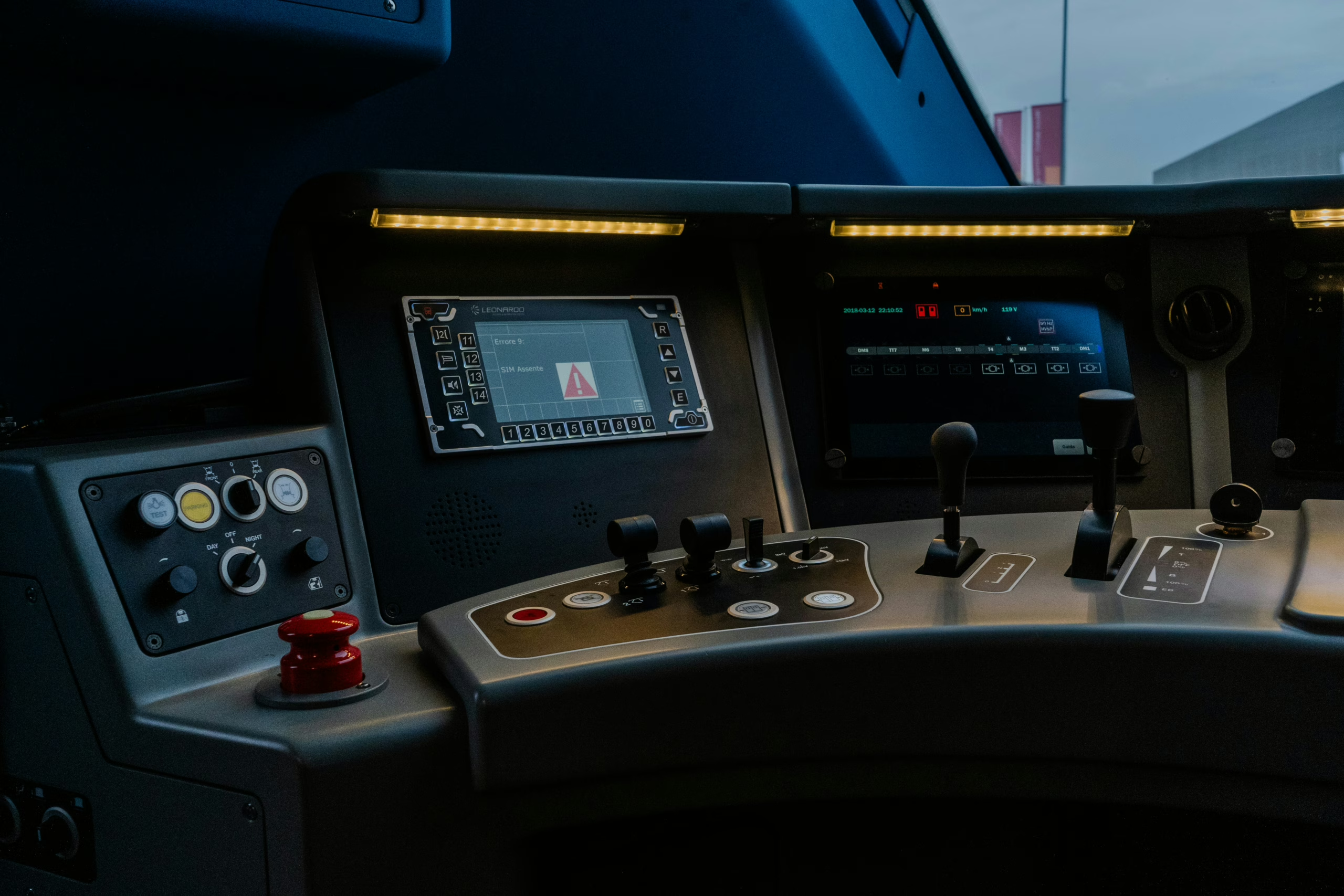
In automotive research, analyzing driver distraction requires more than just tracking where a driver’s gaze falls. You must verify if they are cognitively present or experiencing inattentional blindness. By combining gaze data with EEG-verified cognitive load, researchers can identify moments when a driver “sees” a hazard but fails to process it. Similarly, in aviation, optimizing cockpit design hinges on understanding pilot gaze patterns alongside their physiological stress levels. This ensures that critical flight information is not only visible but also processable during high-stress maneuvers, establishing a legacy of safety and excellence in design.
Industrial training programs also benefit from this dual perspective. By assessing the neural patterns of experts versus novices during complex task execution, organizations can quantify the elusive “flow state.” This allows for the creation of training protocols that move beyond simple repetition, focusing instead on the expansion of human insights and the acceleration of skill acquisition. It’s a professional scale of utility that empowers your team to reach peak performance faster and with greater reliability. Explore how our Eye Tracking Integration services can tailor these capabilities to your specific industrial requirements.
Optimizing the User Experience (UX)
Move beyond the surface-level metrics of clicks and heatmaps to understand what a user truly feels during digital interaction. By linking gaze dwell time with theta-wave activity, you can identify the exact moment a user transitions from curiosity to frustration. Mobile eye tracking, specifically when utilizing eye-tracking glasses like Tobii Glasses III or Dikablis Glasses, allows you to take these insights into real-world retail or manufacturing environments without loosing precision. This approach captures the human element in its natural habitat, revealing the hidden friction points in any user journey.
Safety-Critical Environments
In safety-critical environments like power plant control rooms or air traffic control centers, monitoring situational awareness is a matter of operational integrity. Detecting “neural fatigue” through integrated sensors allows you to predict human error before it manifests as a physical mistake. Prophea.X provides the agency to operate across these high-stakes sectors, offering a unified framework for data acquisition. For specialized industrial hardware, custom integration services ensure that your lab infrastructure remains future-proof and ready for the next phase of behavioral research.
© unsplash
Future-Proofing Your Research with Integrated Multimodal Platforms
The future of behavioral science belongs to those who synthesize data into a coherent narrative of human intent. As we look toward the horizon of 2026, the integration of artificial intelligence and machine learning is revolutionizing how we handle multimodal datasets. Automated data coding and AI-assisted artifact rejection are no longer theoretical luxuries; they’re the standard for high-performance labs. This evolution demands a shift toward “Open Research” principles, where hardware-agnostic software compatibility ensures your EEG and eye-tracking integration remains as agile as your hypotheses. By prioritizing the human element, you can move beyond the three-dimensional limits of current methodologies to expand the boundaries of scientific knowledge.
Prophea.X personifies the agency required to navigate these complex research environments. It serves as the vital partner in your lab’s evolution, connecting advanced computational analysis to the expansion of human insights. This software doesn’t just process data; it acts as an intellectual leader within your workflow, ensuring that every technical capability translates directly into a high-level benefit. By adopting a platform that values error-free precision, you distinguish your work in a field often defined by technical friction. This forward-thinking energy is what transforms a standard study into a legacy of excellence.
The Prophea.X Advantage
Prophea.X provides a sophisticated bridge between neurophysiological states and oculomotor behavior. It allows you to operate across different sectors, from academic neuroscience to industrial training, with quiet confidence and clinical precision. The platform’s ability to unify disparate hardware ensures that your focus remains on the visionary aspects of your research rather than the mechanics of connectivity.
- Seamless synchronization of Dikablis eye tracking with leading EEG systems.
- Unified data visualization for real-time behavioral insights and immediate hypothesis testing.
- Reducing time-to-insight through automated analysis workflows that leverage modern AI capabilities.
Building Your Legacy Lab
Establishing a permanent footprint in the evolution of behavioral science requires a foundation of precision and visionary planning. Our Behavioral Research Lab Consulting services provide the expertise needed to design spaces where technology and human needs converge perfectly. We don’t just sell tools; we position ourselves as your partner in the next phase of human-technology interaction. Through our specialized Training and Workshops, your team gains the mastery needed to handle complex data processing and biological physics with professional scale. This collaborative approach ensures your lab infrastructure is not only highly functional but also future-proof.
Discover how Ergoneers can elevate your research with custom integration and join the vanguard of researchers who are redefining the relationship between people and technology.
Master the Cognitive Map of the Future
Achieving excellence in modern research requires more than just high-fidelity sensors; it demands the seamless synchronization of intent and action. By mastering EEG and eye-tracking integration, you move beyond the limitations of single-sensor data to build a comprehensive cognitive map of the human experience. You’ve seen how overcoming clock drift and leveraging fixation-related potentials can transform raw biological noise into a legacy of profound insight. This journey from the lab to safety-critical industrial environments ensures that every technological advancement remains rooted in human needs.
As a TUM spin-off with over 20 years of academic rigor, Ergoneers stands as a vital partner in your scientific evolution. Prophea.X has the agency to operate across complex sectors as the world’s most advanced multimodal analysis platform; it’s already trusted by global leaders in automotive, aviation, and neuroscience. We empower you to lead the next phase of behavioral research with quiet confidence and clinical precision. Explore our Custom Eye Tracking Integration Services to begin building your lab’s legacy today. The boundaries of scientific knowledge are yours to expand.

Frequently Asked Questions
Synchronization requires sub-millisecond precision to ensure neural epochs align perfectly with oculomotor events. Even a 1ms deviation can distort the analysis of Fixation-Related Potentials or lead to the misinterpretation of cognitive load. High-fidelity research demands hardware that anchors both data streams to a single, unified timeline to maintain scientific authority and prevent data corruption.
You can utilize mobile eye-tracking glasses like Dikablis Glasses for studies conducted in naturalistic, real-world environments. Pairing these with wireless, lightweight EEG systems from Emotiv or Neuroelectrics allows for the expansion of human insights in settings such as manufacturing floors or retail spaces. This approach significantly increases the ecological validity of your research by capturing behavior outside the traditional laboratory framework.
Blinks, saccades, and vertical eye movements are the most frequent ocular artifacts that obscure neural data. Sophisticated EEG and eye-tracking integration uses gaze data as a precise reference signal to isolate and remove these biological distortions through automated algorithms. This process ensures that the resulting EEG signal represents pure cognitive activity rather than oculomotor muscle movement.
Integrating EEG with VR-based eye tracking is highly effective for studying cognitive load and situational awareness in immersive simulations. Modern VR headsets equipped with internal trackers can be synchronized with EEG amplifiers using software platforms like Prophea.X. This setup allows you to observe how users process complex information while interacting with three-dimensional digital environments in real time.
D-Lab and Prophea.X represent the most advanced commercial software solutions for analyzing combined multimodal data streams. While open-source toolboxes like EEGLAB version 2026.0 or MNE-Python version 1.12.1 offer powerful analysis capabilities for experienced programmers, our integrated platforms provide the agency to manage synchronization and visualization within a single, unified, and error-free workflow.
No. You typically needed a dedicated synchronization interface or hardware that supports TTL triggers to achieve clinical precision. Prophea.X replaces these devices, as it acts as the vital bridge between your sensors, ensuring that every marker is recorded simultaneously across both systems.
Manage clock drift by establishing a master clock or utilizing periodic synchronization markers throughout the recording session. Software like Prophea.X features a milisecond precision master clock across all connected channels and ensures loss & drift-less recording through sensor-near data processing.
TTL triggers provide hardware-level synchronization by sending electrical pulses between devices at the exact moment an event occurs. This method bypasses software latency to deliver the sub-millisecond accuracy required for time-locking neural responses to specific visual fixations. It’s the gold standard for maintaining the error-free precision required to lead technological revolutions in human-centered research.