

News & Posts
EMG Integration with Eye Tracking: A Visionary Guide to Multimodal Research
What if you could eliminate the invisible barrier between a subject's cognitive intent and their physical execution with absolute, millisecond-level precision? You've likely felt the frustration of managing data drift between sensors or the physical interference caused by a web of complex cabling that disrupts natural behavior. These fragmented workflows often obscure the very insights you're trying to uncover, leaving your research trapped in a cycle of manual alignment. This guide empowers you to master emg integration with eye tracking to achieve millisecond-accurate data synchronization within a unified software environment. We'll explore how the Prophea.X platform and Dikablis Glasses transform complex biological signals into actionable insights that define the future of human-technology interaction. You'll learn to navigate the expanding boundaries of multimodal research, ensuring your lab remains at the forefront of scientific authority while meeting the rigorous transparency standards of the 2026 EU AI Act. Prepare to move beyond simple sensor connection and embrace a state of true data fusion that prioritizes the human element.
Key Takeaways
- Decode the “Intent-Action” loop to understand how visual attention triggers and guides physical muscle activation in real time.
- Achieve millisecond-perfect emg integration with eye tracking by aligning high-precision sensors within a unified software environment.
- Execute a flawless research protocol by mastering calibration techniques and identifying target muscle groups for maximum data integrity.
- Move beyond simple visual inspection to perform advanced quantitative correlation analysis between gaze heatmaps and EMG amplitude levels.
- Leverage the Prophea.X framework and Dikablis Glasses to establish a scalable, future-proof behavioral research lab focused on human needs.
Key Takeaways
- Synchronising Intent and Action: The Strategic Value of EMG and Eye Tracking Integration
- The Technical Ecosystem: Essential Hardware and Software for Multimodal Success
- Implementation Guide: Executing a Flawless EMG and Eye Tracking Integration
- Advanced Analytics: Deciphering the Relationship Between Gaze and Muscle Activation
- Prophea.X and Dikablis: A Visionary Framework for Future-Proof Research
“`
Synchronising Intent and Action: The Strategic Value of EMG and Eye Tracking Integration
Visualize a research environment where the boundaries between thought and motion dissolve into a single stream of high-fidelity data. As we move through 2026, the focus of human performance monitoring has shifted toward a more organic, holistic understanding of the subject. This transformation relies on the sophisticated emg integration with eye tracking, a unified methodology that treats the human body as an interconnected system rather than a collection of parts. By fusing Electromyography with eye tracking technology, you establish a precise timeline of the “Intent-Action” loop. This cycle demonstrates how gaze precedes and guides physical muscle activation, allowing you to identify the exact millisecond a cognitive decision manifests as physical effort. This level of precision is no longer a luxury; it’s the foundation of modern behavioral science.
Bridging the Cognitive-Motor Gap
Analyze the visual anchors that dictate motor response to bridge the gap between mental processing and physical output. In demanding fields such as elite athletics or robotic-assisted surgery, “pre-motor gaze” is the silent conductor of performance. Gaze data reveals the underlying intent, showing how the brain prioritizes information before commanding the musculoskeletal system to act. The cognitive-motor link serves as the fundamental architecture of modern kinesiology, bridging the gap between mental preparation and physical execution. This insight empowers researchers to optimize training protocols by focusing on the visual triggers that lead to more efficient, less fatiguing movements. It transforms our understanding of “muscle memory” into a quantifiable, visual-motor process.
Beyond Single-Sensor Limitations
Acknowledge the inherent limitations of single-sensor studies to appreciate the necessity of a multimodal approach. Eye tracking provides a detailed record of visual attention, but it cannot measure the metabolic cost or physical strain required to maintain that focus. Similarly, EMG sensors capture the intensity of muscle recruitment without explaining the external stimuli that prompted the action. Multimodal research has emerged as the global industry standard, offering a three-dimensional perspective on human behavior. This emg integration with eye tracking eliminates the friction of fragmented workflows. It positions your lab as a vital partner in the evolution of human-technology interaction by grounding technical data in its practical, human impact. By adopting this integrated framework, you ensure that every research finding contributes to a legacy of human-centric excellence.
The Technical Ecosystem: Essential Hardware and Software for Multimodal Success
High-Frequency Data Acquisition Requirements
Data density varies significantly across different physiological streams. While eye tracking typically operates between 60Hz and 200Hz, EMG sensors demand much higher frequencies to record rapid motor unit firings. Managing this discrepancy is a core challenge for any researcher. You’ll need advanced behavioral research software to downsample or interpolate these streams during analysis without losing the critical nuances of the “Intent-Action” loop. This software acts as a central data hub, preventing the sensor drift that often plagues multi-device setups. It ensures that a blink and a muscle twitch are recorded with the same temporal context, providing a clear window into the subject’s physical effort.
The Software Bridge: Integration via API and TTL
Synchronizing these disparate data streams requires a robust technical bridge that eliminates manual alignment errors. The industry has evolved beyond simple manual triggers toward “Zero-Latency” wireless sync. You can choose between hardware-based TTL (Transistor-Transistor Logic) triggers for absolute signal precision or software-based API synchronization for greater flexibility in dynamic, real-world environments. A unified timestamp for every data packet is non-negotiable. Without it, your analysis of emg integration with eye tracking will suffer from temporal misalignment, rendering your insights into cognitive-motor performance unreliable. If you’re looking to upgrade your lab’s technical capabilities, speak with our technical consultants to explore tailored integration solutions that fit your specific research goals.
Implementation Guide: Executing a Flawless EMG and Eye Tracking Integration
Constructing a reliable workflow is the bridge between theoretical design and empirical success. To achieve a flawless emg integration with eye tracking, you must follow a rigorous sequence that prioritizes data integrity and subject comfort. Begin by defining your research protocol and identifying the specific target muscle groups relevant to your study, such as the forearm extensors for manual dexterity tasks or the masseter for cognitive load assessments. Calibrate the eye tracking system within the subject’s specific field of view, ensuring the gaze vector is pinned accurately to the interaction zone. Establish a master clock or a high-precision trigger signal to serve as the temporal anchor for all data packets. Before full-scale recording, validate the data stream using a “known event” test, such as a synchronized physical strike that appears simultaneously in the video feed and the EMG amplitude. Finally, record and monitor signal-to-noise ratios in real-time to prevent environmental interference from compromising your findings.
Optimising Sensor Placement and Ergonomics
Synchronisation Validation Techniques
Think of synchronization validation as the “clapperboard” of the behavioral lab. You need a sharp, identifiable physical movement to mark all data streams simultaneously, providing a manual check against the automated systems. While automated drift correction algorithms available in 2026 have significantly reduced temporal misalignment, manual validation remains the gold standard for high-stakes research. Precision is the only currency that matters here. A synchronization error of just 5ms can completely invalidate a human factors study by misrepresenting the causal link between visual attention and motor response. This level of accuracy allows you to confidently map the millisecond-by-millisecond relationship between what a subject sees and how their body reacts, turning raw signals into a coherent narrative of human performance.
Advanced Analytics: Deciphering the Relationship Between Gaze and Muscle Activation
Elevate your research from simple visual observation to a state of deep statistical correlation. While video overlays provide a helpful narrative, true scientific authority stems from the clinical precision of quantitative analysis. Advanced emg integration with eye tracking enables you to triangulate gaze fixations directly with muscular recruitment levels, creating a three-dimensional map of human effort. By overlaying visual heatmaps with EMG amplitude peaks, you can pinpoint “High-Effort” visual zones where high cognitive load meets intense physical strain. This data fusion reveals whether a subject is scanning an interface with ease or struggling to execute a motor command. Use gaze fixations as temporal triggers to segment your EMG data automatically. This precision allows you to isolate the exact muscle activation patterns associated with specific visual stimuli, removing the noise of unrelated movements.
Kinesiology and Sports Science Applications
Achieve peak athletic performance by analyzing the “Quiet Eye” period. This critical window of visual stillness immediately precedes successful motor execution. By tracking how these periods correlate with muscle efficiency, you can train athletes to synchronize their focus for maximum output with minimal fatigue. Monitor the degradation of gaze stability alongside shifts in EMG median frequency to detect the earliest onset of physical exhaustion. This holistic approach to optimising human machine interaction studies ensures that your training protocols are grounded in biological reality rather than subjective feedback. It transforms the way we understand the transition from visual preparation to physical action.
HMI and Ergonomics: Reducing Physical Load
Transform the design of cockpits and industrial workstations by identifying the hidden physical cost of visual searches. Unnecessary muscle tension often occurs when a user struggles to locate a critical interface element. By fusing gaze and EMG data, you can determine the exact cognitive-motor cost of navigating complex systems. This insight drives the development of predictive user interfaces that adapt to a user’s intent before they even reach for a control. Implementing a robust emg integration with eye tracking strategy ensures that your designs prioritize the human element by reducing both mental and physical friction. AI-driven pattern detection now operates across these multimodal datasets, identifying subtle correlations that manual inspection might overlook. To see how these analytics can empower your specific research goals, contact Ergoneers to discuss your multimodal analysis requirements.
Prophea.X and Dikablis: A Visionary Framework for Future-Proof Research
Transform your research laboratory from a collection of disconnected devices into a unified, intelligent ecosystem. In 2026, the complexity of emg integration with eye tracking demands more than just hardware; it requires a solution that bridges the gap between raw biological signals and meaningful behavioral insights. Ergoneers has evolved its ecosystem from a set of high-end tools into a comprehensive framework for discovery. This shift ensures that your focus remains on the expansion of human knowledge rather than the friction of technical troubleshooting. By adopting the “Plug-and-Play” philosophy of our integration services, you secure a future-proof foundation that scales with the growing demands of academia and industry. We treat every integration as a geometric expansion of your lab’s capabilities, pushing the boundaries of what is possible in human-technology interaction.
The Prophea.X Advantage in 2026
Prophea.X possesses the digital agency to command your entire multimodal workflow, acting as the central intelligence for data fusion. It offers automated synchronization features that recognize and align external EMG hardware with millisecond precision, effectively eliminating the risk of temporal drift that often complicates long-form studies. You can visualize muscle activity overlaid directly onto gaze video in real-time, providing immediate feedback during complex trials. This unified data stream approach addresses a significant gap in current research methodologies, where data often remains siloed in separate software environments. When the recording concludes, the platform provides robust export capabilities that prepare your datasets for advanced statistical processing. This seamless transition from acquisition to analysis empowers you to uncover the subtle patterns that define the cognitive-motor link.
Empowering the Visionary Researcher
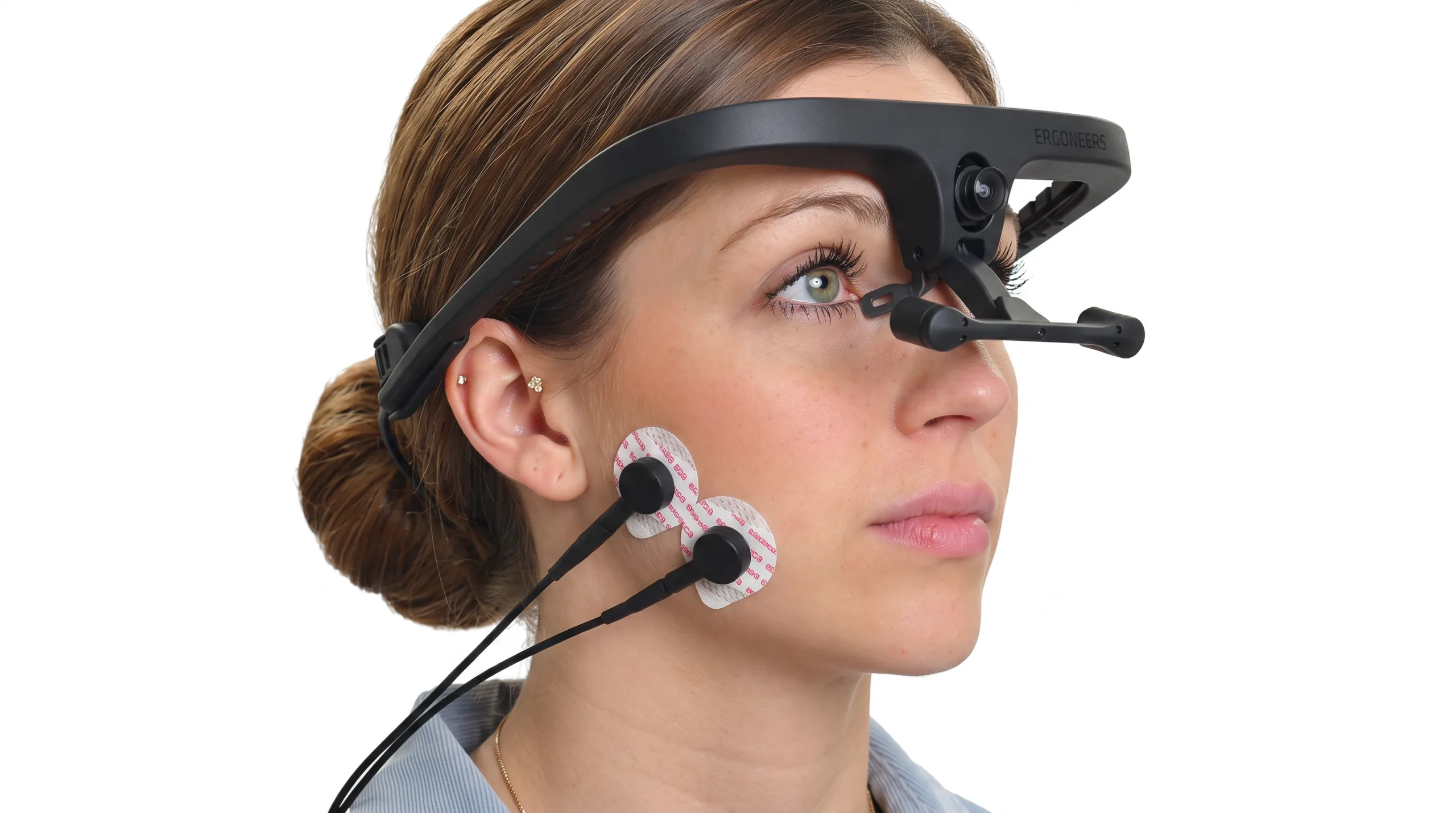
The Dikablis Professional glasses serve as the ideal companion for these studies, featuring an ergonomic frame that specifically avoids interference with facial EMG sensors. This design ensures that your subjects remain comfortable and move naturally, preserving the ecological validity of your data. However, the technology is only one part of the equation. Our Behavioral Research Lab Consulting and specialized Training and Workshops act as the vital bridge between technical complexity and research success. We position ourselves not just as a vendor, but as a collaborative partner in your pursuit of academic rigor and industrial efficiency. We invite you to explore a relationship that prioritizes the human element and builds a lasting legacy of scientific excellence. Discover how Prophea.X transforms multimodal research and lead the next revolution in behavioral science.
Architecting the Future of Human Performance
Mastering the “Intent-Action” loop requires more than just technical dexterity; it demands a strategic alignment of cognitive and physical data streams. You’ve seen how emg integration with eye tracking bridges the gap between neural preparation and muscular execution, providing a three-dimensional view of human behavior. By centralizing these insights within the Prophea.X framework, you eliminate the friction of data drift and fragmented analysis. This transition from raw data to actionable insight is what distinguishes a standard lab from a visionary research center. You’re now equipped to move beyond simple observation and enter a state of true data fusion.
Ergoneers brings a 20-year legacy of behavioral research excellence, born from the academic rigor of TU Munich. This heritage is why 90% of leading automotive OEMs trust our solutions to drive their most critical innovations. Don’t settle for isolated tools when you can command a unified ecosystem designed to prioritize the human element. Elevate your research with the Prophea.X multimodal framework. Your journey toward visionary insight begins with a commitment to precision and a partner dedicated to your success.
Frequently asked questions
Synchronization relies on a combination of hardware triggers and sophisticated software alignment to ensure temporal precision. You can use Transistor-Transistor Logic pulses to mark simultaneous events across sensors or leverage high-precision API-based timestamps within Prophea.X as central data hub. The later approach ensures that every muscle contraction is pinned to a specific gaze fixation with millisecond accuracy, providing a clear window into the subject’s intent and action.
Yes, Prophea.X allows wireless syncronisation via TCP IP or using our API
Effective research requires a sampling rate of at least 1000Hz for EMG sensors to capture rapid motor unit firings accurately. In contrast, eye tracking hardware typically operates between 60Hz and 200Hz. Sophisticated software platforms then interpolate these varying densities to provide a coherent, synchronized stream. This ensures that high-frequency physical effort is correctly mapped against the relatively lower-frequency visual attention markers during analysis.
The primary obstacles include temporal data drift between independent sensors and physical interference between headgear and facial electrodes. Managing fragmented software workflows also poses a significant hurdle for researchers seeking a unified analysis environment. Achieving successful emg integration with eye tracking requires a robust central framework to resolve these synchronization conflicts and ergonomic challenges, ensuring the technology empowers rather than obstructs the research.
Facial EMG is compatible provided you use low-profile electrodes and ergonomic headgear like Dikablis Glasses. The frame design must allow for electrode placement on the zygomaticus or masseter muscles without shifting the eye tracking cameras or causing discomfort. Proper sensor positioning ensures that you can capture emotional or cognitive load markers without obstructing the subject’s field of view or compromising data integrity.
Prophea.X operates as a central agency for data fusion, automatically aligning disparate streams through a unified master clock. It recognizes external hardware signals and applies millisecond-perfect timestamps to every data packet recorded during the session. This eliminates the need for manual alignment and provides a real-time visualization of muscle activity overlaid directly onto the gaze video feed, streamlining the transition from acquisition to insight.
Automotive, aerospace, and sports science sectors derive the most value from these integrated methodologies. Engineers use these tools to optimize cockpit ergonomics by reducing physical strain during visual searches, while sports scientists analyze the “Quiet Eye” period to improve elite athletic performance. These research techniques are also vital for the advancement of personal mobility solutions,like Tobii Dynavox that benefit from improved human-machine interface designs. These industries prioritize the human element to enhance both safety and efficiency, grounding their technological evolution in precise biological data.
You can certainly integrate EEG and eye tracking alongside EMG to create a comprehensive neuro-physical profile. This tri-modal approach allows you to map the entire sequence from neural command to visual attention and physical execution. Such a framework provides an unparalleled depth of insight into the cognitive-motor interactions of your subjects, establishing a new standard for sophisticated behavioral research.