

News & Posts
Eye Tracking for Skills Assessment Research: Quantifying Expertise in 2026

What if you could peer into the cognitive architecture of expertise to map the exact visual patterns that separate a master from a novice? You’ve likely felt the frustration of subjective assessment bias, where identifying specific skill gaps in high-stakes environments feels more like an art than a science. As the global eye-tracking market grows toward an estimated 3.33 billion dollars in 2026, the technology has evolved into a vital partner for objective evaluation. By integrating eye tracking for skills assessment research into your workflow, you transform qualitative observations into precise, data-driven expertise metrics.
This article explores how Prophea.X and Dikablis Glasses allow you to enter a new sphere of behavioral insight. We’ll examine how to unify multimodal data streams and biophysical sensors to eliminate data silos and accelerate training cycles. Discover how to establish absolute performance benchmarks that empower your research and shape a human-centered future. From academic labs to industrial simulators, it’s time to move from simple observation to the expansion of human insights.
Key Takeaways
Move beyond subjective observation by adopting high-precision metrics that quantify cognitive load and visual attention with absolute accuracy.
Master the use of Fixation Duration and Saccadic Latency to create objective benchmarks for information processing and reaction speed.
Unlock the “Quiet Eye” concept to predict performance outcomes and identify specific skill gaps within complex, high-stakes tasks.
Explore how eye tracking for skills assessment research reaches its full potential when synchronized with EEG and other biophysical data streams.
Enter the next era of behavioral research by integrating Prophea.X and Dikablis or Tobii eye-tracking systems into your multimodal lab for seamless, AI-powered analysis.
The Evolution of Skills Assessment Research
Quantifying Expertise
Experience the transition from qualitative guesswork to the clinical precision of gaze-based metrics. In the current landscape of 2026, eye tracking has evolved far beyond its origins in basic academic study to become a cornerstone of behavioral science. When we discuss eye tracking for skills assessment research, we’re talking about the sophisticated science of quantifying cognitive load and visual attention. It’s no longer enough to simply watch a participant perform; researchers now demand the ability to measure the invisible mental processes that drive every movement. This shift toward absolute accuracy allows for the validation of training ROI and the hardening of safety protocols across global industries.
The research chain has expanded. While early applications focused heavily on surgical residents, 2026 sees a massive migration into industrial and high-stakes environments. Professionals in these sectors use high-precision data to differentiate between a lucky success and a repeatable, expert performance. By utilizing Prophea.X, a tool for most flexible real-time human performance and biometridata synchronization, organizations can bridge the gap between biophysical data and practical skill execution, ensuring that human-centered design remains at the heart of technical progress.
From Subjective Observation to Objective Gaze Data
Traditional checklists often fail because they only record the “what” of a performance. They ignore the “how.” A master technician might follow the same steps as a novice, but their information processing is fundamentally different. Objective gaze data captures this internalized expertise by revealing how an expert filters out distractions and focuses on critical cues. This transition empowers researchers to move away from biased, manual observation and toward a heritage of excellence built on data-driven insights. It’s about seeing the task through the eyes of the expert to understand the cognitive shortcuts that define mastery.
The Expanding Spheres of Skill-Based Eye Tracking
The application of eye tracking for skills assessment research now touches diverse spheres of human activity. In automotive simulator training, it’s used to analyze driver distraction and situational awareness with millisecond precision. Aviation and aerospace researchers rely on Dikablis Glasses to monitor how pilots scan complex cockpit interfaces under stress. Even in elite sports, the technology captures the “Quiet Eye” phenomenon, that final, steady fixation before a critical motor action that separates champions from the rest. These multimodal insights provide a unified view of performance that was previously unreachable, shaping a future where expertise is fully transparent and transferable.
Essential Eye Tracking Metrics for Evaluating Professional Competency
Enter the world of high-precision data where every eye movement tells a story of mental effort and procedural mastery. Effective eye tracking for skills assessment research relies on a sophisticated hierarchy of metrics that move beyond simple gaze recording. By analyzing Fixation Duration and Frequency, researchers gain immediate insight into information processing. While a high frequency of short fixations often indicates an expert scanning for familiar cues, a novice may exhibit long, lingering fixations that signal confusion or cognitive strain. These metrics provide the clinical precision required to distinguish between true expertise and lucky performance.
Speed and predictability are equally vital in the research chain. Saccadic Latency measures how quickly a participant reacts to visual stimuli, a critical metric in high-stakes environments like aviation or emergency medicine. To understand the efficiency of these movements, we look to Gaze Entropy. This metric quantifies the predictability of visual search patterns. High entropy suggests a chaotic, reactive search, while low entropy indicates the structured, purposeful scanpath of a professional. For those looking to implement these metrics in a lab setting, exploring the capabilities of Prophea.X for multimodal analysis can help bridge the gap between raw data and actionable insights.
Analyzing Information Processing and Cognitive Load
Interpreting long fixations requires a nuanced approach; they can represent deep processing in an expert or complete disorientation in a learner. Heatmap visualizations play a critical role here by identifying “blind spots” where novices fail to look at mission-critical information. To supplement this, researchers utilize pupillometry to monitor involuntary changes in pupil diameter. Cognitive pupillometry serves as a non-invasive measure of mental effort by tracking involuntary changes in pupil diameter during task execution. This data is particularly valuable in a pilot study on eye tracking in medical simulation, where mental workload often dictates the success of a procedure.
Efficiency Metrics: Scanpaths and Saccadic Movement
The visual journey, or scanpath, reveals the internal logic of a participant’s decision-making process. Expert scanpaths are typically direct and highly efficient, moving seamlessly between relevant points of interest. In contrast, novice scanpaths are often erratic and prone to visual noise, reflecting a lack of situational awareness. There is a strong correlation between saccadic speed and professional experience; experts move their eyes with more intent and less wasted motion. By quantifying these movements, you can establish objective performance benchmarks that empower your training programs and ensure a human-centered future for your industry.

The Quiet Eye - Hallmark of Elite Performance
Discover the “Quiet Eye” (QE), a phenomenon that serves as the definitive signature of a master. In both elite sports and high-precision industrial assembly, the Quiet Eye is the final, steady fixation on a target before a critical motor action begins. Research consistently shows that longer QE periods correlate with significantly higher success rates in high-pressure environments. Using Dikablis glasses with Prophea.X, researchers can capture these millisecond-level fixations in dynamic field settings. Training and analyzing the “Expert Gaze” becomes a reality when you can show a novice exactly how a master stabilizes their vision to process information more effectively.
AI-Powered Behavioral Coding for Rapid Scaling
Enter the next era of data processing, where deep-learning algorithms categorize gaze behavior automatically. This isn’t just about speed; it’s about the synchronicity between AI models and human-centered design goals. Prophea.X expands spheres of knowledge by identifying recurring behavioral motifs that the human eye might miss. This automated coding reduces the time from data capture to actionable insight, allowing for faster training cycles and immediate feedback.
- Automate gaze-to-object mapping in complex 3D environments.
- Identify cognitive bottlenecks through automated fixation analysis.
- Compare individual scanpaths against an “Expert Gold Standard” instantly.
By removing the friction of manual analysis, you empower your team to focus on what matters most: shaping a better, more efficient future for human-technology interaction.
Designing a Multimodal Skills Lab: Integrating Eye Tracking with Biophysical Data
Enter the future of behavioral labs where gaze data provides a window into the mind, yet it’s only half the story. To achieve clinical precision in eye tracking for skills assessment research, we must bridge the gap between visual attention and physiological response. Unified equals easy. By combining gaze metrics with biophysical sensors, you capture the complete research chain of human performance. This multimodal approach transforms a simple observation room into a visionary performance lab that looks toward the next era of technical mastery and human-centered design.
Designing for absolute compatibility is the Ergoneers North Star. We move from academic rigor to industrial application by ensuring that every sensor speaks the same language in real-time. Whether you’re measuring a pilot’s heart rate variability (HRV) during a simulated engine failure or an athlete’s muscle memory through EMG, synchronicity is vital. This unified data stream eliminates silos. It provides a holistic understanding of how the human body reacts to cognitive strain, ensuring that your benchmarks are rooted in objective reality rather than subjective interpretation.
The Synergy of Eye Tracking and EEG/EMG
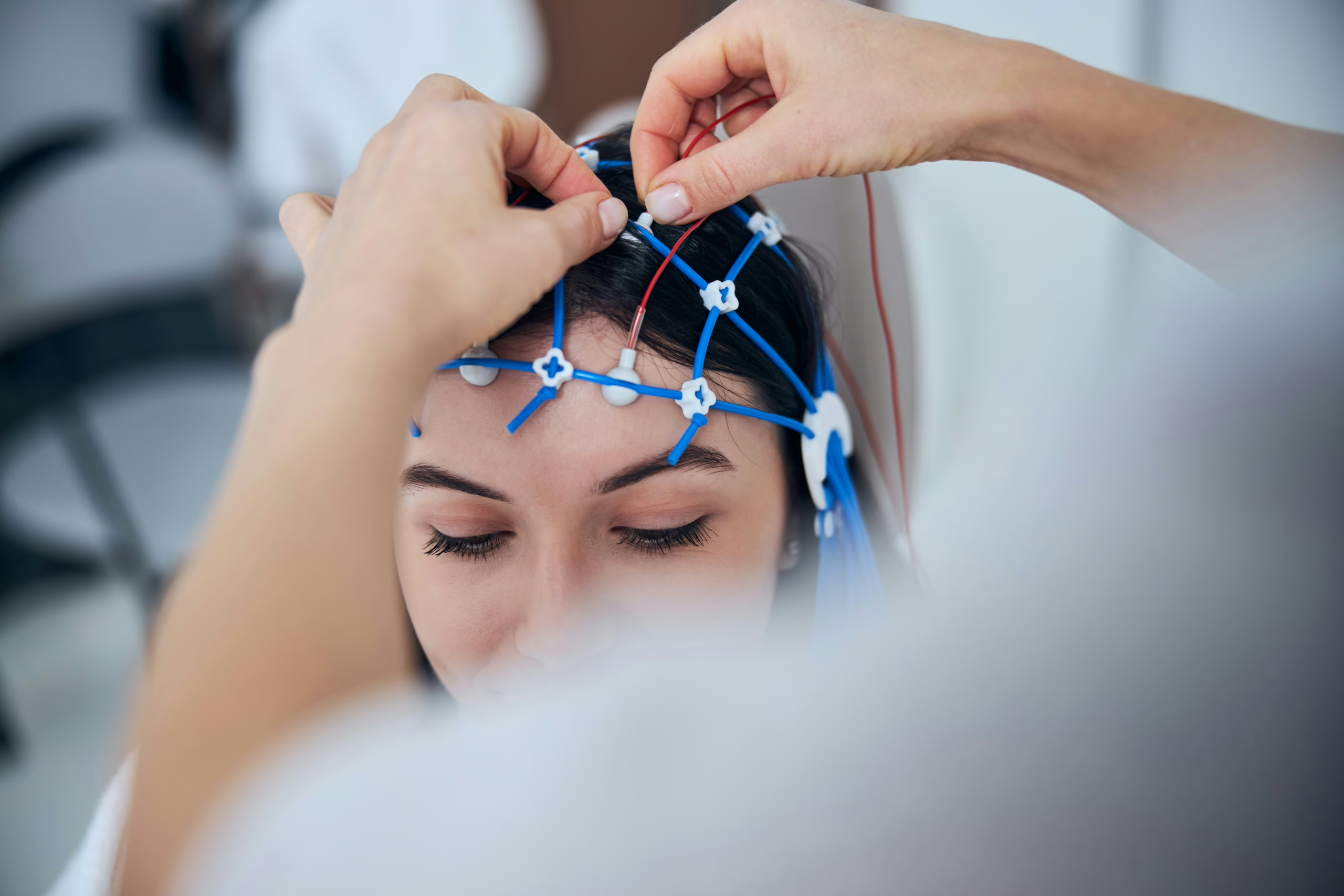
Correlating visual attention with brain states offers a profound look at the effort of expertise. By monitoring alpha and beta waves, researchers can see if a steady gaze is backed by a calm, focused mind or masked by internal panic. You can explore our deep dive into EEG and eye tracking integration to see how these spheres of knowledge overlap. Measuring muscle tension alongside gaze stability allows you to quantify the physical cost of a task. Experts often show lower EMG activity despite higher task complexity, a phenomenon that defines the fluidity of mastery. This balance between mental focus and physical economy is the hallmark of a true professional.
Turnkey Solutions for Performance Labs
Moving from inspiration to implementation requires a reliable partner and a heritage of excellence. A modern human performance lab needs more than just hardware; it requires an ecosystem designed for hassle-free accuracy. Your essential equipment checklist should include Dikablis Professional glasses, high-frequency EEG caps, and a centralized platform like Prophea.X to bind them together. We offer Behavioral Research Lab Consulting to help you design a space that empowers your team and shapes a better, human-centered future. Don’t let technical friction slow your progress. Start building your multimodal research environment today and experience the expansion of human insights.
Elevating Research Precision with Prophea.X and Dikablis Systems
Enter the next era of behavioral research where the clinical precision of Munich-born engineering meets the visionary goals of human-centered design. Throughout this exploration of expertise, we’ve identified the need for objective metrics and multimodal synchronization. Now, we look to the tools that turn these concepts into reality. By choosing the right hardware and software ecosystem, you ensure that eye tracking for skills assessment research is not just a data collection exercise but a transformative force in your organization. Ergoneers provides the trusted partnership required to navigate this complex technological landscape with quiet confidence.
Experience the power of a unified research chain. When your hardware and software exist in perfect synchronicity, the friction of data management disappears. This allows your team to focus on the expansion of human insights rather than troubleshooting sensor connectivity. Whether you are conducting a pilot study in a controlled lab or measuring the visual rhythm of an elite athlete in a stadium, the combination of Dikablis and Prophea.X offers a level of absolute compatibility that is unmatched in the industry. It’s about empowering researchers to shape a better, more efficient future.

Your performance lab
Prophea.X
Expanding Spheres of Multi-Modal Analysis
Prophea.X acts as the intellectual heart of your performance lab, playing cross-industry to provide real-time synchronization of biophysical sensors and gaze data. Unified equals easy. By simplifying the complex data landscape, this platform allows you to visualize cognitive load and visual attention in one cohesive stream. For researchers developing bespoke assessment tools, the custom API usage enables the creation of tailored software solutions that meet specific industry requirements. This flexibility ensures that your research can evolve as quickly as the “AI-powered” revolution demands, keeping you at the forefront of behavioral science.
© Getty Images
Dikablis Glasses X
Mobile Precision for Real-World Assessment
Capturing expertise requires moving beyond the desk and into the dynamic environments where skills are actually performed. Dikablis Professional glasses provide high-precision wearable eye tracking designed for the factory floor, the cockpit, or the sports arena. They deliver absolute accuracy even in variable lighting and high-movement scenarios, ensuring that every saccade and “Quiet Eye” period is recorded with millisecond-level detail. This mobile precision is vital for identifying the subtle visual cues that define professional mastery. We invite you to experience the future of research with Ergoneers and discover how our heritage of excellence can empower your next project. It’s time to dwell and connect with the data that will define the next generation of human-technology interaction.

Shape the Future of Human-Centered Research
Mastering the complexities of human expertise requires moving beyond observation and into the clinical precision of biophysical data. You’ve discovered how high-precision metrics like the Quiet Eye and saccadic latency transform subjective performance into objective benchmarks. By implementing eye tracking for skills assessment research, you bridge the gap between cognitive load and physical mastery; this ensures your training cycles are both faster and more effective. It’s the foundation of a future where data empowers every professional sphere.
Ergoneers stands as a vital partner in this evolution. Founded as a spin-off from the Technical University of Munich (TUM), we bring a heritage of academic rigor to every technical challenge. Our flagship Prophea.X platform provides the AI-powered multimodal analysis required to unify gaze data with EEG and other sensors. Trusted by global leaders in automotive, aerospace, and academic research, we’re ready to help you expand your spheres of knowledge. Enter the Next Era of Behavioral Research with Ergoneers and begin your journey into the next era of behavioral insight today.

© 100+
Frequently Asked Questions
The Quiet Eye represents the final, stable fixation on a specific target immediately preceding a critical motor action. In elite performance, a longer Quiet Eye period allows the brain to program movement parameters more effectively. This metric serves as a definitive signature of expertise in high-pressure tasks. It provides a measurable cognitive anchor for researchers looking to quantify the “calm” of a master professional during high-stakes execution.
Expertise is revealed through the economy of visual search and the efficiency of scanpaths. Experts exhibit purposeful gaze patterns and focus on task-relevant cues, while novices display erratic movements and high fixation frequency on irrelevant information. Using eye tracking for skills assessment research allows you to map these cognitive shortcuts. It transforms subjective performance observation into a clear, data-driven delta between learning and mastery.
Predictive modeling can forecast failure by identifying “visual precursors” like gaze instability or increased saccadic latency. When a participant’s visual search becomes chaotic or their pupil diameter indicates extreme cognitive strain, the probability of error increases. Researchers use these real-time biophysical markers to intervene or adjust training protocols before a physical failure occurs. This proactive approach is essential for maintaining safety in high-consequence industrial environments.
Industrial researchers prioritize fixation duration, scanpath efficiency, and gaze entropy to evaluate procedural fluency. High gaze entropy often signals a lack of situational awareness or confusion during a complex assembly task. By utilizing eye tracking for skills assessment research, you can quantify how quickly a trainee identifies critical safety cues. These metrics ensure that every worker reaches a verified level of competency before they enter the factory floor.
Synchronization requires a central software hub capable of aligning biophysical data streams with millisecond precision. Prophea.X facilitates this by acting as a bridge between eye tracking glasses and EEG caps. Unified equals easy; the platform ensures that a specific visual fixation is perfectly matched with its corresponding neural brainwave. This allows researchers to correlate visual attention with specific cognitive states like deep focus or mental fatigue.
Mobile eye tracking systems like Dikablis Professional are specifically engineered for the high-movement demands of the stadium or the field. These glasses maintain absolute accuracy even during rapid head movements and variable lighting. They provide the clinical precision necessary to capture the millisecond-level gaze shifts that occur during elite athletic performance. This portability allows researchers to take the lab into the real world without sacrificing data quality.
Prophea.X stands as the visionary platform for researchers who need to integrate eye tracking, EEG, and other biophysical sensors even on a scalable multi-subject level where interaction between several participants need to be measured and analysed in real time. It simplifies the complex data landscape by providing a unified environment for AI-powered behavioral coding. The software’s ability to play cross-industry makes it the preferred choice for labs aiming to expand their spheres of knowledge. It empowers your team to move from raw data to actionable human insights with hassle-free accuracy.
The investment for a professional lab depends on your specific research goals and the breadth of multimodal sensors required. Factors include the choice between eye tracking and other biometric wearables like Dikablis, Tobii Glasses II wet or dry EEGS, the amount of observation cameras to be setup and the scale of simulator data integration via Prophea.X. Ergoneers powers a flexible pricing that treads any sensor input equally. Get latest information about available Packages, education discounts and license-models here. Because every research chain is unique, we recommend reaching out for behavioral research lab consulting. This ensures you receive a customized solution that aligns with your technical requirements and aspirational goals.