

News & Posts
AI in Behavioral Research: Trends, Tools, and the Future of Human Insight

You likely recognize the persistent friction of manual behavioral coding and the exhaustion of trying to extract meaningful signals from the noise of disparate datasets. It's a common struggle to synchronize high-frequency sensors like EEG with gaze patterns or simulator event data, often leaving valuable insights buried in technical silos. Integrating AI in behavioral research is no longer a futuristic luxury; it's the essential computational bridge that transforms raw multimodal data into actionable intelligence.
This guide demonstrates how revolutionary tools and computer vision are accelerating data processing and bringing surgical precision to gesture analysis. You'll discover a clear framework for implementing sophisticated systems like Prophea.X and Dikablis Glasses to achieve error-free synchronization. Prepare to move beyond fragmented workflows and embrace a future where technology empowers deeper human insight through clinical precision and visionary scale.
Key Takeaways
- Witness the precision revolution as we transition from labor-intensive manual observation to high-volume predictive analysis.
- Achieve sub-degree gaze precision and automated object recognition by leveraging deep learning algorithms and computer vision.
- Eliminate data silos by synchronizing EEG, EMG, and eye tracking data through a unified architecture for ai in behavioral research.
- Construct a future-ready lab using our framework for auditing infrastructure and selecting specialized behavioral research lab consulting.
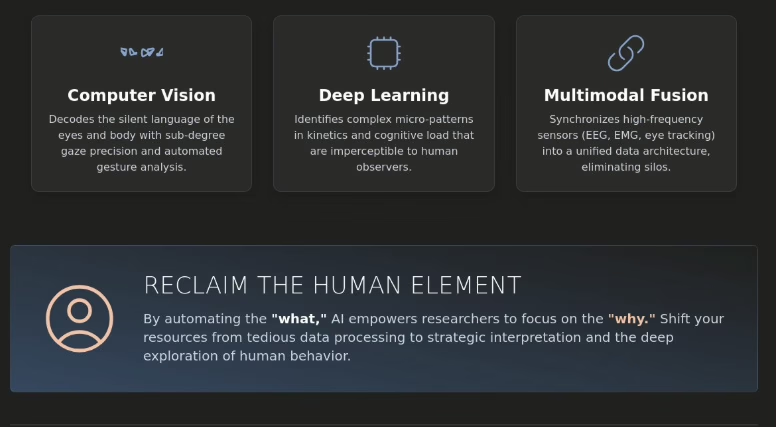
- Reclaim the human element in your research by utilizing AI to handle complex data processing, allowing for deeper focus on the “why” behind the data.
Table of Contents
- The Evolution of Behavioral Research: From Manual Observation to AI Intelligence
- Decoding the Gaze: Computer Vision and AI-Enhanced Eye Tracking
- Multimodal Data Fusion: The Visionary Goal of Synchronized Insights
- Implementing AI in the Modern Lab: A Framework for Researchers
- The Visionary Lab of 2026: Prioritizing the Human Element
The Evolution of Behavioral Research: From Manual Observation to AI Intelligence
The landscape of behavioral science is undergoing a profound metamorphosis. We’re witnessing a decisive shift from descriptive observation to predictive intelligence, a move that redefines how we interpret human action. Historically, researchers relied on the retrospective analysis of recorded behavior, a process often constrained by the limits of human perception. Today, the integration of AI in behavioral research allows for the real-time synthesis of complex biological and environmental data. This transition marks the dawn of the “Precision Revolution,” where the sheer volume of data generated in 2026 makes traditional manual methods obsolete. Machine learning models now identify micro-patterns in human kinetics and cognitive load that remain invisible to the naked eye. By embracing these computational tools, we expand the boundaries of human knowledge and transform the researcher from a data gatherer into a visionary strategist. The Evolution of Behavioral Research reflects this trajectory, moving toward a data-intensive paradigm that prioritizes accuracy, scale, and the expansion of human insights.
Breaking the Manual Coding Bottleneck
Traditional coding schemes often suffer from the inherent variability of human perception. Subjectivity and fatigue introduce noise into datasets, compromising the integrity of longitudinal studies and increasing the risk of human error. Automated event detection eliminates these vulnerabilities by applying consistent algorithmic filters to video and sensor feeds. This acceleration of the research lifecycle ensures that insights are delivered in hours rather than months, allowing labs to maintain a competitive edge. AI-driven coding represents the definitive transition from subjective observation to objective, high-fidelity data. It’s about stripping away the friction of administrative labor to reveal the raw truth of human interaction. By automating the “what,” researchers gain the freedom to explore the “why.”
The Rise of Computational Behaviorism
Modern methodology requires a sophisticated fusion of psychological theory and algorithmic execution. While AI provides the computational power, academic rigor remains the bedrock of every successful study. We don’t just process data; we interpret it through established scientific frameworks that ensure validity. The role of behavioral coding schemes is more vital than ever in this automated era. These schemes provide the necessary structure for machine learning models to align with human-centric goals and ethical standards. This synergy between human expertise and technical agency allows labs to scale their impact without sacrificing clinical precision. Empower your team to look beyond the surface of raw data and engage with the three-dimensional nature of human behavior. This collaborative approach between man and machine ensures that AI in behavioral research serves as a partner in growth, legacy, and the pursuit of excellence.
Decoding the Gaze: Computer Vision and AI-Enhanced Eye Tracking
Harness the power of computer vision to unlock the silent language of the eyes. While many industry discussions fixate on large language models for survey generation, the true revolution of AI in behavioral research lies in the physical realm of high-frequency sensor data. We’ve moved beyond the era of coarse gaze estimation into a phase of sub-degree precision driven by deep learning algorithms. These models don’t just track a point on a screen; they understand the semantic context of the environment. By integrating professional eye tracking glasses like Dikablis, researchers can now automatically map fixations to real-world stimuli in real-time. This shift from post-hoc processing to live behavioral insights empowers you to adjust protocols on the fly, ensuring every participant session yields the highest quality data. It’s about creating a three-dimensional understanding of attention that survives the complexities of the real world.
Automated Area of Interest (AOI) Mapping
Eliminate the grueling task of manual frame-by-frame definition. Modern computer vision systems utilize object recognition to maintain AOI integrity in dynamic environments. Whether tracking a driver’s gaze in a moving vehicle or a consumer’s attention in a crowded retail space, AI ensures that your data remains anchored to the object of interest. This resilience in mobile eye tracking provides a level of reliability previously reserved for static, screen-based setups. It transforms how we conduct industrial training and academic field studies by removing technical friction. If you’re ready to modernize your data collection, connect with our technical experts to explore specialized integration options for your unique lab environment.
Fixation and Saccade Classification
Precision requires more than just raw speed; it demands intelligent discrimination. Neural networks now distinguish between deep cognitive processing and reflexive ocular movement with clinical accuracy. By identifying fixations and saccades through sophisticated neural classification models, we isolate the meaningful signal from the noise of biological jitter. In wearable systems, AI-driven reduction of motion artifacts ensures data integrity even in high-stakes human factors studies where error-free results are non-negotiable. This level of computational rigor is the hallmark of a visionary lab, turning raw biological physics into a clear, actionable narrative of human intent. We’re not just recording movement; we’re decoding the very essence of human-technology interaction.
Multimodal Data Fusion: The Visionary Goal of Synchronized Insights
Dismantle the traditional data silo to reveal a holistic view of human behavior. While eye tracking provides a sophisticated window into attention, it remains a solitary data point without the physiological context of the body and brain. The true potential of AI in behavioral research is realized through multimodal data fusion, where EEG, EMG, and gaze data converge within a unified computational architecture. Prophea.X possesses the inherent agency to bridge these disparate streams, acting as a sophisticated orchestrator that synchronizes high-frequency signals with microsecond precision. This intelligent core doesn’t just aggregate data; it identifies cross-sensor correlations and flags anomalies that human analysts might overlook in high-volume datasets. By weaving together biological physics and advanced analysis, you transform fragmented observations into a coherent, three-dimensional narrative of the human experience. This expansion of scientific knowledge is the bedrock of a visionary lab, ensuring that every insight is backed by synchronized, empirical evidence.
Synthetic Participants vs. Real-World Multimodal Data
Synthetic participants and LLM-generated survey responses offer unprecedented speed, yet they lack the vital grounding of physical bio-markers. Validating AI-generated hypotheses requires the clinical precision of real-world multimodal data to ensure authenticity. Relying solely on synthetic models risks drifting away from the authentic human element that defines high-stakes research. Sophisticated behavioral research software balances predictive modeling with empirical evidence from EEG and gaze patterns. This synergy ensures that visionary insights are anchored in biological reality rather than algorithmic echoes. It’s about maintaining academic rigor while embracing technological evolution.
Real-Time Cognitive Load Estimation
Predict operator fatigue before it leads to critical system failure by harnessing the power of synchronized data. By combining pupil dilation and heart rate variability through AI, researchers can now estimate cognitive load with surgical accuracy. This capability is revolutionary for human machine interaction studies, allowing for the development of adaptive interfaces that respond to the user’s mental state. In 2026, the research lab becomes a proactive partner in human-technology synergy rather than a passive observer. We’re moving beyond recording errors to preventing them through the power of synchronized, intelligent insights. This proactive approach empowers researchers to lead technological revolutions that prioritize human needs and safety.
Implementing AI in the Modern Lab: A Framework for Researchers
Transitioning from legacy manual coding to automated workflows requires more than just new software; it demands a structural shift in your research architecture. Integrating AI in behavioral research is a journey from fragmented data collection to a unified, intelligent ecosystem. To lead this technological revolution, follow this five-step framework designed for the visionary lab of 2026:
- Audit your infrastructure: Evaluate whether your current hardware can sustain high-frequency multimodal streams without technical friction.
- Partner with experts: Accelerate your transition by engaging with behavioral research lab consulting to align your technical capabilities with your academic goals.
- Establish ethical protocols: Implement transparency disclosures and impact assessments as mandated by the Colorado AI Act and the EU AI Act of 2026.
- Master technical connectivity: Execute a custom eye tracking integration to link specialized hardware with your analysis platform via open APIs.
- Validate and verify: Cross-reference AI-generated insights against established scientific benchmarks to ensure clinical precision.
Technical Integration and API Workflows
Open APIs serve as the nervous system of a modern lab. They allow for the seamless flow of data between disparate sensors and centralized analysis hubs. Managing high-frequency streams like 60Hz gaze data or 1000Hz EEG requires a robust backend that eliminates latency and ensures error-free synchronization. Prophea.X simplifies the integration of third-party AI modules by acting as a versatile agent that communicates across different sectors and hardware environments. This agile connectivity ensures that your lab remains a hub of innovation rather than a collection of isolated tools. If you are ready to architect your future-ready lab, reach out to our integration specialists today.
Ethical Considerations in AI Observation
Ethics must serve as the functional guide for every automated study. As AI in behavioral research becomes the default starting point, maintaining the “human element” is a non-negotiable priority. Transparency in automated analysis isn’t just a regulatory requirement; it’s a foundation for trust between researchers and participants. Utilize advanced data anonymization techniques, such as face-blurring and coordinate-only gaze exports, to protect privacy during the processing of video data. By grounding every technical advancement in its practical impact on human well-being, you ensure that your research leaves a legacy of empowerment and integrity. We aren’t just processing data points; we’re honoring the people behind them.
The Visionary Behavior reserach Lab: Prioritizing the Human Element
The visionary lab of the future is defined by a seamless synergy between human intuition and computational agency. We’ve moved past the era where researchers were tethered to the mechanical labor of data entry and manual event marking. By integrating AI in behavioral research, we empower the scientist to transcend the “what” of raw metrics and focus exclusively on the “why” of human intent. This transformation turns the research facility into a proactive hub of innovation where every sensor and algorithm serves a humanistic goal. Ergoneers views this technological surge as a catalyst for professional empowerment rather than a replacement for human expertise. We position ourselves as your vital partner in the evolution toward more responsive, human-centric environments. Closing the loop means using these deep insights to architect technologies that are inherently safer and more intuitive. Your legacy is no longer measured by the volume of your data, but by the depth of the insights you provide to the world.
From Data Processing to Strategic Insight
Researchers are evolving into visionary strategists who orchestrate complex digital ecosystems. Utilizing advanced behavioral research data analysis software like Prophea.X provides a decisive competitive advantage across both academic and industrial sectors. These tools allow labs to process multimodal datasets with error-free precision, significantly accelerating the time-to-market for industrial innovations. Whether you’re optimizing an automotive HMI or refining a medical training protocol, the ability to extract actionable intelligence from noise is paramount. This shift allows for a geometric expansion of what a single lab can achieve. It moves the needle from isolated studies to comprehensive, longitudinal insights that redefine industry standards.
A Legacy of Excellence in the AI Era
Our commitment to academic rigor remains unwavering as we navigate this fast-evolving field. We believe that the integration of AI in behavioral research must be grounded in the clinical precision that high-end hardware demands. This balance of innovation and tradition ensures that your findings hold the weight of scientific authority while pushing the limits of what’s possible. The future of human-technology interaction is being written in labs that prioritize the human element as their ethical and functional guide. We invite you to join this communal effort to lead the next technological revolution. Partner with Ergoneers to transform your lab into a visionary center of excellence where technology and humanity converge to expand the boundaries of knowledge. The journey toward the next phase of human insight begins with a single, synchronized data point.
Lead the Revolution in Human-Technology Interaction
Embrace the next phase of discovery where technical friction no longer limits the scope of your inquiry. You’ve navigated the evolution from manual coding to predictive intelligence, witnessing how computer vision achieves sub-degree precision and how multimodal fusion creates a three-dimensional narrative of human intent. The integration of AI in behavioral research isn’t just a technical upgrade; it’s a fundamental expansion of your scientific legacy. By utilizing Dikablis glasses for high-precision hardware and Prophea.X for visionary multimodal analysis, your lab is prepared to transcend traditional data silos. Our expert lab consulting ensures your transition to these automated workflows remains seamless and ethically grounded.
Prioritize the human element in every study by letting technology handle the complexity of the “what” so you can master the “why.” Join a community of intellectual leaders who are redefining the relationship between people and technology. This geometric expansion of scientific knowledge is within your reach. Discover Prophea.X: The Future of AI-Driven Behavioral Analysis. Your journey toward error-free precision and visionary insight starts today.
Frequently Asked Questions
AI serves as the computational engine that transforms raw sensor noise into synchronized behavioral insights. It automates high-volume data processing tasks like event coding and pattern recognition, which were historically prone to human error. By shifting the focus from descriptive to predictive analysis, AI in behavioral research allows labs to scale their output without compromising clinical precision. This technical agency empowers researchers to engage with complex, three-dimensional datasets that were previously inaccessible.
AI is a visionary partner designed to enhance human capability rather than replace it. While algorithms excel at identifying micro-patterns and managing high-frequency data streams, they lack the creative intuition required to interpret the “why” behind human behavior. Ergoneers views these tools as a means of professional empowerment, freeing you from the mechanical labor of manual observation. This synergy allows you to prioritize the human element and focus on strategic, high-level insights.
Deep learning algorithms achieve sub-degree precision by intelligently filtering biological jitter and classifying ocular movements. In high-end wearable systems like Dikablis and Prophea.X, AI-enhanced computer vision automatically maps gaze fixations to real-world objects, eliminating the need for manual frame-by-frame definition. This neural classification distinguishes between cognitive fixations and reflexive saccades with surgical accuracy. It ensures that your data remains a reliable reflection of human attention, even in the most demanding research environments.
Synthetic participants provide a rapid starting point for preliminary survey research but cannot replace the empirical weight of real-world data. These LLM-generated models lack the physiological grounding of physical bio-markers such as heart rate variability or pupil dilation. For high-stakes industrial or academic research, validating hypotheses through multimodal sensors is essential for maintaining academic rigor. Real-world data ensures your findings are anchored in biological reality rather than algorithmic simulations.
Integration begins with a comprehensive audit of your current data infrastructure to ensure AI readiness. You can then implement a custom eye tracking integration using open APIs to connect specialized hardware with centralized analysis software. Engaging in professional behavioral research lab consulting provides the necessary roadmap for this transition. This collaborative approach ensures that your new AI modules synchronize perfectly with your legacy systems, creating a unified hub for future-ready human-technology interaction.
Ethical observation requires strict adherence to transparency and data anonymization protocols to protect participant privacy. New regulations in 2026, such as the Colorado AI Act, mandate impact assessments and clear documentation of automated decision-making processes. Using techniques like face-blurring and coordinate-only data exports helps maintain the “human element” as your ethical guide. These practices ensure that your research remains a partner in the evolution toward a more responsible and human-centric technological future.
Specialized platforms like Prophea.X are engineered to handle the agency required for multimodal AI data synchronization. This software acts as an intelligent orchestrator, linking streams from EEG, EMG, and gaze sensors into a single, three-dimensional dataset. It eliminates technical friction by providing a unified architecture for cross-sensor correlation and real-time anomaly detection. These platforms ensure error-free precision across diverse sectors, from theoretical academic studies to practical industrial training environments.
AI utilizes advanced computer vision and neural networks to maintain data integrity in dynamic, mobile environments. By semantically identifying objects in a participant’s field of view, the system can automatically map gaze fixations even as the environment shifts. This is particularly vital for research in moving vehicles or retail spaces where traditional static AOIs fail. These intelligent filters ensure that ai in behavioral research delivers actionable insights regardless of the technical complexity of the setting.