

News & Posts
Mastering Behavioral Coding Schemes: A Visionary Framework for Human Insight

© Unsplash
Stop viewing human action as a series of random events and start seeing it as a structured map of intent. Constructing robust behavioral coding schemes is the only way to transform raw, messy observation into the clinical precision your research demands. You've likely felt the weight of time-intensive data entry or the frustration of trying to synchronize video feeds with complex sensor data manually. It's a common struggle; behavioral healthcare utilization rose by over 60% between 2018 and 2024, yet the tools for capturing this data often lag behind the demand for accuracy. Subjectivity shouldn't be the ceiling of your scientific insight.
This article provides the visionary framework you need to design, implement, and automate your observations to achieve seamless integration with eye-tracking and biometric streams. We'll examine the transition from manual friction to automated excellence, showing you how to build a legacy of high inter-rater reliability through a standardized observation framework. Learn how to bridge the gap between biological physics and human behavior. By the end of this guide, you'll understand how to leverage advanced multimodal platforms to turn observational data into definitive scientific breakthroughs.
Key Takeaways
- Define the dictionary of your research by establishing behavioral coding schemes that translate complex human actions into computational insights.
- Architect a robust framework for observation by strategically selecting between time-sampling and event-sampling methods to align with your specific study objectives.
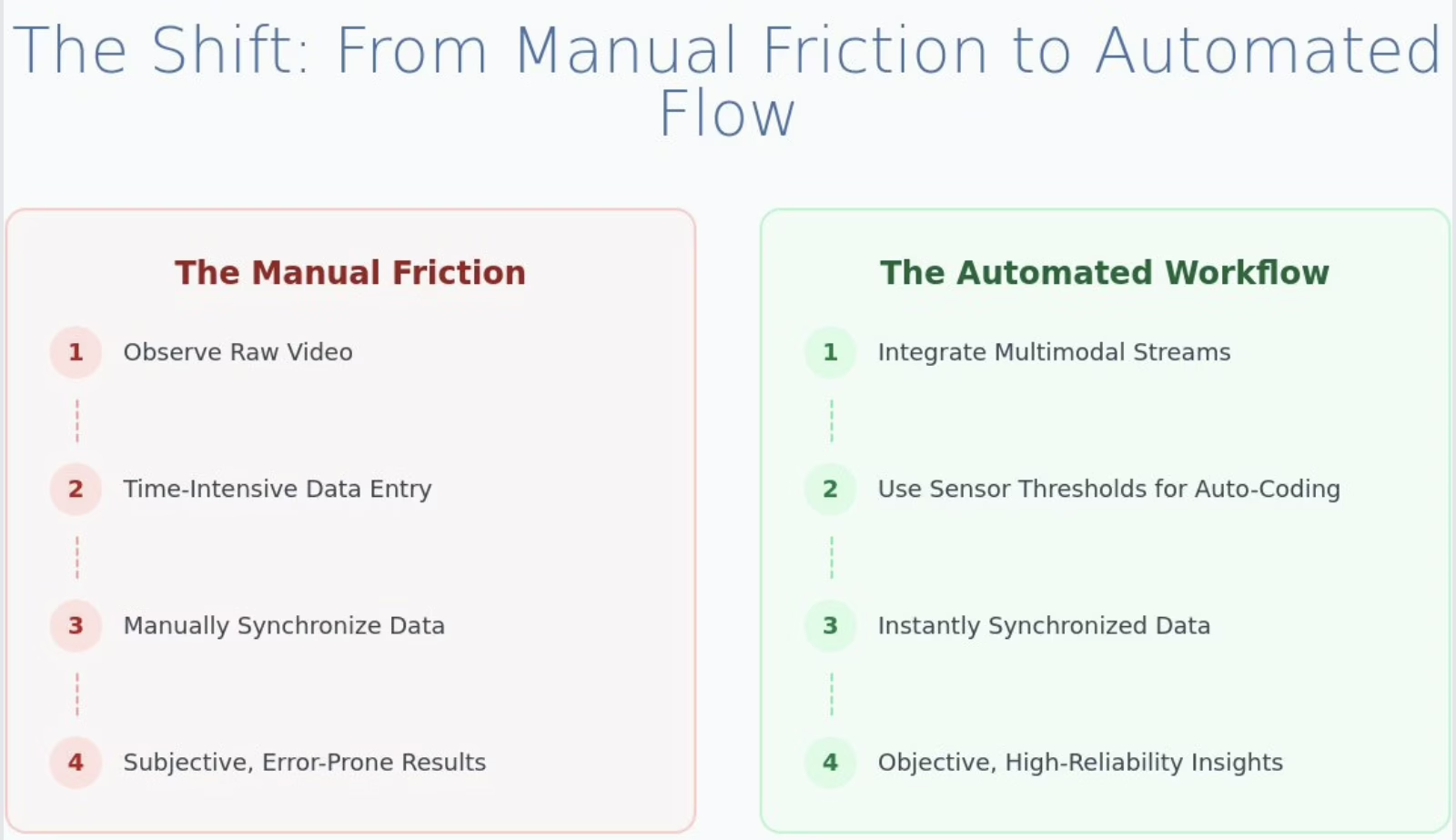
- Accelerate your workflow by integrating semi-automated coding techniques that utilize eye-tracking and sensor thresholds to eliminate the significant time-drain of manual entry.
- Secure your scientific legacy by utilizing standardized manuals and Cohen’s Kappa to achieve the high inter-rater reliability essential for publication-grade data.
- Evolve your analysis with Prophea.X to transcend simple descriptive statistics and enter the realm of visionary, multimodal predictive modeling.
Table of Contents
- What are Behavioral Coding Schemes? Defining the Language of Observation
- Designing an Effective Coding Scheme: The Architecture of Insight
- Manual vs. Automated Behavioral Coding: Navigating the Technical Shift
- Implementing Your Coding Scheme: A Practical Workflow for High-Precision Research
- Beyond the Tally: Prophea.X and the Future of Multimodal Behavioral Analysis
What are Behavioral Coding Schemes? Defining the Language of Observation
Elevate your research from subjective anecdotal observation to empirical certainty. Human behavior represents a dense tapestry of biological signals and intentional actions that require a structured lens to interpret. At their core, behavioral coding schemes are the architectural frameworks of rules used to classify and quantify these actions with clinical precision. They act as the semantic bridge that translates the fluid chaos of a human moment into the rigid structure of computational data.
Think of this framework as the dictionary for your entire research team. When you establish a rigorous coding scheme, you ensure that every observer speaks the same analytical language, regardless of their individual background. Behavior coding provides the foundational methodology needed to pretest surveys and evaluate complex social interactions without falling into the trap of personal bias. It’s about creating a shared reality where a specific gesture or gaze shift means the same thing to every rater in the lab.
These schemes perform the vital task of transforming qualitative “moments” into quantitative “data points.” This conversion is what makes statistical significance possible. By stripping away the ambiguity of narrative description, you maximize the granularity of your captured insights. You aren’t just watching a participant; you’re harvesting precise metrics that reveal the underlying mechanics of human-technology interaction.
The Anatomy of an Ethogram
Every successful observation strategy begins with the ethogram. This document serves as the bedrock of all behavioral coding schemes. An ethogram is the comprehensive inventory of behaviors for a specific species or context. To build one effectively, you must distinguish between structural and functional definitions. Structural definitions describe the physical form of an action, such as the specific angle of a limb or the contraction of a muscle. Functional definitions focus on the outcome, such as the intent to communicate or the completion of a task. Balancing these two perspectives allows you to capture the full three-dimensional reality of behavior.
Why Precision Matters in Behavioral Taxonomy
Vague definitions are the primary cause of coding drift. This occurs when observers slowly lose their alignment over the course of a long study, leading to unreliable results that can’t be replicated. Precision isn’t just a goal; it’s a requirement for scientific legacy. Integrating high-end hardware allows you to validate behavioral intent through eye tracking integration. This multimodal approach moves the conversation beyond “what” happened. It empowers you to understand “why” it happened by connecting gaze patterns to physical actions. This creates a holistic view of the human element that simple tallying can’t achieve. By grounding your taxonomy in verifiable physical data, you ensure your research remains agile and innovative.
Designing an Effective Coding Scheme: The Architecture of Insight
Transforming raw observation into actionable data requires a meticulous design process. Architecting behavioral coding schemes isn’t merely about listing actions; it’s about building a visionary blueprint that aligns your technical hardware with your research objectives. Start by identifying the specific human-machine interactions under study. Whether you’re analyzing a driver’s response to an autonomous alert or an operator’s workflow in a high-stress environment, your objectives dictate the structure of your data. This clarity prevents the technical friction that often stalls research. If you find the design phase overwhelming, consult with our behavioral research experts to refine your methodology early in the process.
Follow these essential steps to ensure your framework is both robust and scalable:
- Identify Objectives: Clarify exactly what you need to measure to prove your hypothesis.
- Choose Coding Units: Decide between time-sampling and event-sampling methods based on your need for frequency or duration metrics.
- Establish MECE Categories: Ensure your behavioral taxonomy leaves no room for ambiguity or overlap.
- Create a Visual Manual: Develop a guide with clear photographic or video examples to anchor your observers’ understanding.
- Pilot the Scheme: Run a preliminary test to identify gaps in your taxonomy before full-scale data collection begins.
A rigorous design phase ensures that your behavioral coding schemes withstand the scrutiny of peer review. By grounding your categories in observable reality, you create a legacy of reliable data that can be shared across the scientific community. Utilize this practical guide to developing coding schemes to anchor your steps in established academic standards.
State vs. Event Coding: Choosing Your Metric
Your choice of metric determines the depth of your insight. State coding focuses on measuring duration, such as how long a driver’s gaze remains fixed on a dashboard display. This is vital for understanding cognitive engagement and distraction. In contrast, event coding measures frequency, tracking how many times a user clicks a specific button or performs a discrete gesture. Combining both provides a holistic view of human performance, allowing you to see not just what happened, but how long it took and how often it repeated. This dual-layered approach is the hallmark of high-precision research.
The MECE Principle in Behavioral Research
Precision relies on the MECE principle: Mutually Exclusive and Collectively Exhaustive. To be mutually exclusive, every behavior must fit into exactly one category; there can be no overlap that forces an observer to choose between two equally valid codes. To be collectively exhaustive, your scheme must provide a “home” for every possible action. When you follow a structured taxonomy, you’ll learn to handle “other” behaviors by creating clear catch-all categories that don’t dilute your primary data. This logic ensures that your findings remain airtight, even when faced with the inherent unpredictability of human action.
implementing-your-coding-scheme-a-practical-workflow-for-high-precision-research
Execution is where visionary design meets technical reality. Once you’ve architected your behavioral coding schemes, the focus shifts to the human element of your research team. Training your observers isn’t a one-time event but a continuous process of calibration. Your coding manual serves as the ethical and functional guide for this alignment, providing the concrete definitions necessary to prevent subjective drift. Without this anchor, even the most advanced hardware can’t compensate for inconsistent human interpretation.
Managing the flow of a multi-sensor study requires a steady, professional hand. You must synchronize data acquisition across diverse inputs like EEG, EMG, and video feeds to ensure a holistic view of the participant’s state. Iterative refinement allows you to update your taxonomy as the study evolves. This agility ensures you don’t lose legacy data while expanding the boundaries of your scientific knowledge. If you’re ready to elevate your lab’s capabilities, contact our experts for a personalized research consultation.
Mastering Inter-Rater Reliability
Scientific publication demands a high level of empirical certainty. Achieving an 80% agreement rate is widely regarded as the “gold standard” for establishing inter-rater reliability in behavioral research. To reach this benchmark, utilize Cohen’s Kappa or Intraclass Correlation (ICC) to provide a statistical measure of observer alignment. Prophea.X offers dedicated tools for comparing multiple coders in real-time, allowing you to identify and resolve discrepancies immediately. This transparency transforms a potential bottleneck into a collaborative opportunity for growth and precision.
Synchronized Data Acquisition
Precision is measured in milliseconds. When you integrate multiple sensors, the importance of accurate timestamps can’t be overstated. A single lag can disrupt the relationship between a biological signal and a physical action, rendering your data unusable. Implementing a custom eye tracking integration simplifies the coding of gaze-related behaviors by automatically aligning eye movements with external events. This seamless connectivity ensures that your longitudinal behavioral datasets remain organized and error-free, providing the foundation for predictive modeling and the expansion of human insight.
Beyond the Tally: Prophea.X and the Future of Multimodal Behavioral Analysis
Solutions/Mobile Eye TrackerEvolve your perspective on data. Transitioning from simple descriptive statistics to predictive behavioral modeling represents the next frontier of human-centric research. Behavioral coding schemes shouldn’t be static tallies of past events; they should be dynamic engines that power your understanding of future human-technology interactions. Prophea.X stands as a visionary partner in this evolution, possessing the agency to operate across diverse sectors while consistently prioritizing the human element. It doesn’t just record; it interprets, linking complex data processing to the expansion of human insights.
High-precision eye tracking, specifically through Dikablis glasses, reveals the “unspoken” behaviors that manual observation often misses. It’s about capturing the micro-gestures and gaze shifts that signify cognitive load or emotional state before they manifest in physical action. By integrating these biological signals into your research, you empower your team to focus on solving human needs rather than wrestling with technical friction. This clinical precision allows you to move seamlessly from theoretical academic contexts to practical industrial training environments, ensuring your findings have a lasting legacy.
The Visionary’s Toolkit
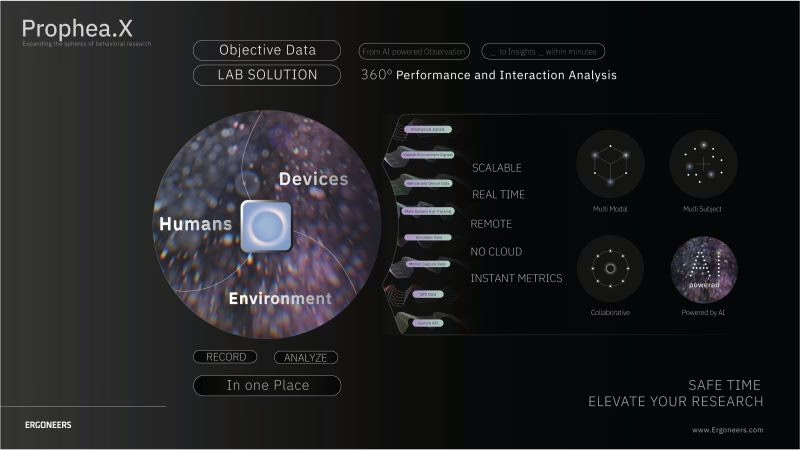
Combine the technical prowess of Dikablis glasses with the computational intelligence of Prophea.X to achieve a true 360-degree view of your subject. Ergoneers supports your entire research lifecycle, offering everything from initial behavioral research lab consulting to specialized training and workshops. This holistic ecosystem ensures that your behavioral coding schemes remain at the cutting edge of biological physics and data processing. Prophea.X acts as an intellectual leader in your lab, expanding its influence across every phase of your multimodal analysis to ensure error-free precision. It’s a platform that operates across sectors to prioritize the human element, serving as the ethical and functional guide for your research.
Next Steps for Your Research
Evaluate your current workflow to identify the bottlenecks and biases that limit your scientific breakthroughs. Transitioning your existing manual schemes into a digital-first environment is the first step toward professional scale and high inter-rater reliability. Discover how human machine interaction studies are being revolutionized by stimulus-triggered coding through simulator connectivity, vehicle and device data integration, and sensor fusion. Start your journey toward the next phase of behavioral research today by embracing a framework that treats data not as an end, but as a path toward human empowerment. Look toward a future where technology adapts to people, and let your research be the catalyst for that change.
Architecting the Future of Human-Technology Interaction
Mastering behavioral coding schemes is the definitive step toward turning observational friction into scientific legacy. You’ve seen how a robust taxonomy and the shift toward multimodal automation can reduce analysis time while maximizing inter-rater reliability. By prioritizing the human element, you bridge the gap between biological physics and practical industrial applications. This journey requires more than just observation; it demands a partner rooted in academic rigor and technological innovation.
Founded as a visionary spin-off from the Technical University of Munich, Ergoneers provides the tools necessary to expand the boundaries of human insight. Our flagship Prophea.X platform and high-precision Dikablis eye-tracking hardware offer the clinical precision your research deserves. Don’t let your data remain static when you can transform it into predictive models of human performance. To understand the full analytical power available to your team, explore the capabilities of behavioral research data analysis software built for the 2026 regulatory landscape. Experience the future of behavioral analysis with Prophea.X and lead the next revolution in your field. Your breakthrough starts with the right framework.
Frequently Asked Questions
An ethogram acts as the foundational catalog of all possible behaviors for a specific species or context, while behavioral coding schemes are the specialized subsets of rules applied to a particular research question. Think of the ethogram as the complete dictionary of human action and the coding scheme as the specific vocabulary chosen to translate a human-machine interaction into data. One is an inventory; the other is an analytical framework.
An ethogram acts as the foundational catalog of all possible behaviors for a specific species or context, while behavioral coding schemes are the specialized subsets of rules applied to a particular research question. Think of the ethogram as the complete dictionary of human action and the coding scheme as the specific vocabulary chosen to translate a human-machine interaction into data. One is an inventory; the other is an analytical framework.
Aim for a Cohen’s Kappa score of 0.70 or higher to demonstrate substantial inter-rater reliability in your scientific publication. Scores above 0.80 are generally considered the “gold standard” for high-stakes research, indicating near-perfect alignment between your observers. Utilizing Prophea.X allows you to track these metrics in real-time, ensuring your team maintains the clinical precision required for visionary scientific breakthroughs and error-free data acquisition.
Expect to spend between five and ten hours manually coding a single hour of high-density video data, depending on the complexity of your scheme. This significant time investment is why many leading labs are transitioning to semi-automated workflows, which can reduce analysis time by up to 60%. Leveraging sensor-driven triggers allows your team to move from passive transcription to active, visionary data validation and insight expansion. Prophea.X is designed to take this approach to the next level.
AI can fully automate the detection of discrete physical actions like facial expressions or specific gestures, but complex social intent still requires expert oversight. By 2026, agentic AI systems will handle more autonomous coding tasks with minimal intervention. However, we champion a “Human-in-the-Loop” philosophy where Prophea.X handles the computational heavy lifting while researchers provide the sophisticated nuance needed to interpret the human element correctly.
Handle concurrent actions by organizing your behavioral coding schemes into multiple, independent channels or tiers within your analysis software. This allows you to code a participant’s gaze on one layer while simultaneously recording their verbal responses or manual gestures on another. This multi-dimensional structure prevents data loss and provides a holistic, three-dimensional view of human performance during complex, high-stress tasks in any environment.
Behavioral coding is highly effective for out-of-lab studies, particularly when paired with mobile hardware like Dikablis glasses. These “in-the-wild” observations provide vital insights into how people interact with technology in natural environments, from industrial shop floors to retail spaces. High-precision hardware ensures that even in uncontrolled settings, your data acquisition remains clinically precise, allowing you to capture the unspoken behaviors that define the human experience.
Prophea.X is the premier platform for seamlessly synchronizing high-precision eye tracking with diverse behavioral data streams. It operates as a visionary partner in the lab, integrating millisecond-accurate timestamps from Dikablis glasses with biometric markers and video feeds. This level of connectivity eliminates technical friction and ensures that your multimodal analysis remains error-free, moving your workflow from simple tallying to advanced predictive behavioral modeling.