

News & Posts
Multi-Sensor Data Fusion Software: The Visionary Guide to Behavioral Research in the Era of AI

In the high-stakes arena of human-machine interaction, the difference between a scientific breakthrough and a failed study often rests on a single millisecond of misaligned data. This precision gap is why advanced multi-sensor data fusion software has evolved from a storage tool into a vital cognitive bridge for the modern researcher. You've likely felt the exhaustion of manual post-processing, where data silos and clock drift threaten to undermine months of rigorous observation—a complexity that Prophea.X by Ergoneers helps human research organisations master through enterprise-grade software design, AI and data orchestration.
It's time to transcend these technical frictions and reclaim the absolute integrity of your insights. By reading this guide, you'll master the complexities of synchronizing disparate behavioral sensors into a unified, high-precision source of truth that reveals the organic connection between biological signals and environmental context. We'll explore how to leverage the Prophea.X ecosystem to automate data cleaning, eliminate synchronization errors, and establish a seamless dashboard for all your physiological data. Discover how to transform fragmented streams into a holistic view of the human element.
Key Takeaways
- Distinguish between low-level hardware fusion and high-level behavioral analysis to architect a more profound understanding of human-machine interaction.
- Eliminate the scientific risks of clock drift by deploying multi-sensor data fusion software that guarantees millisecond-precise synchronization across all sensor modalities.
- Prioritize sensor-agnostic platforms with robust API capabilities to facilitate seamless custom eye-tracking integration within your existing research stack.
- Adopt a rigorous five-step implementation framework to transform fragmented biological signals into a unified, high-precision stream of behavioral intelligence.
- Leverage the Prophea.X ecosystem to automate complex data cleaning and event coding tasks, allowing you to focus on the human insights that drive innovation.
Table of Contents
- The Architecture of Insight: Defining Multi-Sensor Data Fusion for Behavioral Science
- Synchronization: Solving the Temporal Friction of High-Frequency Data
- Critical Features of a High-Precision Multimodal Data Analysis Platform
- A 5-Step Framework for Implementing a Multimodal Study Workflow
- Prophea.X: The Visionary Standard for Synchronized Behavioral Intelligence
The Architecture of Insight: Defining Multi-Sensor Data Fusion for Behavioral Science
Master the complexity of human behavior by looking beyond individual data points. In 2026, the standard for excellence in behavioral science has shifted from simple data collection to the orchestration of multimodal intelligence. True multi-sensor data fusion software acts as a unified environment, capturing and aligning diverse behavioral streams into a single, coherent narrative. It’s no longer enough to look at a single metric; you must understand the symphony of signals that define the human experience.
While basic sensor fusion often focuses on low-level hardware alignment, such as combining gyroscopes and accelerometers for device orientation, high-level behavioral fusion demands a more sophisticated perspective. This involves the temporal alignment of complex eye-tracking gaze data with neurophysiological signals like EEG. As human-machine interaction (HMI) research demands grow in complexity, your platform must scale from theoretical academic contexts to high-intensity industrial training environments without losing a single frame of data.
Beyond Motion: The Sensors of Modern Behavioral Research
Integrate gaze data with physiological markers like heart rate and skin conductance to reveal the hidden layers of cognitive load. These biological signals don’t exist in a vacuum. In a vehicle testing environment, for example, you must ground these reactions in physical reality by incorporating environmental sensors, including GPS, IMU, and vehicle CAN-bus data. Raw sensor data is fundamentally meaningless without a platform that understands the human context. By aligning what a person sees with how their body reacts and how the environment changes, you create a three-dimensional map of interaction that single-sensor studies simply can’t match. Researchers seeking to bridge cognitive intent and physical execution will find that EMG integration with eye tracking adds a critical muscular dimension to this three-dimensional behavioral map.
The Visionary Shift: From Data Logging to Behavioral Intelligence
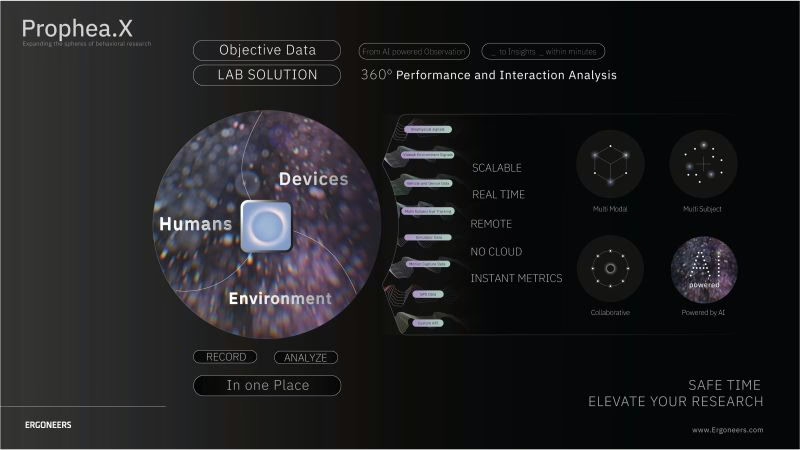
Move past the era of simple data logging and embrace the future of behavioral intelligence. The modern research workflow requires more than just a digital filing cabinet for numbers; it demands real-time behavioral coding and automated pattern recognition. Our multi-sensor data fusion software, Prophea.X, personifies this shift by acting as a collaborative partner in your laboratory. It possesses the agency to operate across sectors, allowing you to see the unseen in human interaction through advanced computational analysis. We define error-free precision as the new gold standard for high-stakes research. This commitment to accuracy ensures that your findings aren’t just data points, but a legacy of scientific excellence that prioritizes the human element in every technological evolution.
Synchronization: Solving the Temporal Friction of High-Frequency Data
Stop trying to force high-frequency biological signals into a spreadsheet. Manual data merging in Excel might seem like a cost-effective shortcut, but it’s a fundamental threat to scientific validity. When you deal with sampling rates of 60Hz, 500Hz, or even 1000Hz, a micro-delay creates a cascade of errors. This is where the phenomenon of clock drift becomes catastrophic. Every sensor has its own internal oscillator, and over the course of a sixty-minute study, these clocks diverge. Without professional multi-sensor data fusion software, your eye-tracking fixations and EEG spikes will slowly drift apart, rendering your analysis of cause and effect entirely speculative.
Mastering the temporal dimension requires a dedicated platform that handles millisecond-precise timestamps across disparate hardware. This precision is the cornerstone of synchronized data acquisition, ensuring that every biological reaction is perfectly anchored to its environmental trigger. By implementing sophisticated multi-sensor data fusion algorithms, researchers can move beyond “close enough” and achieve the error-free precision required for high-stakes aerospace or automotive HMI studies. This level of synchronization isn’t just about technical tidiness; it’s the only way to ensure research reproducibility in a world of increasing data complexity.
The Physics of Data Alignment: NTP, PTP, and Hardware Triggers
Choose the right protocol for your laboratory’s architecture. While Network Time Protocol (NTP) provides a basic baseline, Precision Time Protocol (PTP) is essential for sub-microsecond accuracy in local networks. High-end research demands hardware triggers that force a physical “handshake” between devices. This ensures that an eye-tracking frame aligns perfectly with a neural spike or a heart rate variability shift. In industries like automotive testing, where a reaction delay of 100 milliseconds can be the difference between safety and failure, “close enough” synchronization is a liability you can’t afford.
Post-Processing vs. Real-Time Sync: Which Do You Need?
Evaluate your needs based on the immediacy of your insights. Real-time data streaming allows for live participant monitoring and immediate intervention during a trial. However, post-hoc synchronization remains the vital standard for deep-dive behavioral coding. Modern multi-sensor data fusion software eliminates the friction by automating the most tedious 80% of the data cleaning workflow. It identifies gaps, corrects for drift, and prepares your datasets for analysis in a fraction of the time it takes to do so manually. If you’re ready to modernize your workflow, discuss your synchronization requirements with our expert team to find the right balance for your lab.
Critical Features of a High-Precision Multimodal Data Analysis Platform
Construct your research environment on a foundation of sensor agnosticism. In the rapidly evolving landscape of 2026, a high-precision platform must remain hardware-neutral to prevent technical stagnation. A visionary multi-sensor data fusion software acts as a universal translator, allowing you to bridge the gap between niche physiological sensors and standard environmental inputs. Demand API flexibility that supports custom eye tracking integration, ensuring your laboratory remains agile enough to adopt next-generation biological sensors as they emerge. This adaptability is the hallmark of a platform designed for long-term scientific legacy.
Visualizing the human experience requires more than generic data arrays or simple line graphs. You need advanced visualization tools that transform raw numbers into intuitive, actionable insights. Prioritize features that provide real-time heatmaps, dynamic gaze plots, and synchronized waveform overlays. These tools allow you to see the immediate relationship between a participant’s visual attention and their physiological arousal. As research environments become increasingly digital, you must also insist on security architectures that handle sensitive physiological data with clinical precision, maintaining compliance without sacrificing computational speed.
Hardware Compatibility and the Open Lab Philosophy
Avoid the trap of single-vendor ecosystems that limit your scientific reach and lock your data into proprietary silos. An “Open Lab” philosophy ensures that your analysis software can communicate with both legacy sensors and the latest VR/AR headsets. There’s a powerful synergy between using professional eye tracking glasses and a robust data fusion engine. This combination allows you to capture high-fidelity gaze data in naturalistic settings while maintaining the ability to fuse that data with external signals like vehicle telemetry or heart rate variability. Your tools should expand your boundaries, not define them.
AI-Assisted Analysis and Behavioral Coding
Empower your team with AI-assisted analysis to eliminate the bottleneck of manual processing. Modern multi-sensor data fusion software utilizes machine learning to automate object recognition and gaze-on-target metrics within video streams. This doesn’t replace the researcher; it liberates them. This shift towards automated intelligence is part of a larger trend, where Ergoneers is helping organizations architect the self-optimizing enterprise through sophisticated AI orchestration. By automating the repetitive 80% of data preparation, you can dedicate your expertise to nuanced manual coding and high-level behavioral interpretation. Collaborative features further amplify this impact, allowing synchronized datasets to be shared across global teams, fostering a communal approach to solving the mysteries of human interaction.
A 5-Step Framework for Implementing a Multimodal Study Workflow
Transforming complex research questions into reproducible scientific data requires a disciplined, structured approach. High-precision behavioral science isn’t just about owning the best hardware; it’s about the methodology used to unify those signals. By following a rigorous framework, you ensure that your multi-sensor data fusion software serves as a reliable source of truth rather than a source of technical friction. This process begins with intellectual clarity and ends with the expansion of human insights.
Step 1: Define your research objective with clinical precision and identify the specific biological sensor modalities needed to answer it. Step 2: Calibrate all hardware components to establish a common time-sync protocol, creating a definitive master clock. Step 3: Conduct a pilot data collection to verify that your multi-sensor data fusion software is aligning disparate streams with millisecond accuracy. Step 4: Execute the full study while monitoring real-time signal integrity to catch sensor dropouts before they ruin a session. Step 5: Synthesize your findings within the platform using multimodal overlays and automated coding to reveal the hidden patterns in participant behavior.
The Pre-Study Checklist: Avoiding Data Friction
Eliminate technical bottlenecks before the first participant enters the lab. This involves verifying sampling rates and ensuring compatible data formats for EEG and eye tracking integration. Don’t overlook the human element; participant comfort is vital in studies involving multiple wearables, as physical fatigue can skew physiological markers. Configure the master clock to prevent drift during long-duration HMI sessions. A well-prepared lab is the only environment where visionary research can flourish without the distraction of manual errors.
Scaling from Pilot to Production
Manage the exponential growth of data when moving into longitudinal human machine interaction studies. As your datasets expand into the terabyte range, you must rely on automation to handle repetitive analysis tasks. This allows your team to focus on the high-level behavioral insights that drive innovation. Establish best practices for data archiving that maintain the integrity of multi-sensor records for years to come. Your data is your legacy; protect it by using a platform designed for professional scale and scientific rigor. If you’re ready to implement this framework in your own lab, contact Ergoneers for expert consulting and training.
Prophea.X: The Visionary Standard for Synchronized Behavioral Intelligence
Harness the power of a platform built on two decades of scientific excellence. Prophea.X represents the definitive evolution of Ergoneers’ 20-year legacy in the field of behavioral research. It isn’t merely a utility for recording; it’s a sophisticated multi-sensor data fusion software designed with the agency to operate across diverse sectors, from academic laboratories to high-stakes industrial environments. This versatility is essential when studying the implementation of Industry 4.0 systems, such as the robotic solutions provided by EdNex Automation, where human-machine interaction is critical. By adopting a “Visionary Expert” approach, we’ve developed a system that speaks the language of researchers, prioritizing the human element in every calculation.
Achieve error-free precision through the seamless integration of our Dikablis Glasses and an expansive array of third-party physiological sensors. Prophea.X acts as the central nervous system of your lab, empowering the next generation of HMI science by aligning complex biological signals with environmental reality. This holistic perspective ensures that your data isn’t just a collection of numbers, but a profound insight into the human-technology relationship. We don’t just provide tools; we offer a partnership in the expansion of scientific knowledge.
Why Prophea.X Outperforms Generic Data Platforms
Don’t settle for generic business intelligence tools that lack the nuance required for deep behavioral study. While other platforms focus on navigation or simple data arrays, Prophea.X is dedicated specifically to the complexities of human interaction. This specialized focus allows us to offer a communal support structure where Ergoneers acts as your dedicated research partner rather than a simple vendor. Our users frequently report significant efficiency gains, such as reducing manual analysis time by 60% through automated synchronization and intelligent pattern recognition. This shift from manual labor to high-level analysis allows your team to focus on the cognitive drivers behind the data. For studies requiring precise measurement of physical execution alongside visual attention, our platform’s support for EMG integration with eye tracking delivers the millisecond-accurate synchronization that separates rigorous science from guesswork.
Your Partner in the Evolution of Research
Empower your lab to look toward the future of human-technology interaction with quiet confidence. We provide more than just software; our team offers comprehensive behavioral research lab consulting and specialized training and workshops to ensure your success. Whether you’re integrating VR, AR, or AI-driven insights for 2026 and beyond, Prophea.X is built to scale with your ambitions. We invite you to join a legacy of excellence and experience the next phase of scientific discovery. Book a Prophea.X demonstration today and discover how we can help you redefine the boundaries of behavioral intelligence.
Architecting the Future of Human-Centric Innovation
Embrace the next era of behavioral science by bridging the gap between biological physics and environmental context. We’ve explored the critical importance of millisecond-level synchronization and the transformative power of a unified multimodal workflow. These aren’t just technical requirements; they’re the foundation of scientific integrity. By deploying professional multi-sensor data fusion software, you empower your lab to transcend data silos and focus on the profound “why” behind human interaction.
Ergoneers stands at the intersection of academic rigor and industrial agility. As a Technical University of Munich (TUM) spin-off with over 20 years of high-precision research legacy, we remain the trusted choice for global leaders in the automotive and aerospace sectors. We aren’t just selling tools; we’re inviting you into a collaborative future where technology serves human needs. Experience the future of behavioral research with a Prophea.X demo and reclaim the absolute precision your study deserves. The next breakthrough in human-machine interaction is waiting for your discovery.
Frequently Asked Questions
A human behavior multimodal data analysis platform is a centralized software environment designed to capture, align, and analyze diverse behavioral data streams simultaneously. It functions as a cognitive bridge, allowing researchers to observe how physiological signals like heart rate or brain activity correlate with environmental triggers in real time. By unifying these disparate sources, the platform provides a holistic view of human behavior that unimodal studies cannot achieve.
You can integrate a wide variety of hardware with Prophea.X thanks to its sensor-agnostic architecture. While it offers seamless, native compatibility with Tobi Glasses III and our Dikablis Glasses X, the platform’s flexible API allows for custom eye tracking integration with many third-party devices via TCP/IP or UDP. This open-lab philosophy ensures you aren’t locked into a single hardware ecosystem, allowing your laboratory to remain agile as new sensor technologies emerge.
The software maintains millisecond-precise synchronization by utilizing advanced multi-sensor data fusion software algorithms that correct for clock drift across different devices. It employs protocols like Precision Time Protocol (PTP) and hardware triggers to force a physical handshake between the EEG and eye-tracker. This rigorous temporal alignment ensures that every neural spike is perfectly anchored to the corresponding gaze frame, preserving the scientific validity of your high-frequency data.
Prophea.X provides the capability for both real-time data streaming and deep-dive post-hoc analysis. Real-time monitoring allows you to verify signal integrity and participant engagement during the live study, which is vital for preventing data loss. However, the platform’s power truly shines during post-processing, where it automates the most tedious 80% of behavioral coding and data cleaning, allowing you to focus on high-level human insights.
High-precision studies require a robust computational foundation, typically involving a high-performance workstation with a dedicated GPU to handle multiple high-frequency data streams. Depending on your research modalities, you may need specific hardware interfaces such as a vehicle CAN-bus adapter, EEG amplifiers, or professional eye-tracking glasses. We recommend consulting with our lab experts to ensure your hardware configuration matches the specific sampling rates and data throughput of your chosen sensors.
AI acts as a collaborative partner by automating the repetitive tasks of object recognition and gaze-on-target metrics within video streams. By using machine learning to identify patterns across synchronized data acquisition datasets, the software can highlight significant behavioral events that might be missed during manual review. This computational assistance doesn’t replace the researcher; it empowers them to focus their expertise on nuanced interpretation rather than manual data entry.
Modern multi-sensor data fusion software is specifically designed to operate within the three-dimensional boundaries of immersive VR and AR environments. It can synchronize gaze data with virtual object interactions and physiological responses, providing a complete picture of the user experience in digital spaces. This capability is essential for future-proofing your research as HMI studies increasingly move from physical cockpits to simulated, high-fidelity virtual worlds.
While the platform is built for scientific authority, its intuitive interface is designed to be accessible to researchers across various disciplines. You don’t need to be a software engineer to operate Prophea.X, though a foundational understanding of data synchronization is helpful. We offer dedicated training and workshops to ensure your team can master the software’s advanced features, moving you quickly from technical implementation to visionary discovery.