

News & Posts
Eye Tracking Technology: A Comprehensive Guide for Behavioral Research
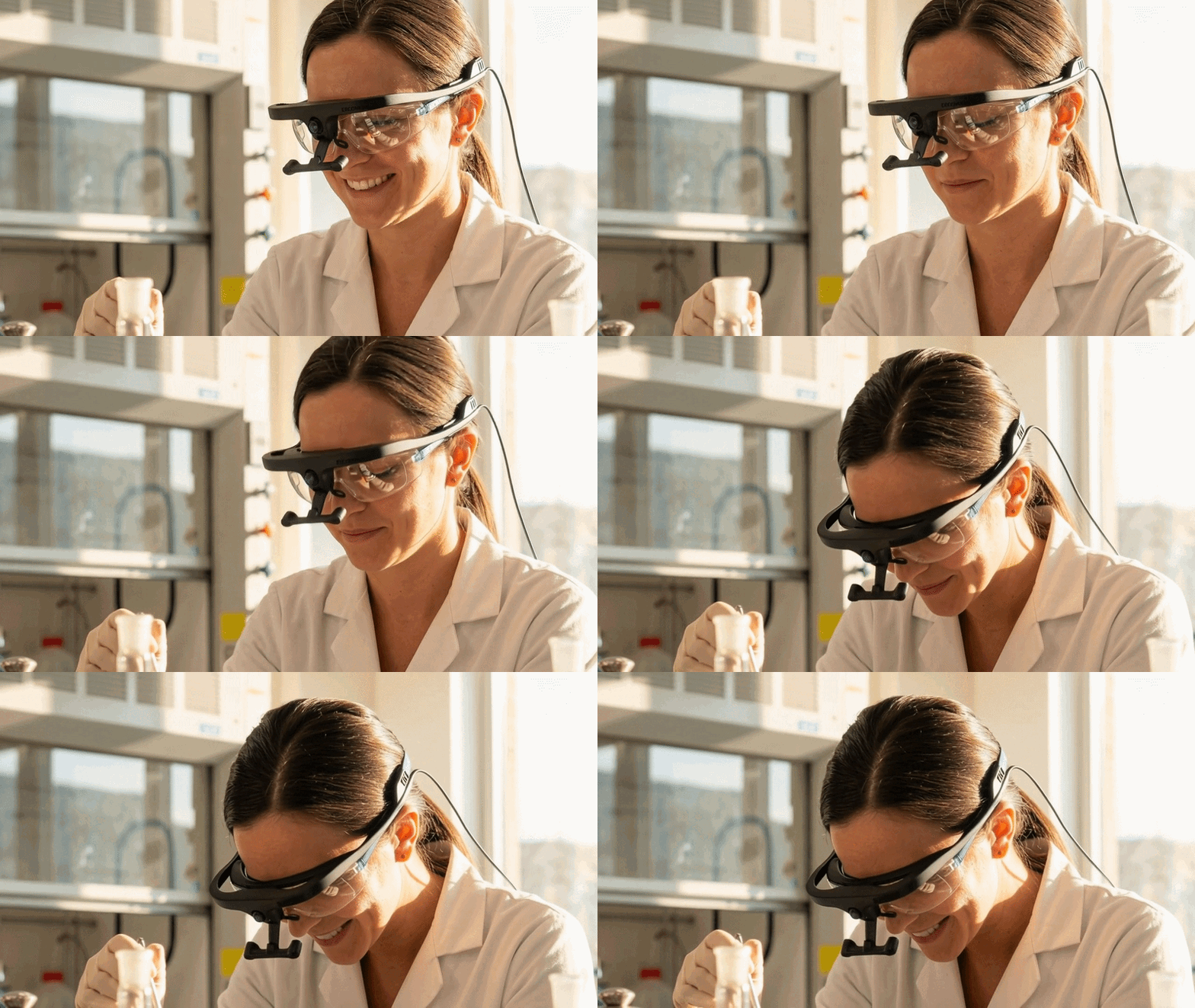
Eyetracking is a most valuable method to decode human behaviour. If you have tried eye-tracking before you've likely felt the frustration of data friction during recording from callibration issues to signal loss in changing light conditions or low accuracy of multi-sensor synchronization especially in dynamic environments. It's clear that mastering eye tracking technology is no longer just about hardware but implimenting powerful software-hardware compositions to really identofy where a subject looks. Triangulating intent within a complex, multimodal landscape comes next.
This guide empowers you to transform raw gaze data into profound human behavioral insights. You'll learn how to navigate high-frequency analysis and establish a robust framework for your next study. We'll compare hardware modalities such as Dikablis and Tobii Glasses and demonstrate how Prophea.X acts as an intelligent partner to unify your data streams. From understanding core technical mechanisms to implementing advanced behavioral research lab consulting strategies, this 5-minute read is is about to elevate your research from simple observation to visionary discovery.
Key Takeaways
- Move beyond static heatmaps to decode complex ocular activity and high-frequency behavioral signals within a modern research framework.
- Master the technical nuances of Pupil-Corneal Reflection (P-CR) to ensure data integrity across diverse lighting and dynamic environmental conditions.
- Evaluate the precision of screen-based versus wearable modalities, such as Dikablis Glasses, to align your hardware choice with specific laboratory or real-world requirements.
- Establish a robust foundation for multimodal studies by positioning eye tracking technology as the central anchor for complex sensor fusion.
- Utilize Prophea.X to synchronize disparate data streams and transform raw video into structured, actionable insights through AI-driven behavioral coding.
Table of Contents
- Understanding Eye Tracking Technology: Beyond the Gaze
- The Mechanics of Precision: How Modern Eye Trackers Capture Data
- Comparing Eye Tracking Modalities: Screen-Based vs. Wearable vs. Remote
- Selecting the Right Technology for Your Research Framework
- The Future of Behavioral Insights: Integrating Eye Tracking with Prophea.X
Understanding Eye Tracking Technology: Beyond the Gaze
Eye tracking is a sophisticated biometric technology that measures ocular activity and gaze vectors to determine exactly where a person is looking, for how long, and in what sequence. While early applications often focused on simple visual attention, the field has undergone a radical transformation. By 2026, the industry has moved beyond basic heatmaps to embrace complex behavioral signal analysis. This evolution allows researchers to decode the subconscious dialogue between a human and their environment, making eye tracking technology the gold standard for objective human-machine interaction (HMI) studies.
Modern research demands more than just a point on a screen. It requires a deep dive into the biological physics of the eye. By capturing high-frequency data, we move from observing “what” someone sees to understanding “why” they react. This shift transforms raw ocular data into a vital partner for industrial safety, automotive design, and psychological research.
The Core Metrics of Visual Attention
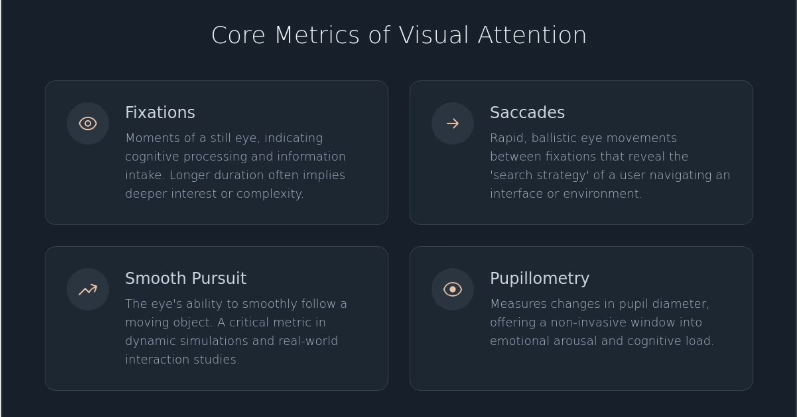
To master the landscape of behavioral research, one must first identify the core signals that define human visual strategy. These metrics provide the empirical evidence needed to validate research hypotheses:
- Fixations: These are the moments when the eye remains relatively still, acting as the primary indicator of cognitive processing and information intake. Longer fixations often suggest higher complexity or deeper interest.
- Saccades: These rapid, ballistic movements between fixations reveal the “search strategy” of the participant. They highlight how a user navigates a cockpit or a digital interface.
- Smooth Pursuit: This describes the eyes’ ability to closely follow a moving object, a critical metric in dynamic simulation environments.
- Pupillometry: Measuring changes in pupil diameter provides a non-invasive window into emotional arousal and mental effort, allowing researchers to quantify cognitive load without interrupting the task.
Why Precision Matters in 2026 Research
Success in high-stakes research depends on the integrity of your data. There is a vast chasm between consumer-grade tracking and scientific-grade high-precision hardware. While basic trackers might suffice for casual interaction, they lack the sampling frequency required to capture micro-saccades or subtle tremors. High-end eye tracking technology often operates at 120 Hz or higher, ensuring that no nuance of human behavior is lost to temporal aliasing.
Precision isn’t just a technical specification; it’s a commitment to error-free research. In industrial or medical contexts, even a single degree of offset can lead to flawed conclusions. Scientific-grade systems maintain accuracy in real-world environments, providing the clinical precision necessary to build a legacy of reliable, replicable findings. This level of detail empowers you to bridge the gap between theoretical academic contexts and practical, high-stakes applications.
The Mechanics of Precision: How Modern Eye Trackers Capture Data
Harness the power of optical physics to transform invisible ocular movements into quantifiable data. Professional eye tracking technology relies on the sophisticated interplay between infrared illuminators and high-speed cameras. This Pupil-Corneal Reflection (P-CR) technique captures the geometric relationship between the center of the pupil and the reflection on the cornea, known as the glint. By measuring the distance and angle between these two points, the system determines exactly where a subject is looking within a three-dimensional space.
Mastering these mechanics requires understanding how systems adapt to environmental variables. Researchers must choose between dark-pupil and bright-pupil tracking based on the participant’s physiology and the ambient lighting. Bright-pupil tracking, often used in darker settings, creates a high-contrast effect that makes the pupil easily distinguishable. Conversely, dark-pupil tracking excels in well-lit environments where the camera’s offset from the light source creates a dark void.
The corneal reflection acts as a stable reference point, allowing modern systems to compensate for minor head movements without losing the gaze signal. By 2026, this hardware foundation is bolstered by AI-driven filtering algorithms. These intelligent agents operate within platforms like Prophea.X to strip away data noise in real-time. This process preserves the integrity of the signal while ensuring that the subtle nuances of micro-saccades aren’t lost to technical friction. It’s this fusion of biological physics and computational intelligence that empowers you to bridge the gap between raw data and human insight.
The P-CR Mechanism and Optical Physics
Examine the geometry of the eye to appreciate how a gaze vector is calculated. Infrared light reflects off the cornea to create a trackable glint, which the system uses to establish a geometric vector relative to the eye’s optical axis. Using non-visible light is essential; it prevents participant distraction and maintains the naturalistic integrity of your behavioral study. This allows for a seamless recording experience where the participant remains focused on the stimulus rather than the hardware.
Sampling Rates and Temporal Resolution
Temporal resolution defines the granularity of your insights. While entry-level 60Hz systems capture basic gaze points, professional 200Hz+ systems are required for linguistic or neurological research. High-speed scientific systems reaching benchmarks of 1200Hz allow you to observe the finest cognitive shifts and rapid ocular tremors. In 2026, the standard for multimodal research involves synchronized data acquisition across multiple sensors. This ensures that your gaze data aligns perfectly with EEG or GSR signals. If you’re ready to design a high-precision study, you can consult with our experts to find the ideal hardware configuration for your lab.
Comparing Eye Tracking Modalities: Screen-Based vs. Wearable vs. Remote
Select the architecture that aligns with your research environment to ensure the highest data integrity. While the underlying eye tracking technology remains consistent, the physical modality dictates the participant’s freedom and the spatial resolution of your results. Researchers must weigh the clinical precision of stationary systems against the ecological validity of wearable solutions to capture the most authentic human behavior. This decision is the cornerstone of your study’s success, as it determines how effectively you can bridge the gap between raw data and actionable insights.
Evaluate screen-based (remote) trackers for controlled, stimulus-driven laboratory experiments where high sampling rates and sub-degree accuracy are paramount. These systems excel in UX testing and psychological software trials where the stimulus is static. Conversely, deploy wearable glasses for mobile, real-world, or cockpit environments where the participant’s physical navigation is the focus. For immersive simulation frameworks, integrated VR/AR systems provide a unified view of gaze within a digital twin, allowing for the expansion of human insights in entirely virtual realms.
Wearable Technology for Dynamic Environments
Deploy professional eye tracking glasses to capture expertise in high-stakes industrial training or sports performance. Wearable systems like Dikablis Glasses provide the necessary freedom of movement to study participants as they interact with complex machinery or navigate physical spaces. This mobility allows you to record behavior in the exact context where it occurs, which is vital for understanding real-world decision-making processes.
Analyze behavior in 3D space using Area of Interest (AOI) mapping, which allows you to translate mobile gaze data into structured insights even when the participant is in motion. Modern wearable solutions prioritize the human element through ergonomic design, ensuring stability and comfort during long-term behavioral lab sessions. While mobility introduces challenges like calibration drift, our advanced AI-driven filtering in Prophea.X is designed to mitigate these errors, maintaining a legacy of precision in every recording.
Remote Tracking for Controlled Stimuli
Identify use cases for screen-based systems when your stimulus is fixed, such as a monitor or a static physical display. These remote trackers utilize a “head box” concept; this is a specific volume in space where the participant can move naturally without the system losing track of their eyes. Because it doesn’t require wearable hardware, this setup offers the fastest participant throughput and minimizes the potential for hardware-induced fatigue or distraction.
Compare the ease of setup in remote systems against their inherent mobility limitations. While they offer superior spatial accuracy for reading studies or fine-grained visual search tasks, they can’t follow a participant into the field. Select these systems when your research hypothesis focuses on the cognitive processing of high-resolution digital content rather than physical exploration. By matching the modality to your specific eye tracking technology needs, you ensure that your data is both reliable and relevant to the human needs you aim to address.
Selecting the Right Technology for Your Research Framework
Establish a rigorous technical foundation by aligning your hardware choice with the specific demands of your research hypothesis. The most common objection among behavioral scientists is whether modern eye tracking technology is reliable enough for high-stakes sensor fusion. The answer lies in your ability to synchronize high-frequency data streams without introducing temporal jitter. By prioritizing systems that offer open API access and custom eye tracking integration, you ensure that your lab remains a flexible, future-proof environment for discovery.
Mastering this landscape requires more than just high-end hardware. It demands a partnership with experts who understand the nuances of data processing. Our expert-led training and workshops bridge the knowledge gap for new teams, ensuring that your transition from raw gaze vectors to profound insights is seamless. This collaborative approach empowers researchers to focus on the human element while the technology operates with error-free precision in the background. It’s about building a legacy of excellence through reliable, repeatable methodology.
Defining Your Accuracy and Precision Requirements
Distinguish between accuracy and precision to maintain the clinical rigor of your study. Accuracy represents the average distance between the actual gaze point and the recorded data, while precision measures the consistency of those data points over time. In 2026, the technical benchmark for spatial resolution in high-end systems is defined by a root-mean-square (RMS) precision of less than 0.01 degrees under ideal laboratory conditions. While 0.5 degrees of accuracy may suffice for general marketing research, high-stakes industrial training or neurological studies often demand the 0.1-degree threshold to capture micro-movements reliably.
The Multimodal Imperative: EEG, EMG, and Beyond
Recognize that isolated gaze data provides only a partial view of the human experience. To truly excel at optimising human machine interaction studies, you must treat the participant as a unified biological system. This requires the integration of eye tracking with other biometric sensors like EEG (electroencephalography) and EMG (electromyography) to capture a holistic picture of cognitive load and physiological response. Prophea.X works with a great number of high precision and entry level partner Sensors like Emotive, Thought Technology or Neurolectric EEGs to pursue your research goals.
Achieving this level of synchronization demands hardware-level coordination. Use TTL (Transistor-Transistor Logic) triggers for microsecond-precise alignment between disparate sensors; alternatively, rely on the advanced computational agency of Prophea.X to manage software-level sync. This visionary approach transforms your research lab into a comprehensive hub for human-technology interaction. If you’re ready to design a custom multimodal framework, connect with our consulting team to begin your implementation.
The Future of Behavioral Insights: Integrating Eye Tracking with Prophea.X
Elevate your research from the collection of disparate data points to the orchestration of a unified behavioral narrative. While high-precision hardware provides the foundation, the true evolution of eye tracking technology lies in its integration into a central nervous system for multimodal data execution. Prophea.X serves as this vital core, empowering researchers to synchronize gaze data with physiological and environmental streams in real-time. This active platform doesn’t just store information; it possesses the agency to transform raw biological signals into structured, actionable insights that drive industry and academia forward.
Embrace a unified platform that eliminates technical friction by providing a single interface for synchronization, analysis, and visualization. By consolidating your workflow, you move beyond the limitations of passive data viewing. AI-driven behavioral coding now allows for the rapid transformation of raw video into meaningful patterns, identifying key events with a speed that manual processes cannot match. This visionary approach ensures that the human element remains at the center of your study, allowing you to focus on high-level interpretation while the software handles the computational heavy lifting with error-free precision.
Automating the Behavioral Workflow
Shift your focus from the tedious task of manual coding to the strategic advantage of automated event detection. In 2026, the standard for professional labs is no longer just about recording; it’s about the intelligent expansion of human insights. Prophea.X utilizes advanced algorithms to recognize behavioral markers, ensuring that your analysis is both objective and exhaustive. This automation minimizes human error and significantly reduces the time between data acquisition and discovery. It’s a commitment to a workflow where the software acts as a collaborative partner, expanding the boundaries of what your team can achieve within a single study.
From Data to Legacy: Scaling Your Research Lab
Secure the future of your institution by adopting a long-term view of lab design. Establishing a cutting-edge research environment requires more than just purchasing tools; it demands a partnership rooted in academic rigor and industrial expertise. Through our specialized behavioral research lab consulting and hands-on training and workshops, we help you build a legacy of scientific excellence. We position ourselves not as a vendor, but as a vital partner in your growth, ensuring your facility is equipped to handle the next phase of human-technology interaction.
Join a community of intellectual leaders who are redefining the relationship between people and technology. Whether you’re optimizing a vehicle cockpit or exploring cognitive processing in a virtual environment, the right framework is essential for professional scale. Explore our professional behavioral research solutions to discover how our integration ecosystem can empower your next technological revolution.
Advancing the Frontiers of Human-Technology Interaction
Mastering the technical landscape of eye tracking technology is the first step toward decoding the complex nuances of human behavior. You’ve seen how precision hardware and intelligent software like Prophea.X work in tandem to transform raw gaze vectors into structured insights. By selecting the right modality and embracing a multimodal framework, you ensure your research remains both rigorous and relevant. This journey from data acquisition to profound discovery requires a partner who understands the clinical demands of the lab and the aspirational goals of the future.
Founded at the Technical University of Munich, Ergoneers offers a 20-year legacy of excellence as a global leader in multimodal HMI integration. We don’t just provide tools; we empower your team to lead technological revolutions through specialized consulting and high-precision hardware. It’s time to bridge the gap between human needs and technical capability. Empower your research with Prophea.X and Dikablis. Your next breakthrough is waiting to be seen.
Frequently Asked Questions
Modern high-precision systems achieve sub-degree accuracy, typically ranging between 0.1 and 0.5 degrees under controlled conditions. This level of precision allows researchers to pinpoint gaze locations on small targets even within complex digital interfaces or dynamic real-world environments. Achieving these benchmarks requires professional-grade hardware and rigorous calibration to ensure the data reflects the participant’s true focus of attention with clinical reliability.
Yes, contemporary systems are engineered to accommodate most corrective lenses and contact lenses seamlessly. Advanced Pupil-Corneal Reflection (P-CR) algorithms effectively compensate for the additional reflections and refractions caused by glass or plastic. While thick frames or specific infrared-blocking coatings can occasionally interfere with the camera’s line of sight, professional research glasses are designed to maintain a robust track for the vast majority of the population.
Sampling rate refers to the frequency at which the tracker captures the eye’s position, measured in Hertz (Hz), while accuracy defines the distance between the recorded gaze and the actual target. A high sampling rate is essential for capturing rapid ocular events like saccades and micro-tremors. Accuracy ensures that the captured data points are geographically correct, providing the spatial truth necessary to validate your research hypotheses.
Synchronize your multimodal data using hardware-level TTL triggers or specialized integration platforms like Prophea.X. These tools act as a central hub, aligning timestamps across disparate biometric sensors with microsecond precision. This rigorous synchronization ensures that a visual fixation and a physiological response, such as a change in heart rate, are mapped to the exact same moment in time for a holistic behavioral analysis.
Research typically employs screen-based (remote) trackers, wearable glasses like Dikablis, and integrated VR/AR headsets. Screen-based systems are the standard for static stimuli in laboratory settings, offering high temporal resolution. Wearable glasses empower you to study mobile behavior in real-world or industrial environments. VR integrations facilitate immersive simulation studies, allowing for the expansion of human insights within entirely digital frameworks.
Modern eye tracking technology utilizes low-power near-infrared light to track ocular movements without physical contact or distracting flashes. This allows participants to behave naturally and maintain focus on their tasks. Because the technology is unobtrusive, the ecological validity of your behavioral research remains intact throughout the entire recording session.
Ambient lighting can impact data quality by creating competing reflections on the cornea or causing the pupil to constrict significantly. Professional systems mitigate these challenges by utilizing both bright-pupil and dark-pupil tracking modes to maintain a high-contrast signal. Maintain consistent lighting in your lab to prevent calibration drift and ensure that the cameras can clearly distinguish the pupil from the surrounding iris.
Analyze your high-frequency data using comprehensive platforms like Prophea.X, which provide dedicated modules for recording, visualization, and automated behavioral coding. This software transforms raw gaze coordinates into structured metrics such as fixations, saccades, and heatmaps. Utilizing a unified integration ecosystem ensures that eye tracking technology operates as a seamless, intelligent partner within your broader multimodal research framework.Analyze your high-frequency data using comprehensive platforms like Prophea.X, which provide dedicated modules for recording, visualization, and automated behavioral coding. This software transforms raw gaze coordinates into structured metrics such as fixations, saccades, and heatmaps. Utilizing a unified integration ecosystem ensures that eye tracking technology operates as a seamless, intelligent partner within your broader multimodal research framework.