

News & Posts
How latest eye-tracking technology is opening a new era for sports performance insights

© Ryan Arnst
Eye-Tracking: Applications, Potentials, and Challenges in Sports Training & Performance Analysis
This white paper explores the application of state-of-the-art multi subject eye tracking and video observation in sports science, with a special emphasis on team sports and distinguished analysis objectives for individual object-player dynamics and laying out potentials for multi-modal studies
Abstract
Mobile Eye Tracking and Video Observation in Sports Science
Mobile eye tracking is rapidly becoming a cornerstone in the field of sports behavior analysis. It allows for the real-time or post-hoc capture of visual focus—where, when, and how long an athlete looks at specific stimuli. This capability is critical in understanding perceptual-cognitive skills such as visual search strategies, fixation durations, and scanning patterns. Video observation, when used in parallel, grounds these gaze patterns in context, enabling a more holistic interpretation of what is happening and why.
Wireless eye trackers from Tobii like Tobii Glasses III as much as Ergoneers´ Dikablis Glasses.X enable athletes to perform in natural environments, free from the constraints of laboratory settings. These tools provide reliable, accurate gaze data even during rapid motion and in outdoor conditions. Importantly, they can be integrated into Prophea.X multi-subject setups, where several athletes are observed simultaneously.
In team sports, this means the ability to study interpersonal gaze behavior—how players coordinate visually, how they distribute attention during dynamic plays, and how communication is visually cued. In individual sports, it allows for detailed analysis of gaze-object alignment, such as tracking a ball, evaluating a target, or focusing on a coach’s instructions.
Challenges remain, of course. Calibrating eye trackers in uncontrolled settings, dealing with occlusion or erratic lighting, and ensuring precise synchronization with other data streams are non-trivial hurdles. However, the benefits far outweigh the complications—especially when data is processed and interpreted through a powerful platform like Prophea.X, which handles large volumes of synchronized visual and sensor data across multiple athletes.
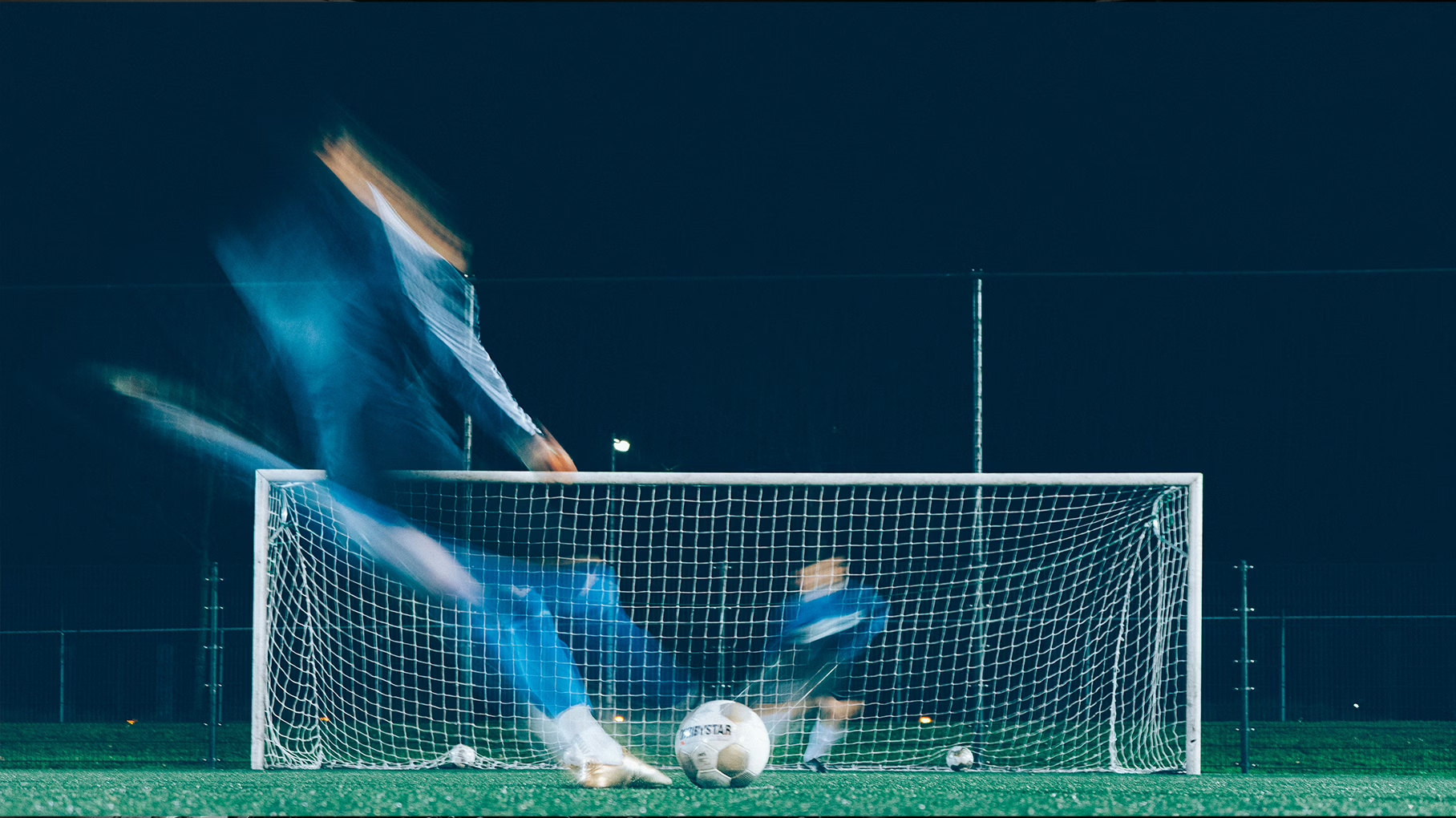
© Jannes Glas
Enhancing Team Performance Through Visual and Behavioral Insights
Applications in Team Sports
Team sports such as soccer, basketball, or rugby involve complex, coordinated actions under high cognitive and physical demands. Players must simultaneously process vast amounts of visual information—opponents, teammates, the ball, spatial positioning, and tactical cues. Eye tracking offers a direct window into how players prioritize visual information, how they anticipate actions, and how effective team communication manifests through gaze.
Multi-subject tracking, made possible by Prophea.X, allows researchers to record and analyze the gaze behavior of multiple players simultaneously. This makes it feasible to study joint attention—moments when two or more players are looking at the same object or player—and to assess how coordination develops visually across different phases of play. For example, when a midfielder scans the field before delivering a pass, does their gaze anticipate the striker’s run? Are defenders aligning their gaze with the movements of attackers or reacting too late?
Video observation enriches this data by providing contextual clarity. With the integration of automatic subject recognition and areas of interest (AOIs), it is possible to isolate key behaviors and tactical decisions. Gaze patterns can be analyzed in relation to ball possession, spatial positioning, or team formations. With Prophea.X , AOIs can be defined dynamically or statically, allowing researchers to track visual attention towards moving targets or fixed zones like goals, sidelines, or coaching areas.
The challenges are real. Overlapping bodies, changing lighting, and unpredictable play scenarios make video and gaze tracking in team sports a technical endeavor. Managing large data sets and maintaining calibration accuracy are additional concerns. Nevertheless, Prophea.X addresses these issues with its advanced data management architecture, automated event recognition, and scalable annotation tools.
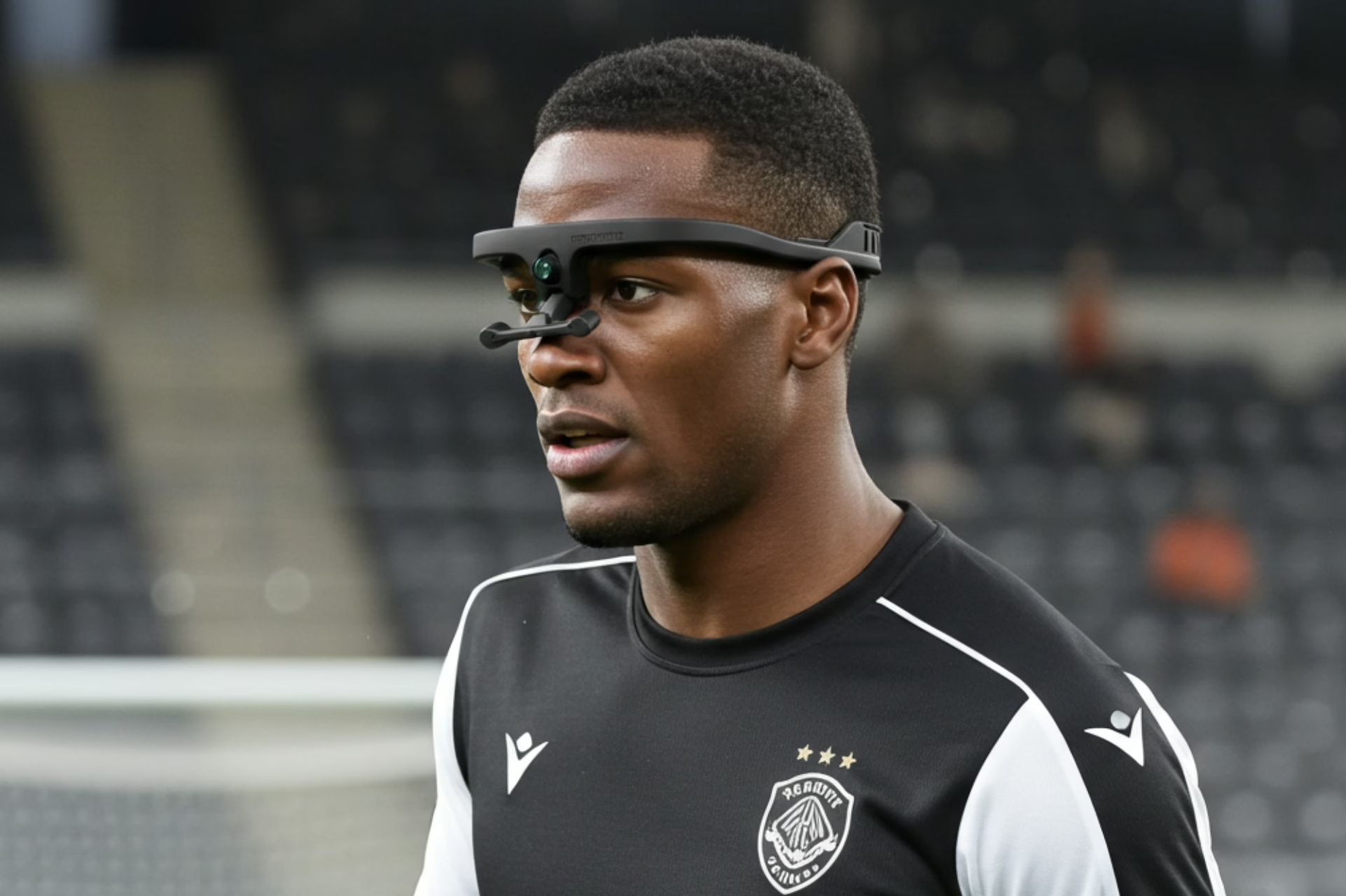
Uncovering the Hidden Drivers Behind Athletic Performance Under Pressure
Linking Performance, Stress, and Environmental Factors
Understanding athletic performance means understanding stress—both its sources and its effects. Eye tracking, combined with video and physiological sensors, can provide a multimodal view of how stress manifests during performance.
Gaze instability, rapid saccades, and erratic fixations often indicate cognitive overload or stress. When these indicators are synchronized with environmental cues (e.g., crowd noise, lighting changes, color stimuli) and biophysical signals (like heart rate, galvanic skin response, or EEG), researchers gain a full-spectrum view of athlete experience.
Prophea.X’s Ecosphere enables the integration of multiple sensor types using protocols like LSL, ROS, and UDP/IP. This makes it possible to build complex experiments that link behavior (e.g., gaze direction), environmental stimuli (e.g., sound, light), and physiological response in real time.
For example, an ice hockey player might exhibit gaze narrowing during a pass or slap shot in a noisy arena. Simultaneously, heart rate spikes and increased skin conductance indicate stress. By capturing and analyzing this synchronized data, coaches and sports scientists can identify exact stress drivers to develop training strategies that prepare athletes for high-stress conditions.
The primary challenge in this domain is managing complexity. Multiple devices, synchronization errors, and data volume can overwhelm researchers. Prophea.X addresses this issue with an intuitive interface for sensor integration, powerful back-end data management for collaborative workflows, and real-time visualization tools.
Conclusion
Prophea.X as a Gateway to Future Sports Research
The combination of eye tracking, video observation, motion capture, and physiological monitoring represents a new frontier in sports science. These technologies, when integrated properly, offer a comprehensive, data-rich understanding of how athletes perform, decide, and interact under pressure.
Prophea.X stands at the center of this transformation. Its capacity to manage multi-subject setups, define dynamic AOIs, and synchronize heterogeneous data streams makes it an essential tool for sports researchers and performance analysts. Whether it’s improving tactical awareness in team sports, refining focus in individual sports, or decoding stress patterns across modalities, Prophea.X provides the infrastructure and intelligence needed to turn behavioral data into performance gains.
As the field of sports science continues to evolve, Prophea.X offers not just analysis but insight—insight that empowers coaches, trainers, and athletes to reach new levels of understanding and excellence.
References & Resources
1. Tobii Pro Glasses 3
2. Dikablis Glasses.X by Ergoneers
3. Prophea.X by Ergoneers
4. Vickers, J. N. (2007). Perception, Cognition, and Decision Training: The Quiet Eye in Action.
5. Williams, A. M., & Ford, P. R. (2008). Expertise and Expert Performance in Sport.
6. Davids, K., Araújo, D., & Shuttleworth, R. (2005). Applications of Dynamical Systems Theory to Football.
7. McGuckian, T. B., Cole, M. H., & Pepping, G.-J. (2018). A Systematic Review of the Technology-Based Assessment of Perceptual-Cognitive Processes in Sport.
8. Land, M. F., & Tatler, B. W. (2009). Looking and Acting: Vision and Eye Movements in Natural Behavior.


