

News & Posts
Checklist: Building a High-Precision Human Performance Lab
As the bottleneck in recent UX and performance research has shifted from a lack of data to the invisible wall between physiological metrics and behavioral reality, the challenge today is to bring insights into one framework. You likely recognize the friction of managing isolated data silos where your Eye-tracking, EEG, Simulator, and Motion-Capture Systems refuse to speak the same language. Building a high-precision human performance or UX lab therefore demands a shift from collecting fragments to architecting a unified ecosystem. It requires a vision that prioritizes the human element while also maintaining the clinical rigor necessary to meet high-frequency capabilities. More self-explaining; it needs to be capable of capturing and synchronizing the latest file formats, handling complex acquisition protocols, and guaranteeing data privacy. We've designed this checklist to help you bridge the gap between theoretical benchwork and real-world application.
You'll discover how to synchronize multimodal data streams and eliminate the technical hurdles that stall scalability. We'll explore the essential infrastructure for seamless integration, the power of Prophea.X to orchestrate complex datasets, and the behavioral frameworks that turn raw numbers into human-centric breakthroughs. This article guides you through the critical steps to evolve your research environment into a vital partner for the future of human-technology interaction.
We've designed this checklist to help you bridge the gap between theoretical benchwork and real-world application. You'll discover how to synchronize multimodal data streams and eliminate the technical hurdles that stall innovation. We'll explore the essential infrastructure for seamless integration, the power of Prophea.X to orchestrate complex datasets, and the behavioral frameworks that turn raw numbers into human-centric breakthroughs. It's time to evolve your research environment into a vital partner for the future of human-technology interaction.
Key Takeaways
-
Redefine your human performance lab as a multidimensional space where physiological precision meets the complexity of human-machine interaction.
-
Integrate core physiological sensors like ECG and EMG with environmental controls to simulate high-stakes stress scenarios with absolute accuracy.
-
Utilize Dikablis eye tracking technology to transform visual attention into a measurable window of cognitive load and real-time decision-making.
-
Deploy a unified software architecture like Prophea.X to synchronize multimodal data streams and eliminate the friction of fragmented research.
-
Bridge the gap between bench research and industrial application by leveraging expert consulting to scale your laboratory’s operational impact.
What is a Human Performance Lab in the Digital Age?
The modern human performance lab has transcended the boundaries of traditional sports science. It’s no longer a static environment confined to measuring maximum oxygen uptake or muscle fatigue. Instead, it has evolved into a multidimensional digital ecosystem designed to quantify the subtle nuances of human potential. This shift represents a fundamental move from purely physiological testing toward a holistic focus on human-machine interaction (HMI). Researchers now examine how the human nervous system, cognitive load, and physical movement synchronize when interacting with complex technological interfaces while eventually also still in extreme physical or mentally demanding situations.
Precision data serves as the foundation for this evolution. When we capture high-fidelity metrics, we aren’t just looking for errors; we’re seeking to engineer safer, more efficient technology that adapts to the user. This requires bridging the gap between the controlled rigor of academic research and the fast-paced demands of industrial application. A visionary lab acts as a vital partner in this process, transforming raw biological physics into actionable insights that empower both the designer and the end user. By prioritizing the human element, we turn technical data into a legacy of improved safety and performance.
The Evolution from Kinesiology to Behavioral Science
Traditional biomechanics focused heavily on injury prevention and mechanical efficiency. While these remain critical, the digital age demands a deeper understanding of the “why” behind every movement. We now augment physical metrics with sophisticated cognitive data to build comprehensive Human Performance Modeling frameworks. This transition enables researchers to move beyond the bench and into “in-the-wild” simulations. Whether it’s a pilot in a flight simulator or a technician on a factory floor, the goal is performance optimization. We’re not just preventing failure but expanding the boundaries of what humans can achieve through seamless technology interaction.
Interdisciplinary Collaboration as a Foundation
Success in this field requires a convergence of diverse scientific disciplines. A world-class human performance lab thrives at the intersection of several key domains:
- Biomedical Engineering: Providing the hardware precision to capture clean physiological signals.
- Cognitive Psychology: Interpreting the mental states, stress levels, and attention patterns behind the data.
- Data Science: Processing massive, multimodal datasets into clear, predictive behavioral trends.
The challenge often lies in the language of the data itself. Different research silos frequently use incompatible formats, leading to technical friction that stalls progress. Ergoneers facilitates this transition by providing a unified data language. Through strategic behavioral research lab consulting, we ensure that every sensor communicates through a single, coherent platform. This synergy allows your team to focus on discovery rather than troubleshooting connectivity. Our goal with Prophea.X is to create a collaborative environment where insights from a single study can influence both academic theory and practical industrial design while interdisciplinary teams can easily use a license together or exchange project data and accelerate their insight generation through collaborative workflows.
Essential Infrastructure for a High-Precision Research Lab
Mastering the architecture of a human performance lab requires more than just purchasing high-end devices. It demands a centralized data acquisition hub that serves as the laboratory’s nervous system. Without this core, your sensors remain isolated islands of data, leading to the technical friction that stalls breakthrough insights. You must prioritize hardware that offers clinical-grade precision while maintaining the flexibility needed for high-stakes research. Establish your foundation with core physiological monitoring, including electrocardiography (ECG), electromyography (EMG), and detailed respiratory analysis. These metrics provide the baseline for understanding the human body’s response to external stressors.
Leading institutions, such as at Frauenhofer Institute or Oregon Performance Research Laboratory, demonstrate how groundbreaking scientific research depends on this level of technical integration. By synchronizing high-fidelity motion capture with physiological sensors like eye-tracking or EEGs you create a three-dimensional view of the human subject. This holistic approach allows you to move beyond simple data collection and toward the expansion of human insights. If you’re unsure how to align your technical layout with your research goals, our Behavioral Research Lab Consulting team can help you map out a future-proof infrastructure.
Physiological and Biomechanical Hardware
Select sensors that deliver medical-grade precision without sacrificing research flexibility. In a modern human performance lab, movement must be natural and unencumbered. This makes wireless, low-latency devices essential for capturing clean data during dynamic tasks. Ensure your hardware choices are compatible with a unified software platform to allow for future-proof scaling. By investing in modular systems, you empower your lab to evolve alongside emerging technologies in biological physics and computational analysis. Precision is non-negotiable when your goal is the evolution of industry standards.
Simulation and Environmental Control
Engineering a world-class environment requires the ability to isolate specific performance factors. Use immersive technologies like VR, AR, or physical simulators to create high-fidelity scenarios that mimic real-world challenges. Controlling variables such as visual stimuli, cognitive load, and environmental stressors allows you to observe human behavior under pressure. This level of control is vital for moving research from the bench to practical application. By integrating these real-world stressors into a controlled setting, you bridge the gap between theoretical study and the practical needs of industry leaders.
The Behavioral Layer: Eye Tracking and Cognitive Load
Physiological metrics like heart rate or muscle activation tell only half the story. To truly understand the mechanics of expertise, you must look at the cognitive intent driving the physical action. Eye tracking serves as the definitive window into the researcher’s cognitive state, revealing how subjects prioritize information under pressure. Within a high-precision human performance lab, this behavioral layer transforms raw observation into a quantifiable study of mental workload. By synchronizing visual attention with physiological spikes, such as a sudden rise in heart rate, you can pinpoint the exact moment a participant experiences cognitive overload.
Leading institutions like the Stanford Human Performance Lab ,utilize these interdisciplinary approaches to push the boundaries of human-technology interaction. While static eye tracking provides depth in controlled environments, mobile eye tracking is essential for capturing natural behavior in dynamic, high-movement scenarios. This distinction is critical when transitioning research from the laboratory bench to real-world industrial or athletic applications. By integrating these behavioral metrics, you move beyond the surface of performance to uncover the cognitive architecture of success.
Dikablis Professional: The Standard for Gaze Analysis
Achieve high-precision gaze data without compromising the participant’s natural range of motion. We designed Dikablis Professional to eliminate the technical friction that often plagues behavioral studies. Its open-frame design prioritizes participant comfort, which is vital for maintaining realism during long-duration tests. These professional eye-tracking glasses allow for seamless Eye Tracking Integration with other sensors, ensuring that your gaze data is perfectly aligned with your biomechanical metrics. This level of precision is what separates a world-class human performance lab from a standard testing facility.
Quantifying Mental Effort and Distraction
Measure what your subjects aren’t telling you. Use pupillometry and fixation patterns to assess cognitive strain and identify the “look-but-failed-to-see” errors that often precede accidents in high-stakes environments. When a participant’s eyes rest on a critical warning but their brain fails to process it, you’ve identified a vital failure point in the human-machine interface. Analyzing the relationship between visual focus and physical output allows you to engineer systems that prevent fatigue-induced errors. By quantifying mental effort, you empower your team to build a legacy of safer, more intuitive technologies that respect the limits of human cognition.
The Human Performance Lab Setup Checklist
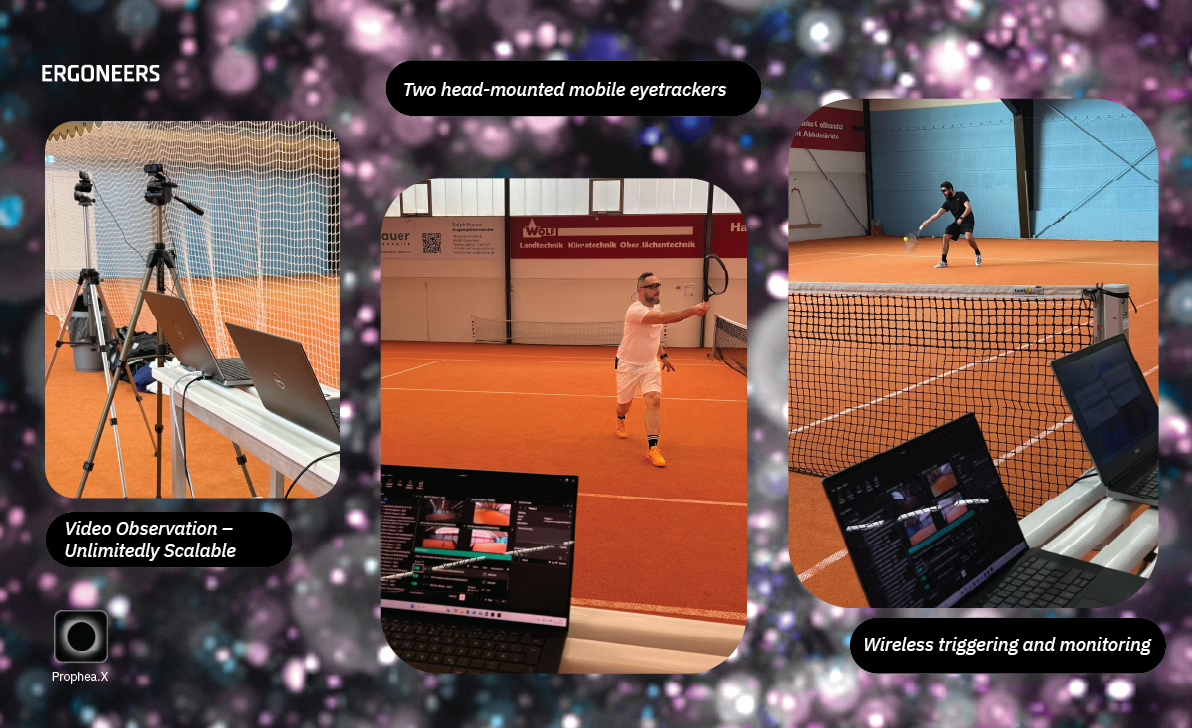
Constructing a premier human performance lab starts with a clear architectural blueprint. You must first define your research scope. Is it focused on clinical rehabilitation, elite athletic training, or industrial human-machine interaction (HMI)? This decision dictates your infrastructure needs and sensor requirements. Designing a physical layout that accommodates both static observation and mobile testing phases ensures your facility remains versatile. Establish standardized protocols for data ethics and participant safety from day one. Finally, implement an iterative pilot program to rigorously test sensor connectivity before launching full-scale studies. Precision demands a unified software platform that handles multimodal data without hesitation.
Technical Integration and Sensor Synchronization
Synchronization is the most common failure point in high-precision research. Overcoming the “time-sync” challenge across disparate hardware brands requires a sophisticated data acquisition strategy. You can’t rely on manual alignment when working with millisecond-sensitive gaze data and physiological signals. Use robust APIs to create a custom, seamless research workflow that bridges the gap between different technical languages. If your focus includes specialized behavioral testing, you might find our guide on how to set up a UX lab particularly useful for refining your technical stack. If you’re ready to move from concept to construction, our Behavioral Research Lab Consulting experts can provide the technical roadmap your project deserves.
Data Management and Ethical Standards
Security and compliance are the pillars of a sustainable human performance lab. You must ensure your data collection methods align with the February 2, 2026, FDA Quality Management System Regulation (QMSR) deadline, which incorporates ISO 13485:2016. For those in behavioral health, the July 1, 2026, CARF standards update requires clear oversight for the use of artificial intelligence in research. Structure your databases to support long-term longitudinal studies while maintaining strict GDPR or HIPAA compliance. Automating your data cleaning processes allows your team to spend less time on spreadsheets and more time on high-level analysis. This focus on ethical precision protects your participants and secures the integrity of your findings for years to come.
Scaling Excellence with Prophea.X and Ergoneers Consulting
The pinnacle of a modern human performance lab is reached when data ceases to be a collection of points and begins to function as a coherent narrative of human intent. Scaling your research requires a transition from fragmented sensor monitoring to a centralized intelligence system that breathes life into raw numbers. This evolution isn’t merely about adding more hardware; it’s about refining the computational architecture that connects biological physics to real-world behavioral outcomes. By prioritizing the human element, you transform your laboratory from a testing facility into a vital partner in the technological revolution.
Prophea.X acts as the central agency within this ecosystem, possessing the capability to bridge the gap between complex physiological streams and actionable insights. It doesn’t just record data; it orchestrates it. This software empowers researchers to move beyond the limitations of manual synchronization, allowing for the expansion of scientific knowledge through error-free precision. When your software handles the technical friction, your team is free to focus on the visionary work of redefining human-technology interaction.
Prophea.X: The Future of Multimodal Analysis
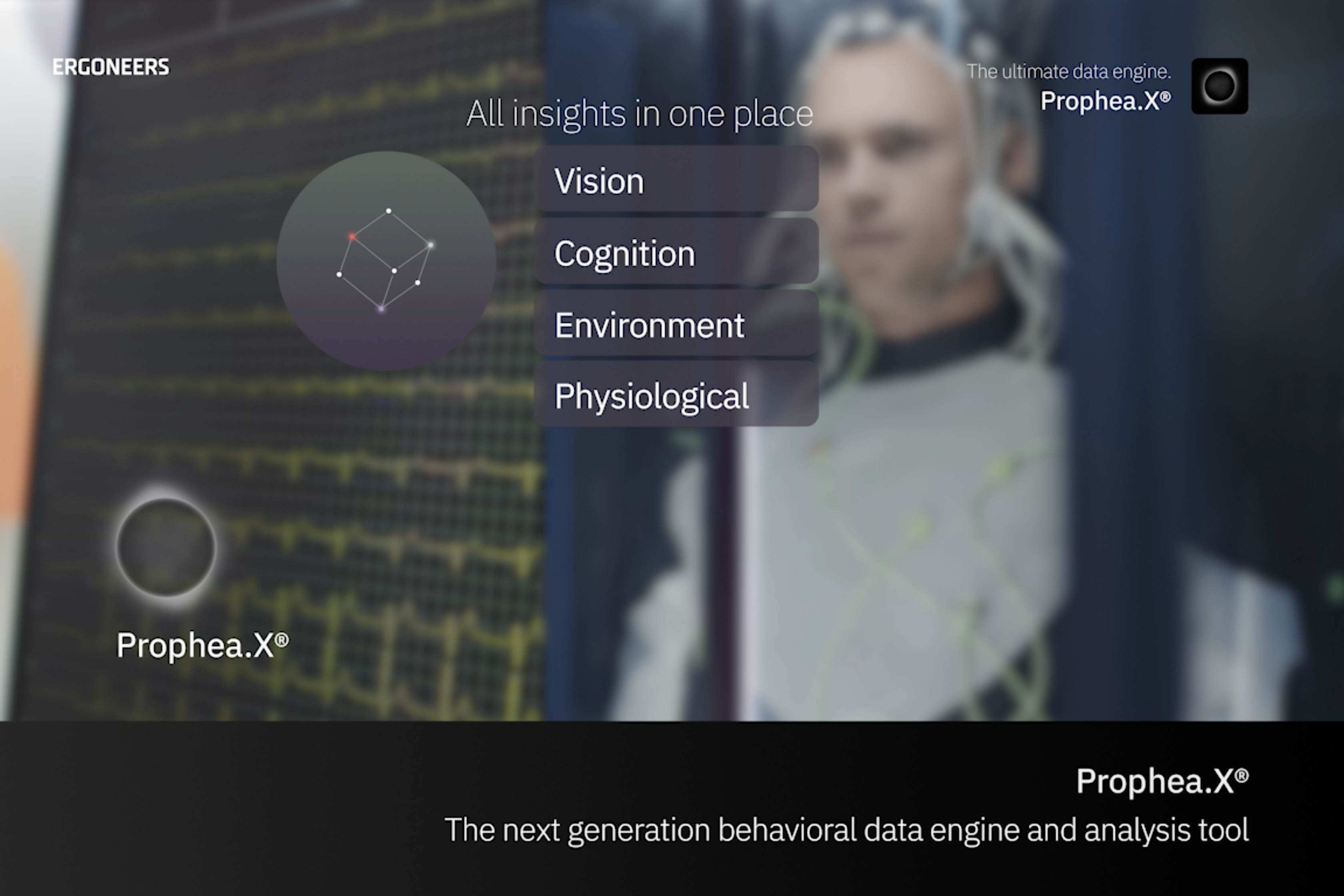
Synchronize your most critical data streams within a single, visionary interface. Prophea.X manages the simultaneous acquisition of eye tracking, EEG, and high-definition video, ensuring that every millisecond of human behavior is captured with clinical rigor. Utilizing this advanced behavioral research software provides a unified framework for analysis, significantly reducing the time from initial data collection to final research publication. This streamlined workflow allows you to maintain academic rigor while meeting the rapid pace of industrial innovation. It’s the essential tool for any researcher looking to map the three-dimensional boundaries of human potential.
Visionary Consulting for Lab Design
Build your legacy on a foundation of academic excellence and technical innovation. Leveraging our origins as a TUM spin-off, Ergoneers brings a unique blend of scientific authority and agile engineering to your project. Our Behavioral Research Lab Consulting services provide custom technical integration for unique research requirements that standard off-the-shelf solutions can’t meet. We don’t just sell tools; we partner with you to expand the boundaries of your research through:
- Custom Technical Architecture: Designing lab layouts that optimize both participant comfort and sensor accuracy.
- Specialized Training and Workshops: Empowering your team to master complex partner-tools like Tobii Glasses, Emotiv EEGs, Dikablis and Prophea.X.
- Seamless Integration: Ensuring that every piece of hardware, from motion capture to respiratory sensors, operates in harmony.
Empower your institution with the intellectual leadership it needs to lead the next phase of behavioral science. By partnering with visionary experts, you ensure your human performance lab remains at the forefront of the industry for years to come. Precision is the promise; insight is the result.
Architecting the Future of Human Potential
Engineering a world-class human performance lab requires more than a standard checklist; it demands a commitment to the evolution of human-technology interaction. You’ve discovered how bridging the gap between physiological data and cognitive behavioral insights creates a unified framework for breakthrough research. By prioritizing the human element and eliminating technical friction through advanced synchronization, you position your laboratory as a leader in both academic rigor and industrial application. Seamless integration is no longer a luxury; it’s the foundation of scientific discovery.
Ergoneers stands ready to support this transformation. Founded as a TUM spin-off in 2005, we’ve spent decades perfecting the tools of the trade. Prophea.X multimodal platforms serves as the central intelligence for labs worldwide. Our Dikablis eye-tracking technology remains a global standard for the highest-precision gaze analysis in any light conditions. Don’t let fragmented data silos limit your vision or stall your innovations. Partner with Ergoneers for Visionary Lab Consulting to build a research environment where clinical precision meets human empowerment. Let’s pioneer the next phase of behavioral research together.
Frequently Asked Questions
The primary purpose of a human performance lab is to quantify human potential and optimize human-machine interaction through empirical data. These facilities serve as multidimensional spaces where researchers analyze the physical and cognitive limits of individuals in high-stakes environments. By measuring how a person responds to technical interfaces, you can engineer safer systems and more effective training protocols that prioritize the human element.
Essential infrastructure for a modern human performance lab includes high-fidelity physiological sensors for ECG and EMG analysis, high-precision eye tracking systems like Dikablis Professional, and environmental control systems. Most importantly, you need a centralized data acquisition hub. Platforms like Prophea.X act as the laboratory’s nervous system; they ensure that every sensor communicates in real time to provide a holistic view of the subject’s performance.
Measure cognitive load by analyzing pupillometry and fixation patterns through advanced gaze analysis tools. These metrics reveal the mental effort required to complete a task and identify potential failure points before they lead to human error. When you pair eye tracking with physiological metrics like heart rate variability, you gain a three-dimensional understanding of mental strain. This approach allows you to quantify distraction and cognitive fatigue in dynamic simulations.
Eye tracking is vital because it provides a direct window into the participant’s intent and attentional priorities. In sports, it reveals the visual search strategies of elite athletes; in industrial settings, it identifies “look-but-failed-to-see” errors in safety-critical tasks. Using Dikablis Glasses allows researchers to capture these insights in high-movement environments without restricting natural behavior. This data bridges the gap between what a person sees and how they physically react.
Synchronize data streams by utilizing a unified software architecture that supports multimodal integration. Platforms like Prophea.X possess the agency to align disparate hardware signals, such as EEG and EMG, into a single, time-stamped dataset. This eliminates the technical friction of manual alignment and ensures millisecond precision. By using robust APIs and specialized training, your team can create a seamless research workflow that transforms raw sensor data into sophisticated behavioral insights.
Learn more about EEG pairing with Eye-tracking or other multimodal signals in this dedicated article.
Yes, a human performance lab is an invaluable asset for corporate R&D and user experience (UX) research. Companies use these facilities to test how users interact with new products or complex software interfaces under varying levels of stress. By quantifying cognitive load and visual attention, designers can create more intuitive products that reduce fatigue and increase user satisfaction. This transition from academic theory to industrial application expands the boundaries of traditional market research.
Ethical considerations center on data privacy, informed consent, and strict adherence to regulatory standards. You must ensure your protocols comply with the February 2, 2026, FDA Quality Management System Regulation (QMSR) deadline and the July 1, 2026, CARF updates regarding artificial intelligence. Safeguarding behavioral data requires robust encryption and clear oversight. Prioritizing these ethical pillars protects your participants and secures the long-term integrity of your research legacy within the scientific community.
The timeline for setting up a professional lab typically spans several months, depending on the complexity of your technical integration. Defining the research scope and selecting hardware usually takes four to eight weeks, followed by physical installation and pilot testing. Partnering with a visionary expert through Behavioral Research Lab Consulting can accelerate this process. Professional guidance ensures your infrastructure is future-proof and compliant with emerging industry standards from the very beginning.