

News & Posts
The Promises and Pitfalls of Eye Tracking

Eye-tracking technology has revolutionized fields from psychology to human-computer interaction, offering unprecedented insights into attention, cognition, and behavior. Yet, reviewing recent articles, our team often discovers that despite its potential, many researchers still grapple with outdated, error-prone, and labor-intensive methods.
Collaborating with leading research institutions, it has become our mission to improve the way eye-tracking research is conducted today. From often inefficient, expensive, and scientifically flawed to the eye-opening data asset this behavior research technology is.
This post explores the technical and methodological shortcomings of current practices—and how innovative solutions and practices can transform the field.
Eye-tracking – Where Errors Begin
The Technical Foundation
1. Data Streams and the Gaze Vector Problem in Mobile Eye-tracking
Most eye-tracking systems deliver two or three basic data streams:
- XY coordinates of the pupil, mapped onto a field image from a camera representing the subject’s point of view (POV).
However, relying on XY coordinates to plot gaze points solely onto a flat image introduces a cascade of potential errors:
- Eye-Camera Positioning: Misalignment between the eye tracker and the subject’s eye can distort gaze vectors, especially in mobile setups.
- Lighting Conditions: Variations in ambient light or reflections can disrupt pupil detection, leading to inaccurate gaze estimation.
And most misleading:
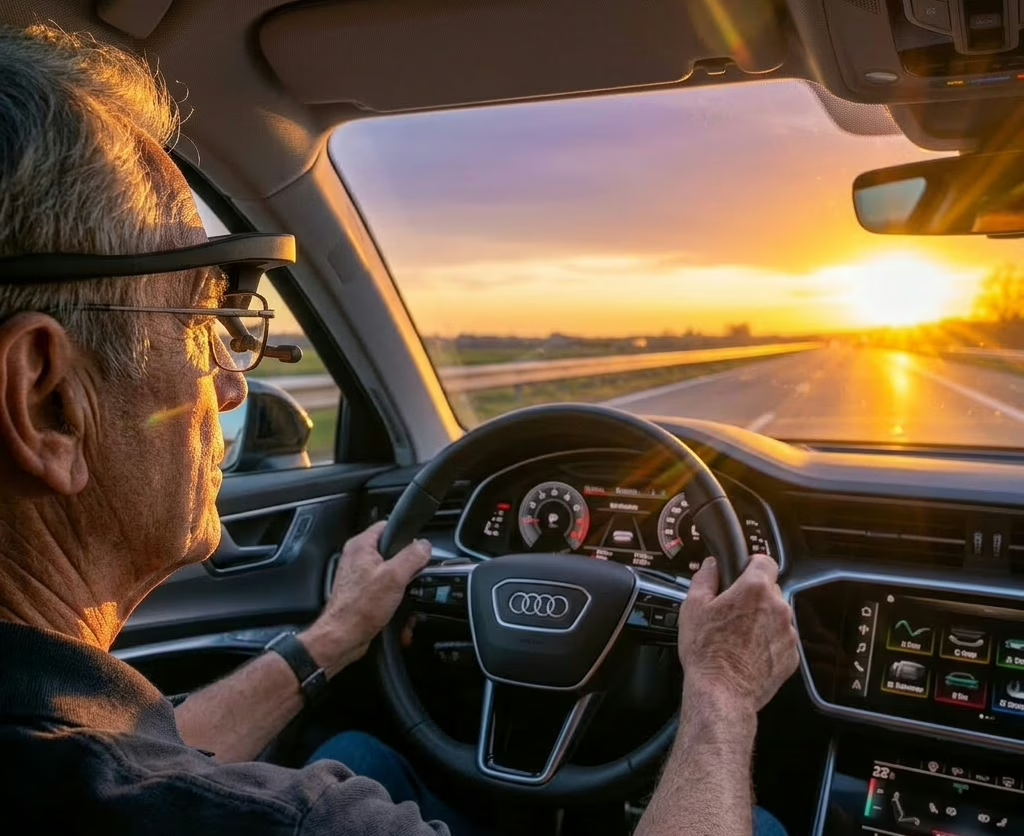
- Head Movement Compensation: Traditional systems assume a static head position, but real-world scenarios involve constant motion—turning, tilting, or shifting in space.
The Human Factor
Application Errors in Research
2. The Heatmap Fallacy: A Screen-Based Relic in Mobile Research
Heatmaps—colour-coded visualisations of gaze density—are a staple of screen-based eye tracking. Yet, in mobile or dynamic environments, they become scientifically questionable:
- Assumption of Static Scenes: Heatmaps visualizing the accumulated time one’s gaze is focused on a point in the field-camera’s image assume the subject’s POV remains unchanged. In reality, head and body movements (e.g., a driver scanning a busy intersection) render heatmaps unreliable.
- False Insights: A “hotspot” on a heatmap plotted onto video or a still frame might reflect an earlier point of attention. Many eye-tracking solutions give you options to have accumulated fixations stay visualized for a flexible amount of seconds to adjust to the fact of changing situations. Imagine a driver’s vision while on a road. Represented by the image of the field camera, his point of view is constantly changing as he drives his vehicle along the road. A colorful presentation of cumulated fixation time visualized on a single frame of a video does neglect the fact that the gazepoints represented do not belong to the POV of the driver in that moment but also the seconds before. Also, heatmaps visualizing the accumulated fixation duration of multiple single subjects are also misleading, as coming back to a driving situation, it is basically impossible that multiple subjects would arrive at the same place while having the identical head position at the same time while navigating through always-changing traffic and obstacles like red lights, etc. Even in simulations, these cumulated heatmaps are highly misleading and can’t be suggested for scientific use.
- Result: Gaze points plotted onto the POV video feed with delay and head movements will not reflect true attention, leading to misleading conclusions.
- Bottom Line: Heatmaps in mobile eye tracking are, in most cases, useless for deriving valid insights or at least have to be interpreted with caution, accounting for background knowledge for what they represent.

3. Calibration: The Overlooked Achilles’ Heel
Even with precise hardware, calibration errors are rampant:
- Pre-Recording: Poor calibration (e.g., incorrect distance, angle, or lighting) can skew data before the study begins.
- During Recording: Subjects may move, blink, or adjust their position, invalidating initial calibration.
Consequence: Without careful calibration, researchers spend hours manually recalibrating or discarding data, inflating costs and delaying insights.
The Workflow Bottleneck
Manual Coding and Analysis
4. The Grind of Event Coding
To compensate for technical limitations, researchers often resort to manual event coding:
- Frame-by-Frame Review: Analyzing fast reactions (e.g., a driver braking for a pedestrian) requires painstaking frame-by-frame scrutiny.
- Subjective Interpretation: Coding “attention” or “reaction time” introduces human bias, especially when defining “areas of interest” (AOIs) post-hoc.
Impact:
- Time and Budget Drain: Projects stall or get canceled due to unsustainable workloads.
- Superficial Analysis: Researchers may skip deep dives, settling for surface-level observations.
A Paradigm Shift: 3D Eye Tracking, Direct Simulator Integration and Automated AOIs
5. The Ergoneers Solution
Direct Simulator Data Integration:
Prophea.X allows direct integration with driving or flight simulators, automatically synchronizing gaze data with simulator events (e.g., braking, lane changes). This reduces manual coding and improves the accuracy of reaction time analysis by aligning eye-tracking data with real-time simulator outputs.
Machine Vision Meets Eye Tracking
To address these challenges, Ergoneers developed a 3D machine-vision system that:
- Anchors Gaze to Real-World Coordinates:
- Uses infrared-reactive or emitting QR markers (also possible to hide behind filters for minimal visual disruption) to map gaze data onto a 3D space.
- Therewith the system adjusts for head/body movements in real time.
- Automates AOI Detection:
- By predefining AOIs (e.g., rearview mirrors, supermarket shelves) and linking the to 3D space, areas of interest are now tracked dynamically, eliminating manual coding or error-prone manual review and coding.
- Enables instant metrics: How long did the subject look at the speedometer? When, how long or often did they look into the rear mirror ? Metrics that, using Ergoneers AOI technology, can be calculated instantly.
Result:
- 90% Reduction in Analysis Time: What once took hours now requires a single click in Prophea.X.
- Budget Savings: Institutes redirect funds from labor to new research avenues.
- Scalability: Studies that were once impractical (e.g., long-duration or multi-subject mobile eye-tracking) become feasible.

The Future
Eye Tracking in a Humanoid World
6. Beyond 2026: Eye Tracking for AI and Humanoid Interaction
As our world and human-machine interaction evolve, we prepare the groundwork for deploying high-performance, precision eye-tracking in:
- Driving & Flight Simulators: Eye-tracking and multimodal analysis with direct simulator connectivity for unlimited multi-subject analysis. Discover Propheadata engine
- Autonomous mobility: From driver monitoring to self-driving and the future of humanoid “drivers” navigating complex urban environments.
- Retail 2030: AI shoppers interacting with dynamic, personalised, and immersive store layouts.
- Diverse Populations: Systems that adapt to cultural or individual differences in gaze behaviour of ageing populations.
The Value Proposition:
By fixing the foundational flaws through 3D space definition and automated precision AOIs in eye tracking, as well as multi-subject capabilities, and technical device connectivity, Prophea.X unlocks:
✅ Faster, cheaper, and more reliable research.
✅ Deeper insights into human behavior.
✅ A bridge between lab studies and real-world applications.
Moving Forward
The eye-tracking community stands at a crossroads
Clinging to outdated methods risks irrelevance, while embracing 3D automation and machine vision opens doors to discoveries we’ve only dreamed of.
Have you encountered any of the challenges described above? Are you ready to unlock new speeds in eye tracking? Our continuous research embraces a strong community of eye-tracking professionals like you.