

News & Posts
Sports Science Eye Tracking: Decoding Elite Athletic Performance with High-Precision Data
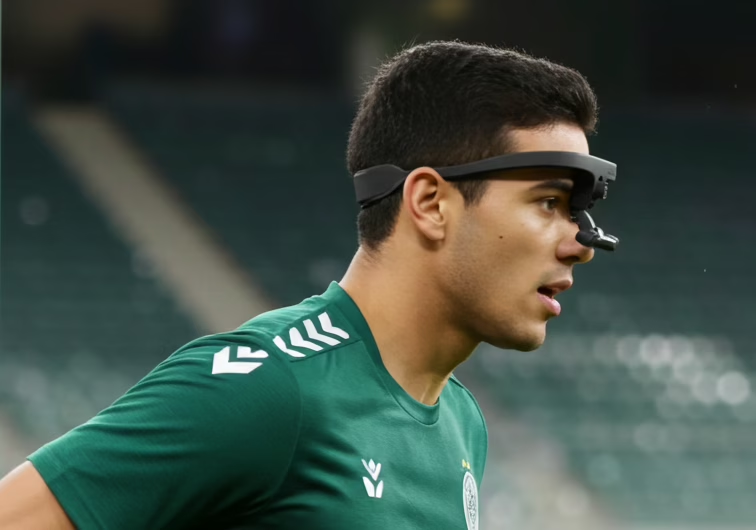
Recent studies involving elite Para athletes reveal that eye-tracking metrics account for 52% of the variance in athletic performance, yet traditional vision tests often fail to predict these results entirely. You likely recognize the frustration of relying on subjective coaching observations that cannot quite capture the split-second cognitive focus required for a game-winning play. Integrating sports science eye tracking into your training protocols bridges this gap; it replaces fragmented sensor data with a clear window into the athlete's mind.
Discover how high-precision eye tracking transforms subjective intuition into an objective science, unlocking the hidden patterns of elite decision-making and visual focus. This guide explores how sophisticated tools like Dikablis Glasses and the Prophea.X software ecosystem create a unified framework for analyzing visual and physical data. We will examine how these technologies accelerate learning curves and move research from the lab into the high-stakes environment of live competition. Prepare to redefine the boundaries of human potential through the lens of precise behavioral insights and high-precision data synchronization.
Key Takeaways
- Transform subjective coach observations into objective, clinical data by measuring precise visual attention during high-intensity athletic tasks.
- Decode the “Quiet Eye” phenomenon and field-scanning strategies to understand exactly how elite performers process information before taking action.
- Integrate gaze data with biometric sensors like EEG and EMG for a multimodal understanding of the relationship between sight and physical execution.
- Bridge the gap between theory and practice by deploying wearable sports science eye tracking tools in live, game-like environments.
- Empower your research with Prophea.X to automate behavioral analysis and identify critical performance trends through advanced AI and machine learning.
Table of Contents
- What is Sports Science Eye Tracking and Why Does it Define Elite Performance?
- Decoding the Elite Gaze: Key Metrics for Sports Performance
- Beyond Gaze: Integrating Multimodal Data for Holistic Analysis
- Implementing Eye Tracking: From Controlled Labs to Live Performance
- The Future of Athletic Intelligence: Prophea.X and AI-Driven Analysis
What is Sports Science Eye Tracking and Why Does it Define Elite Performance?
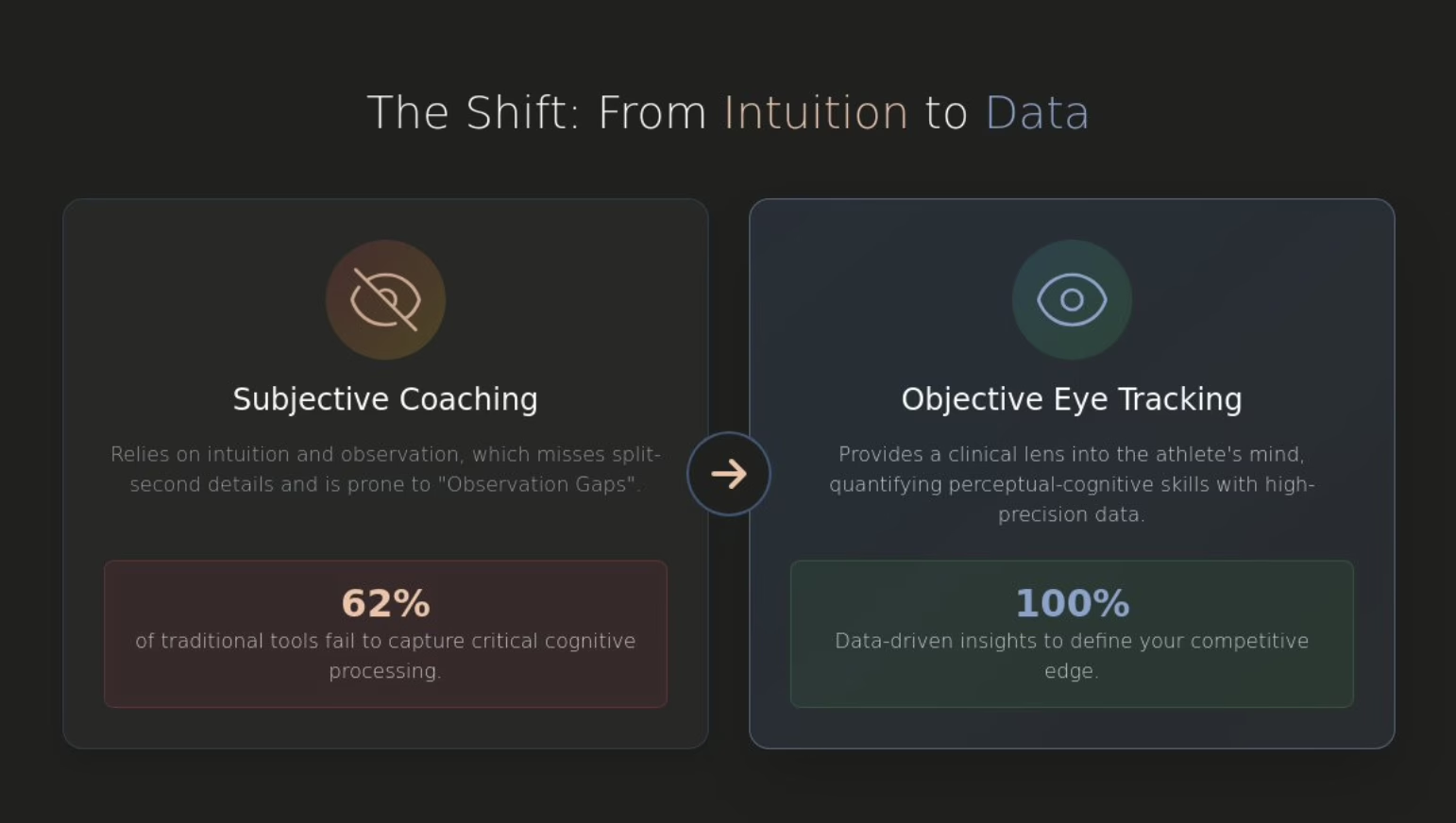
Define your competitive edge by looking where others cannot. Sports science eye tracking is the objective measurement of an athlete’s visual attention during high-stakes tasks, serving as a sophisticated bridge between raw biological potential and tactical execution. It represents the clinical lens through which we view human potential, moving beyond the limitations of the naked eye. While traditional coaching relies on the seasoned but subjective eye of a mentor, modern gaze-tracking technology introduces a level of clinical precision that transforms how we understand performance. We identify the disconnect between what a coach sees and what an athlete processes as the Subjective Observation Gap. Research indicates that 62% of traditional analysis tools fail to capture the critical cognitive processing occurring behind the eyes. Our primary goal is to quantify the perceptual-cognitive skills that distinguish world-class champions from talented amateurs.
The Shift from Subjective Coaching to Objective Science
Empower your coaching staff with data that transcends intuition. In high-velocity sports like tennis or hockey, the speed of play often exceeds the limits of human observation. Coaches can’t track every microsaccade or fixation in real-time, leading to fragmented insights. High-precision hardware, such as Dikablis Glasses, functions as a vital partner in this evolution. It provides a three-dimensional view of the athlete’s focus, allowing for evidence-based tactical decisions that were previously impossible. This shift moves training from the realm of gut feeling into a sphere of professional scale and academic rigor. By grounding every technical metric in its practical impact, we turn complex biological physics into a roadmap for growth and legacy.
Visual Cognition: The Foundation of Athletic Success
Excellence is fundamentally a cognitive event. Before an athlete executes a motor command, the brain must filter a chaotic environment to synthesize relevant cues. This intricate link between gaze behavior and motor control accuracy forms the bedrock of athletic success. A critical metric in this sports science eye tracking analysis is the Quiet Eye, which represents the final, stabilized fixation on a target before physical movement begins. Capturing these split-second focus shifts requires a level of error-free precision that only high-end research hardware can provide. By mapping the three-dimensional geometry of visual focus, we empower researchers to see the expanding boundaries of human capability. It isn’t just about where an athlete looks; it’s about the cognitive efficiency that directs their gaze toward victory.

Decoding the Elite Gaze: Key Metrics for Sports Performance
Analyze the visual architecture of a champion to find that elite performance is rarely about seeing more; it’s about seeing correctly. Through the clinical application of sports science eye tracking, we move beyond the surface of athletic movement to quantify the specific gaze behaviors that drive success. By measuring how an athlete filters environmental noise to extract relevant cues, researchers can now map the cognitive blueprint of high-pressure decision-making. This process involves the rigorous analysis of several key metrics:
- Fixation Duration: The length of time an athlete maintains their gaze on a specific point to process information.
- Saccadic Eye Movements: Rapid, ballistic jumps between fixations that reveal how an athlete shifts focus across the field.
- Gaze-Path Analysis: The sequential map of an athlete’s visual journey, highlighting their tactical priorities during a play.
The Mechanics of ‘Quiet Eye’ and Accuracy
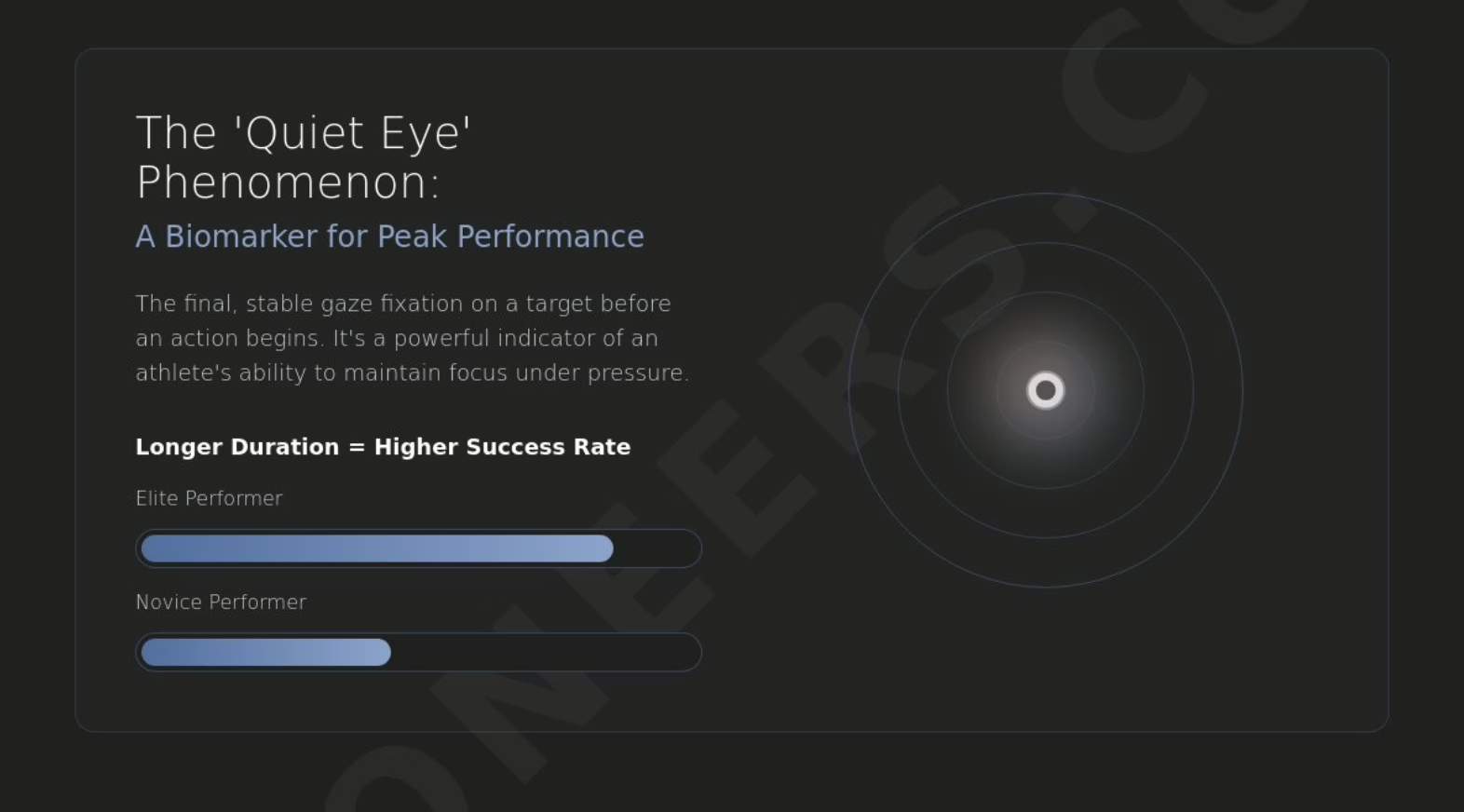
Observe the moment of peak performance and you’ll find the ‘Quiet Eye’. This phenomenon describes the final, stable fixation on a target immediately before a motor action begins. In precision sports like golf or archery, data confirms that a longer final fixation correlates directly with higher success rates. Quiet Eye duration serves as a reliable biomarker for an athlete’s ability to maintain focus under physiological stress. By isolating this metric, coaches can shortcut the learning curve for novice players, training them to stabilize their visual focus earlier in the movement cycle. This targeted intervention transforms a vague instruction to “keep your eye on the ball” into a precise, measurable training objective. Refine your research methodology by exploring advanced eye tracking integration solutions that capture these moments with error-free precision.
Visual Search Patterns in Team Dynamics
Contrast the scanning patterns of a veteran quarterback with those of a rookie to see the power of visual search strategies. Experts prioritize information-rich areas, such as the hip orientation of a defender or the subtle spacing of a defensive line, while novices often track the ball or irrelevant peripheral movement. Sports science eye tracking reveals that elite players scan the field with higher efficiency, utilizing fewer fixations to gather more actionable intelligence. This superior tactical awareness allows them to ‘read the game’ and anticipate plays before they unfold. It’s a three-dimensional chess match where the winner is determined by who processes the visual field with the greatest speed and accuracy. By identifying these expert patterns, teams can develop training workshops that teach younger athletes how to prioritize the most critical cues during rapid transitions.
Beyond Gaze: Integrating Multimodal Data for Holistic Analysis
Elite performance is rarely the result of a single biological system. While sports science eye tracking provides the “where” of athletic attention, it remains a solitary piece of a much larger physiological puzzle. To truly decode the architecture of a champion, researchers must look beyond the gaze. We must bridge the gap between visual perception, neural processing, and muscular execution. This requires a transition from isolated data silos to a multimodal framework where gaze, brain activity (EEG), and muscle activation (EMG) operate in a single, synchronized timeline.
Central to this evolution is the role of behavioral research software. It acts as the unifying agent, weaving disparate data streams into a cohesive narrative of human performance. By integrating these sensors, we move from descriptive analytics to a holistic understanding of the athlete. We see the brain’s decision (the “why”) and the muscle’s response (the “how”) alongside the eye’s focus (the “where”). It’s a comprehensive approach that turns raw numbers into actionable human insights. Researchers seeking to apply these same multimodal principles beyond sport will find valuable methodological parallels in human machine interaction studies, where synchronizing physiological data streams is equally critical for understanding cognitive load and interface design.
Synchronizing Gaze with Physiological Execution
Achieving sub-millisecond synchronization is the gold standard for high-end research. When we link gaze data with EMG, we uncover the precise latency between a visual cue and the first spark of muscle activation. This level of clinical precision reveals how elite athletes translate information into action faster than their peers. Imagine a “holistic athlete” profile where every saccade is mapped against a specific muscular twitch. This unified data empowers coaches to identify bottlenecks in the kinetic chain that are invisible to the naked eye. It turns the human body into a transparent, three-dimensional map of efficiency and power.
The Role of EEG and Cognitive Load in Performance
Empower your mental performance protocols by measuring the invisible weight of competition. By pairing sports science eye tracking with EEG, we can quantify cognitive load during high-stress moments. This dual-sensor approach allows us to analyze “tunnel vision” not just as a metaphor but as a measurable physiological response where the visual field narrows and neural noise increases. Understanding these thresholds has been proven vital for developing psychological resilience. When we can see exactly when an athlete’s brain becomes overwhelmed, we can design training environments that expand their cognitive bandwidth. This data-driven approach to mental toughness ensures that the athlete’s focus remains sharp, even as the physiological demands of the game reach their peak.

© Unsplash
Implementing Eye Tracking: From Controlled Labs to Live Performance
Step into the arena where theory meets reality. The transition from screen-based lab environments to the chaotic velocity of live performance marks the next phase of athletic research. High-precision sports science eye tracking no longer requires athletes to remain tethered to a desk or restricted by artificial laboratory constraints. Modern wearable systems empower researchers to capture the “elite gaze” during a full-sprint breakaway or a high-intensity serve. This evolution demands hardware that survives the rigors of the field while maintaining the clinical precision of a controlled environment.
Eliminate technical friction to ensure athlete buy-in and data integrity. If calibration processes are cumbersome or fragile, you risk losing the window of peak physiological arousal. We prioritize seamless integration and error-free calibration, allowing the technology to disappear into the athlete’s natural workflow. This focus ensures that the research remains centered on the human element: the cognitive processing that drives victory. By grounding technical capability in practical impact, we turn high-end research hardware into a vital partner for athletic evolution.
Selecting the Right Hardware for the Sport
Match your tools to the velocity of the game. For high-movement sports like soccer, hockey, or basketball, Dikablis Professional glasses represent the pinnacle of wearable technology. They offer the ergonomic necessity of lightweight, slip-resistant frames that stay secure during peak physical exertion. Unlike static screen-based systems used for tactical video analysis, these wearables provide a wide field of view and high-frequency sampling. This ensures every critical shift in focus is captured even as the athlete’s head moves through three-dimensional space. Precision in the hardware is the only way to guarantee precision in the insights.
Designing High-Impact Sports Research Studies
Build a robust protocol that translates raw gaze data into tactical advantages. A successful field study follows a logical sequence: establish baseline search patterns, record during high-fidelity game simulations, and conclude with a post-performance review. Utilize heatmaps and gaze plots to visualize the data, providing athletes with immediate, objective proof of their cognitive focus. This visual evidence accelerates the learning curve by showing them exactly what they missed during a play. Optimizing your facility layout is equally critical; our Behavioral Research Lab Consulting helps you design environments that replicate game-like visual demands without compromising sensor accuracy. Contact us for our full range of eye tracking integration solutions to start your transition from the lab to the stadium today.
The Future of Athletic Intelligence: Prophea.X and AI-Driven Analysis
Look toward 2026 and you’ll see a fundamental transformation in how we process human focus. The era of manual data annotation is ending, making way for automated intelligence that operates at the speed of the athlete. Sports science eye tracking is evolving from a descriptive tool into a predictive powerhouse, driven by the agency of Prophea.X. This next-generation platform doesn’t just record gaze; it understands the intent behind every fixation. By leveraging machine learning, we can now identify performance patterns that remain invisible to the human eye. This ensures that technology serves as a vital partner in an athlete’s growth and legacy, prioritizing the human element in every calculation. We invite you to partner with Ergoneers as we lead the evolution of human-performance science together.
Automating Insight with Advanced Software
Scale your research without compromising on clinical precision. Prophea.X simplifies the traditionally labor-intensive process of data processing through automated coding schemes and intelligent visualization. By allowing AI to handle the heavy lifting of frame-by-frame analysis, researchers can focus on higher-level human insights rather than technical friction. This software possesses the agency to expand its influence across various sporting disciplines, providing a consistent brand promise of error-free precision. It turns complex biological physics into digestible, actionable intelligence. This shift empowers teams to move from data collection to implementation in record time, ensuring that the relationship between people and technology remains seamless and productive.
Predictive Analytics and Injury Prevention
Anticipate the needs of the body before the athlete even feels the strain. We hypothesize that subtle shifts in gaze patterns, such as increased saccadic latency or fragmented visual search, can predict fatigue-related injury before a physical breakdown occurs. This proactive approach extends to neurological health, where sports science eye tracking plays a critical role in objective concussion assessment and recovery protocols. By monitoring the three-dimensional nature of visual focus, we create a safer, more resilient path to elite status. We don’t just track eyes; we safeguard the future of the performer. Experience the future of sports science with Prophea.X and redefine the expanding boundaries of scientific knowledge on the field and in the lab.
Mastering the Visual Dimension of Athletic Excellence
The transition from subjective intuition to objective science marks a permanent shift in how we cultivate elite performance. By integrating sports science eye tracking, you gain a transparent view of the cognitive focus and visual search strategies that define champions. This journey moves beyond the gaze, linking neural intent with muscular execution through seamless multimodal synchronization. It’s about building a legacy of human-centric research where data serves the growth and safety of the athlete.
Our foundation as a spin-off from the Technical University of Munich ensures that every tool we provide is rooted in academic rigor and clinical precision. From our flagship Prophea.X software platform to the ergonomic excellence of Dikablis eye-tracking glasses, we empower you to decode the three-dimensional complexities of human behavior. Empower your research with Prophea.X and Dikablis high-precision systems. Step into the future of performance science and expand the boundaries of what your athletes can achieve.
Frequently Asked Questions
Eye tracking improves decision-making speed by identifying the precise visual cues that precede a successful action. When athletes review their gaze paths, they learn to ignore environmental noise and prioritize information-rich areas, such as a defender’s hip orientation. This targeted training shortens the cognitive gap between perception and execution. It allows performers to react faster because they’ve optimized their visual search strategies for the most relevant tactical data.
High-precision hardware like Dikablis Glasses is specifically engineered for the rigors of high-impact environments. These glasses utilize lightweight, slip-resistant frames that maintain a secure fit during the rapid accelerations of basketball or football. This ensures that the sensors remain aligned with the athlete’s eyes, providing error-free data even during peak physical exertion. Durability and ergonomics are prioritized to prevent the equipment from interfering with the athlete’s natural movement or focus.
Quiet Eye represents the final, stabilized fixation on a target before a motor command is executed. It is considered a premier metric in sports science eye tracking because it serves as a reliable biomarker for an athlete’s focus under physiological stress. Data indicates that longer Quiet Eye durations correlate with higher accuracy in precision tasks. By quantifying this moment, researchers can objectively measure the cognitive efficiency required to perform in high-pressure scenarios.
Sub-millisecond synchronization allows researchers to link gaze data with heart rate, EEG, or EMG monitors seamlessly. This multimodal approach provides a comprehensive view of the “holistic athlete” by connecting visual attention to physiological and neural responses. Platforms like Prophea.X act as the unifying agent for these disparate data streams. It enables you to see exactly how an athlete’s cognitive load or muscle activation fluctuates in response to specific visual stimuli.
Modern high-precision systems allow for rapid calibration that typically concludes in under sixty seconds. We prioritize a workflow that eliminates technical friction, ensuring that the athlete doesn’t lose their competitive mindset during the setup process. This error-free precision is vital for field-based studies where time is limited. Once calibrated, the hardware maintains its tracking accuracy throughout the session, allowing for continuous data capture without the need for frequent readjustments.
Screen-based systems are primarily used for lab-controlled tactical analysis or static stimulus testing. In contrast, wearable sports science eye tracking moves the research into the stadium, capturing gaze in three-dimensional space during live movement. Wearables provide the mobility required for high-velocity sports, while screen-based units offer high-frequency sampling for fine-grained cognitive research. Choosing the right tool depends on whether your study prioritizes controlled observation or real-world athletic execution.
AI-driven platforms like Prophea.X automate the coding of behavioral data, transforming hours of manual film review into immediate, actionable insights. The software identifies complex performance patterns and gaze transitions that a coach might miss during standard observation. This shifts the coaching workflow from descriptive analysis to prescriptive intelligence. It allows for the scalability of research across entire teams, providing objective proof of cognitive focus that empowers better tactical decision-making.
Eye tracking provides clinical, objective metrics for neurological health by measuring saccadic latency and fixation stability. These parameters act as sensitive indicators of cognitive impairment, often revealing deficits that traditional physical tests might overlook. By establishing a baseline for each athlete, researchers can use gaze data to support evidence-based return-to-play protocols. This technology has the potential to support that decisions regarding an athlete’s health are grounded in additional high-precision data during professional physical assessments.