News & Posts
Publication Report 2025 - Eye Tracking and Multimodal Analysis

General Trend
Eye tracking is increasingly used as a functional component within intelligent systems. In vehicles, robots, and interactive environments, gaze data is combined with additional signals—such as motion, context, and physiology—to support models of attention, intention, and risk. Rather than serving solely as a measurement tool, eye tracking is becoming part of operational perception pipelines in real-world systems.
In 2025, more than 50 peer-reviewed studies were published by research laboratories worldwide using Ergoneers technology. These publications span transportation, human–machine interaction, perception research, and multimodal AI. This report reviews the year’s output and highlights five studies that exemplify current methodological and applied trends
Here are the 5 publications that stood out to us and why we believe they deserve a closer look:
1. A Foundational for next-generation in-car AI and human–robot collaboration.
Enhancing Gaze Prediction in Multi-Party Conversations via Speaker-Aware Multimodal Adaptation by MC Lee, Z Deng
ACM CHI 2024/25 – Multimodal Attention & Real-World Interaction
Why this study stands out:
This paper represents the state of the art in multimodal human sensing—combining eye tracking with other signals (e.g., head pose, motion, context, sometimes physiology) to infer user intent and cognitive state in naturalistic environments.
Impact trajectory:
- Directly applicable to driver monitoring systems (DMS) in vehicles.
- Enables AI models to reason about attention, intention, and risk in real time.
- Sets the methodological standard for fusing gaze with other streams—exactly what future autonomous and semi-autonomous systems require.
External Link: https://dl.acm.org/doi/abs/10.1145/3716553.3750755

2. A tight alignment with latest automotive OEM needs and regulatory safety frameworks.
Collision Risk Perception Models Using Physiological and Eye-Tracking Signals by H. Lee, O. Lim, A. Singh and S. Samuel
IEEE – Eye Tracking in Applied Transport / Human–Machine Contexts
Why it matters:
IEEE transport and HMI papers are often engineering-grade rather than purely theoretical. This work situates gaze in operational environments where vehicles, interfaces, or safety systems rather than constrained lab tasks are tested in a realistic setup.
Impact trajectory:
- Bridges perception research with deployable systems.
- Supports real-time gaze inference for:
- Hazard detection
- Interface adaptation
- Driver distraction mitigation
External Link: https://ieeexplore.ieee.org/abstract/document/11106510/

3. Elevating eye tracking from a measurement tool into a cognitive signal for intelligent systems.
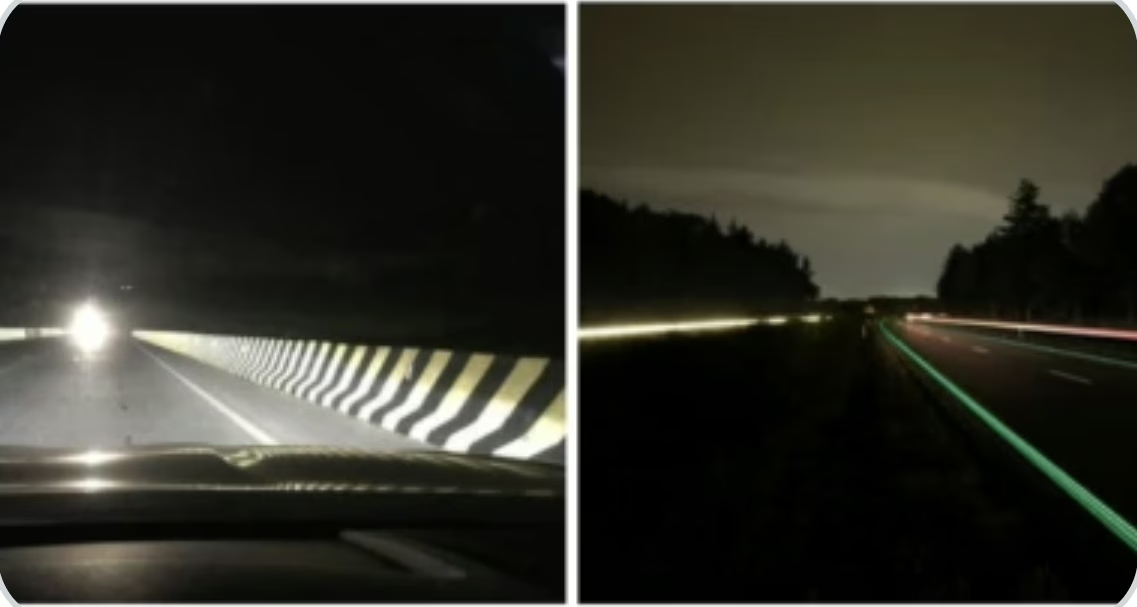
Driving Simulator Evaluation of Long Persistent Self-Luminous Pavement Markings’ Visual Guidance By Xiaolong Yang, Chuanqi Xian, Xiaowei Feng, Yingting Cao, Chunhong Peng , Xiang Liu
Springer 2025 – Visual Attention in Real-World Perception
Why it matters:
This is part of a new generation of perception research focused on ecological validity: how vision and gaze operate in the wild rather than in screen-based experiments.
Impact trajectory:
- Advances models of how humans allocate attention in dynamic environments.
- Provides theoretical grounding for:
- Predictive driver models
- Human-aware robotics
- AI systems that infer “what matters now’
- Validates evaluation of new road marking systems in the field
External Link: https://link.springer.com/article/10.1007/s42947-025-00679-1
4. Engineering a backbone for real-world multimodal AI.
CogMamba: Multi-Task Driver Cognitive Load and Physiological Non-Contact Estimation with Multimodal Facial Features by Yicheng Xie & Bin Guo
Why it matters:
This work emphasizes hardware integration, synchronization, and real-time pipelines.
Impact trajectory:
- Demonstrates how gaze can be fused with:
- IMUs
- Cameras
- Physiological sensors
- Critical for:
- In-vehicle monitoring
- Wearable safety systems
- Embodied AI and robotics
External Link: https://www.mdpi.com/1424-8220/25/18/5620

5. Connecting eye tracking to population-level safety outcomes.
Inflating system expectations prior to SAE level 3 automated vehicle use: effects on monitoring behavior, resumption of control, and attitudes toward driving automation by Dustin J. Souders, Shubham Agrawal, Irina Benedyk, Yuntao Guo, Yujie Li, Srinivas Peeta
Transportation Research (TRIP, 2025) (doi: 10.1016/j.trip.2025.101725)
Why it matters:
This study is explicitly rooted in transport safety. TRIP papers (Transportation Research Interdisciplinary Perspectives) influence policy, infrastructure design, and industry standards.
Impact trajectory:
- The Study uses gaze and behavioral measures to understand:
- Distraction
- Risk perception
- Decision latency in traffic contexts
- Feeds directly into:
- Road-safety interventions
- Driver assistance systems
- Latest urban mobility design
External Link: https://www.sciencedirect.com/science/article/pii/S259019822500404X

Summary
These five resources are particularly noteworthy for their practical and forward-looking applications. They operate in open, dynamic real-world environments; integrate gaze within multimodal cognitive frameworks; are designed for seamless AI- deployment, and offer direct insights for advancing automotive, transport, and robotic technologies.
Seen from a wider angle, the most significant study was Enhancing Gaze Prediction in Multi-Party Conversations via Speaker-Aware Multimodal Adaptation by Meng-Chen Lee, Zhigang Deng
For us, this study underlines the turning point in how eye tracking is understood. Today gaze tracking is fused with body motion, head pose, and context to form a living model of intent. The system does not ask what is visible, but what matters now. This mirrors how humans move: sparsely, purposefully, and in time. Attention becomes event-based rather than continuous. Perception becomes prediction rather than reaction. Vision becomes a control signal rather than an input stream. The paper shows how machines can learn when to look, not only where. It transforms gaze into a computational resource. This enables AI systems that infer risk, readiness, and intention. For vehicles, robots, and embodied agents, this is foundational. It is the moment where “quiet eye” becomes an algorithm. Human expertise is no longer studied—it is used as a blueprint to engineer. This is where we are headed with Prophea.X. Our new research suite, which naturally supports multi-modal data acquisition and inbound event analysis in one cohesive framework—saving hours of time, diminishing signal loss, while increasing precision. Overall we aim to empower researchers to be able to focus on their creative tasks rather than fiddling between codecs and formats.
Congratulations to Meng-Chen Lee, Zhigang Deng and all other researchers in the field for their outstanding publications which yearly contribute to a more human-centred future in technology and life science.
Access all studies published in 2025 & head over to the Ergoneers Publication Hub !